
The Little Texas Songwriter Came Home and Sang for the Women Nobody Else Was Writing About
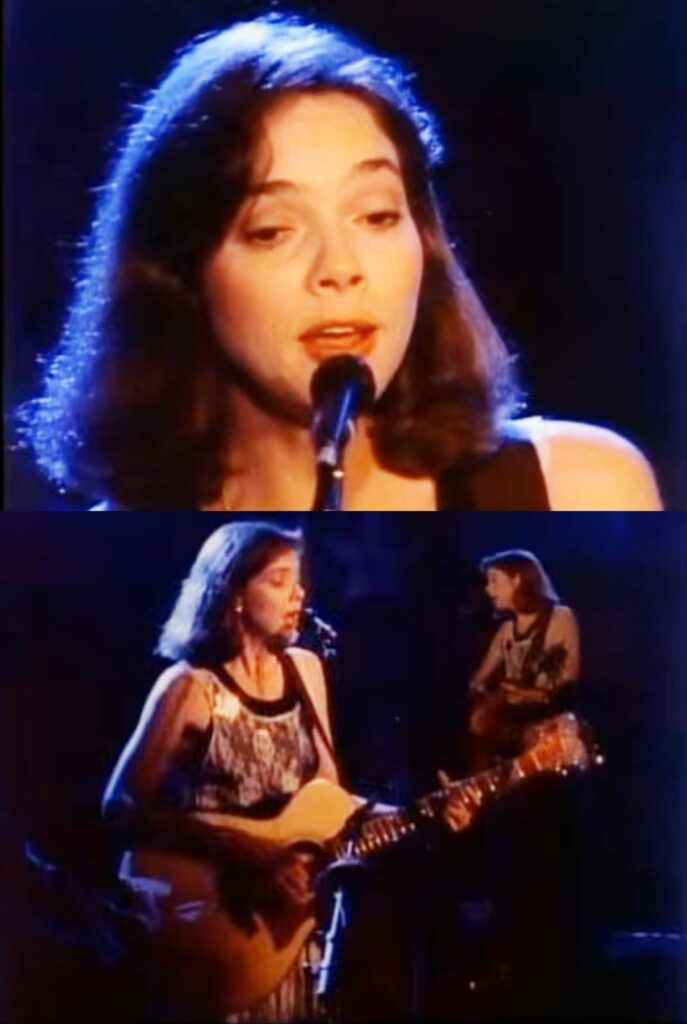
On a warm August evening in 1988, Nanci Griffith returned to a place that felt less like a venue and more like a chapter from her own life story.
The setting was Anderson Fair in Houston, Texas, the legendary coffeehouse where she had spent years developing her craft as a songwriter. Long before sold-out theaters, national television appearances, and international recognition, Griffith had stood on this small stage, learning how to capture an audience with little more than a guitar and a story.
Now she was back.
The occasion would become One Fair Summer Evening, her first live album and one of the most beloved recordings of her career.
Among its many memorable moments, few resonate more deeply than her performance of “Workin’ in Corners.”
What makes the song remarkable is not only what it says, but when it said it.
Today, conversations about invisible labor, emotional burdens, and the challenges faced by working women are common. Entire books, documentaries, and social movements have explored these subjects.
But Griffith was writing about those realities decades earlier.
The women in “Workin’ in Corners” are not celebrities, politicians, or people whose names appear in headlines. They are mothers, workers, caregivers, and survivors. They are the people trying to hold families together while navigating the overlooked corners of everyday life.
In lesser hands, a song like this might have become a protest.
Nanci Griffith chose a different path.
She chose compassion.
Rather than pointing fingers or delivering accusations, she simply told stories. She observed. She listened. She gave voice to people who rarely saw themselves reflected in popular music.
That approach is what gives the performance such enduring power.
Women hear understanding.
Men hear perspective.
Everyone hears humanity.
Perhaps that is why the audience at Anderson Fair seems almost reverently silent throughout the performance.
The room does not behave like a typical concert crowd. There is no constant chatter. No distraction. No need for spectacle.
Instead, listeners lean into the songs.
They listen to every word.
That atmosphere was one of Anderson Fair’s defining characteristics. It was a place where songwriting mattered. A place where stories were treated with the same respect as melodies.
The silence becomes part of the performance itself.
A second instrument.
A sign that the audience understands they are witnessing something meaningful.
The timing of the concert is also important.
By 1988, Griffith stood at a pivotal moment in her career. She had recently released Little Love Affairs and was moving toward broader international recognition. Success was arriving quickly.
Yet there is no trace of distance between performer and audience.
She does not carry herself like a star.
She feels like a neighbor.
A friend.
Someone sitting across the table sharing stories over coffee.
That quality became one of the defining characteristics of her career. Fans often remarked that her speaking voice sounded exactly like her singing voice. It was one of the highest compliments a storyteller could receive because it suggested authenticity. The person on stage was the same person off stage.
Looking back after her passing in 2021, One Fair Summer Evening has taken on even greater significance.
Many longtime admirers consider it the recording that best captures who Nanci Griffith truly was. Not the polished studio artist. Not the charting performer. But the storyteller.
The Texas songwriter.
The woman who called her music “folkabilly” because neither folk nor country alone seemed large enough to contain it.
And nowhere is that spirit more evident than in “Workin’ in Corners.”
The song reminds us that some artists achieve greatness not by writing about extraordinary people, but by recognizing the dignity hidden within ordinary lives.
Nearly four decades later, that Houston performance still feels intimate.
Still feels relevant.
Still feels honest.
Because Nanci Griffith understood something many songwriters never learn:
People do not always need someone to speak for them.
Sometimes they simply need someone to see them.
And on that summer night at Anderson Fair, she did exactly that.