
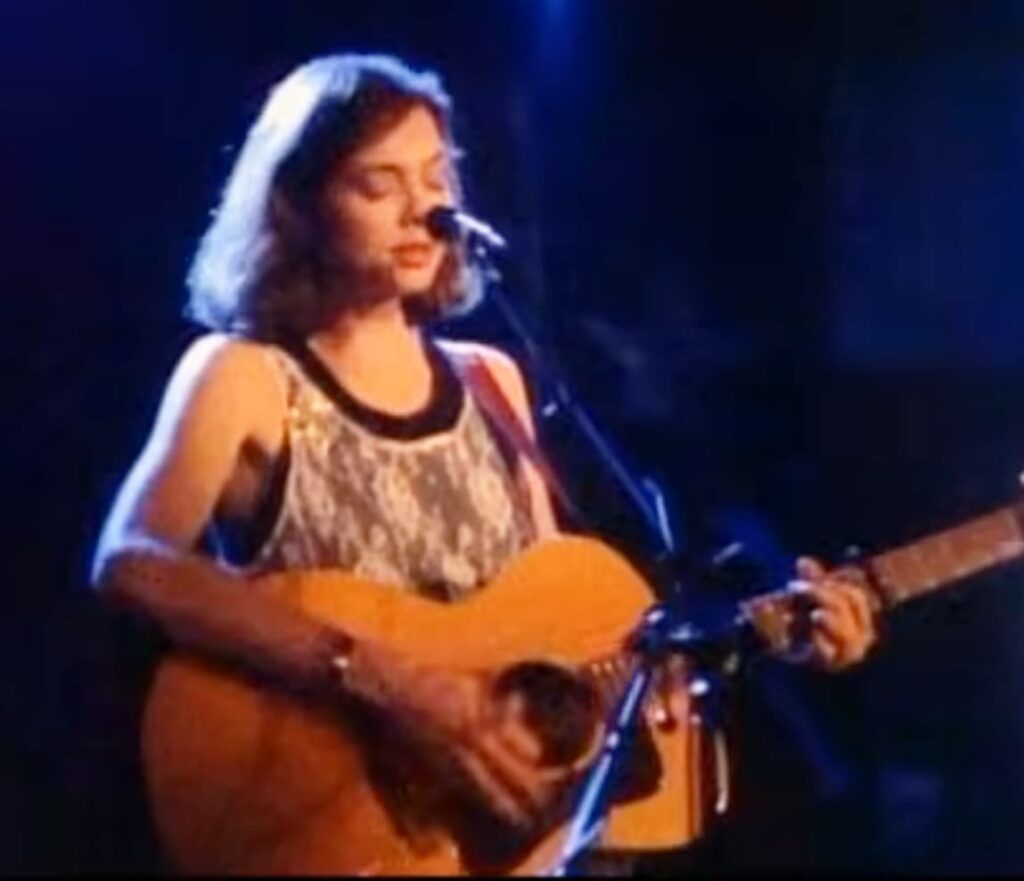
Long before Grammy Awards and international acclaim, Nanci Griffith returned to a small Texas stage and quietly revealed the qualities that would make her one of America’s most beloved storytellers.
In 1988, Nanci Griffith stood on the stage of Anderson Fair in Houston, Texas, and performed “More Than A Whisper.” There were no television cameras chasing ratings, no arena-sized crowds, and no elaborate production designed to create a spectacle.
Instead, there was a songwriter, a guitar, a room full of listeners, and a song.
Looking back today, that simplicity is precisely what makes the performance so valuable.
For Nanci Griffith, Anderson Fair was far more than another stop on a tour schedule. It was one of the places where her artistic identity had been shaped. Years before she became known throughout the folk and country world, she was a young Texas songwriter carrying her guitar into intimate venues like this one, learning how to hold an audience not with volume or theatrics, but with stories.
That history gives the performance the feeling of a homecoming.
While many artists return to famous concert halls after achieving success, Griffith returned to one of the rooms that had believed in her long before the music industry did. Watching the performance today, it feels less like a concert and more like a conversation between an artist and the community that helped raise her.
The timing makes the recording even more fascinating.
The year 1988 marked a pivotal chapter in Griffith’s career. Her album Little Love Affairs had recently been released, and songs such as “Love at the Five and Dime” were introducing her to audiences far beyond the Texas folk circuit. Recognition was growing. Opportunities were expanding.
Yet she had not fully crossed into the national spotlight that would later bring Grammy recognition and worldwide acclaim.
As a result, this performance captures a rare and fleeting moment.
Nanci Griffith was no longer an unknown singer-songwriter performing for a handful of loyal supporters.
But she was not yet the celebrated figure history would remember.
She was standing precisely between those two worlds.
That transitional quality gives the recording a special emotional resonance. Viewers are witnessing an artist on the verge of a larger destiny while still rooted in the intimate spaces that first nurtured her voice.
The song itself offers perhaps the clearest window into Griffith’s artistic philosophy.
Unlike many Nashville stars of her era, Nanci Griffith never built her reputation on vocal power. Her voice was distinctive but modest, carrying a vulnerability that perfectly suited her songwriting. What set her apart was her ability to find extraordinary meaning in ordinary lives.
The title “More Than A Whisper” feels almost like a mission statement.
Throughout her career, Griffith specialized in stories that arrived softly rather than dramatically. She sang about everyday people, small-town memories, quiet hopes, and private heartbreaks. Her songs rarely demanded attention.
They earned it.
Like a whisper that lingers in the mind long after it has been spoken, Griffith’s music often achieved its greatest impact through subtlety.
Another reason this performance feels so poignant today is the era in which it occurred.
In 1988, audiences attended concerts without smartphones. No one was recording clips for social media. No one was measuring success through views or algorithms. Those gathered inside Anderson Fair simply came to listen.
The atmosphere preserved in the footage now feels almost impossible to recreate.
There is an innocence to the room. An unspoken understanding that music deserves patience and attention. Looking back from the modern era, the performance resembles a photograph preserved from another time, untouched by the distractions that would later transform the relationship between artists and audiences.
The venue itself plays a vital role in the story.
For many folk music enthusiasts, Anderson Fair represents something larger than a performance space. It stands as one of the most important homes of the Texas singer-songwriter tradition, a place where authenticity mattered more than commercial ambition. Numerous respected artists passed through its doors before achieving wider recognition.
In that sense, Anderson Fair becomes almost a second character in the performance.
It is not merely the setting.
It is part of the story.
Viewed after Griffith’s passing in 2021, the recording carries an even deeper emotional weight. Audiences no longer see a talented performer building a career. They see a woman whose songs would touch countless listeners over the decades that followed.
They see a voice that could never quite be duplicated.
They see one of America’s great musical storytellers still standing near the beginning of a journey that would leave an enduring mark on folk and country music.
Perhaps that is why this performance remains so treasured.
It captures Nanci Griffith before the awards, before the larger stages, before the expectations that accompany fame.
What remains is the purest version of her art.
A guitar.
A song.
A room willing to listen.
And a storyteller whose quiet voice would eventually travel much farther than anyone inside Anderson Fair could have imagined that summer evening in 1988.