
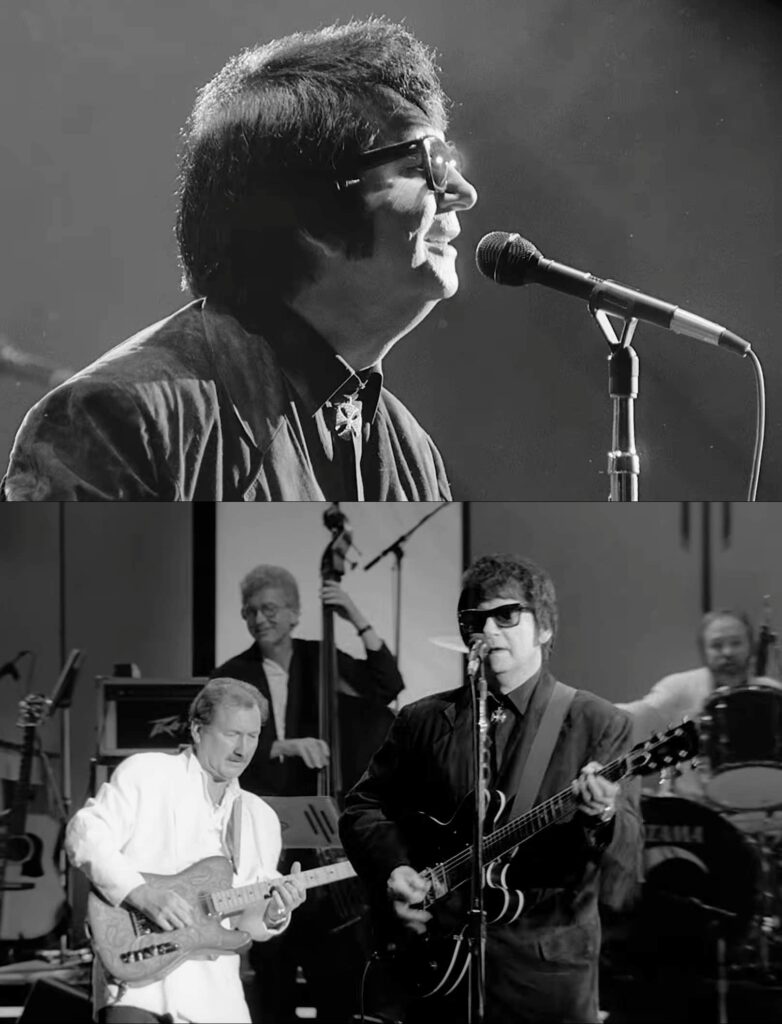
In one of his final great performances, Roy Orbison was not revisiting his youth. He was proving that great music can grow older without ever growing old
When Roy Orbison launched into “Mean Woman Blues” during the legendary Black & White Night concert, something immediately felt different.
Anyone familiar with Orbison’s career could see it.
This was not the solemn, statuesque figure most audiences associated with classics such as “Crying,” “Only the Lonely,” or “In Dreams.” For much of his career, Orbison had been known for standing almost motionless on stage, allowing the power of his voice to carry the emotional weight of the performance. His dramatic ballads rarely required theatrical gestures. The stories lived inside the songs themselves.
But “Mean Woman Blues” revealed another side of him.
He smiled more.
He seemed lighter.
There was mischief in his voice.
The performance carried an energy that felt spontaneous and joyful, as though Orbison were enjoying a private joke with both the band and the audience.
For many viewers, that is what makes this moment so memorable. It offers a glimpse of a Roy Orbison rarely seen on television. Not the tragic romantic. Not the mysterious man behind dark glasses. Not the voice of heartbreak.
Just a musician having fun.
Yet when modern audiences watch the performance, another layer of emotion inevitably enters the picture.
The concert was recorded in 1987.
Roy Orbison would pass away in December 1988.
Knowing what happened afterward changes the experience. Viewers today understand that they are witnessing one of the final great chapters of an extraordinary career. Every smile, every laugh, every burst of energy carries an added poignancy because history has already revealed what the people in the room could not know.
What remains remarkable, however, is how completely Orbison defies any sense of farewell.
There is no hint of decline.
No suggestion that his finest days are behind him.
If anything, he appears revitalized.
The success of Black & White Night arrived during one of the most remarkable comebacks in popular music. After years in which newer generations sometimes overlooked his influence, Orbison suddenly found himself surrounded by artists who openly revered him. The stage was filled with musicians who had grown up listening to his records, studying his songs, and learning from his example.
The respect was unmistakable.
But Orbison did not perform like a man receiving a lifetime achievement tribute.
He performed like a man who still had something to say.
That is why “Mean Woman Blues” stands out so vividly within the concert. Rather than treating the song as a nostalgic relic from the 1950s, he attacked it with enthusiasm and confidence. He was not attempting to recreate the young rock-and-roll singer who first recorded it decades earlier.
He was bringing the perspective of a man in his fifties back to the music of his youth.
And that made the performance richer.
By then, Orbison had experienced triumph, heartbreak, professional setbacks, personal loss, and renewed success. All of those experiences seemed to accompany him onto the stage. The youthful energy remained, but it was now supported by wisdom and resilience earned over a lifetime.
Perhaps that is the real story of Black & White Night.
Roy Orbison was not looking backward.
He was demonstrating that the past was still alive.
As he sang “Mean Woman Blues,” the years seemed to collapse. The young rockabilly singer from the 1950s and the celebrated musical elder of the 1980s existed in the same moment. The audience was not simply watching a legend perform an old hit.
They were watching a legend have a conversation with his younger self.
And with every smile, every playful vocal turn, and every burst of rock-and-roll energy, Roy Orbison reminded everyone in the room why his music had survived long enough to inspire generations.
More than three decades later, that performance remains one of the brightest moments of Black & White Night.
Not because it feels nostalgic.
Because it feels alive.