
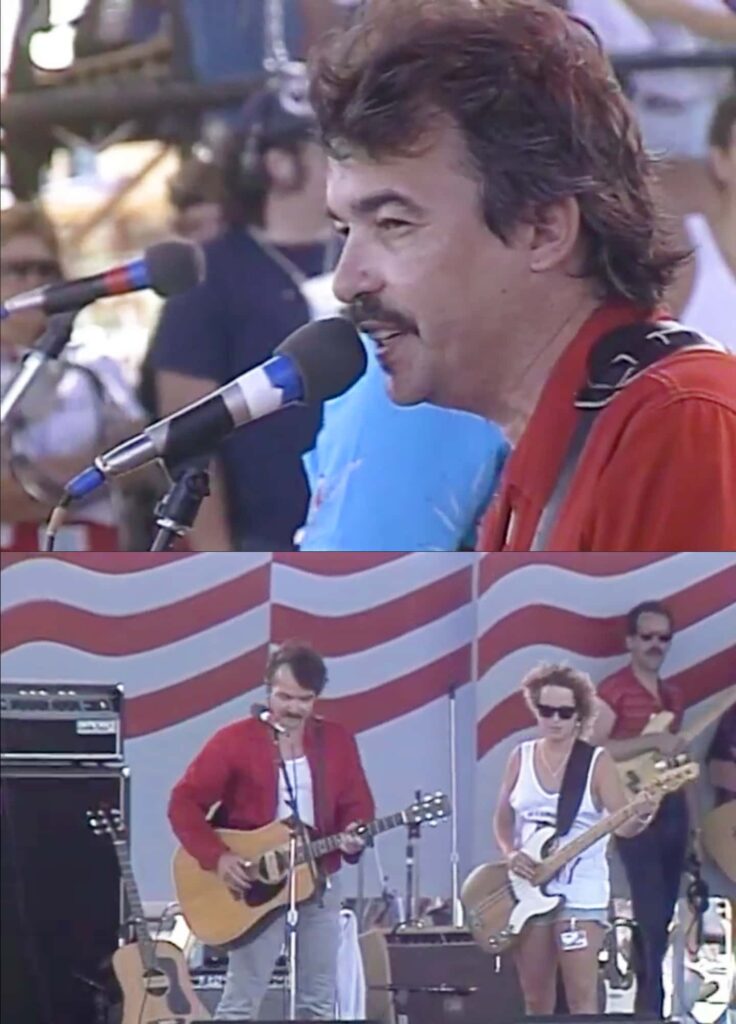
The Anatomy of American Disillusionment: An In-Depth Analysis of John Prine’s “Sam Stone” (Live at Farm Aid 1986)
To understand the trajectory of American roots, folk, and country music in the late 20th century, one must eventually grapple with the monumental legacy of John Prine. Often affectionately referred to as the Mark Twain of American songwriting, Prine possessed a preternatural ability to distill the complexities of the human condition into three-chord masterpieces. Among his most towering achievements is “Sam Stone,” a devastatingly stark portrait of a Vietnam veteran consumed by opioid addiction. While the original 1971 studio recording remains a masterpiece of the folk revival era, Prine’s live performance of “Sam Stone” at Farm Aid in 1986 offers a deeply compelling, weathered, and historically layered rendition that demands meticulous examination.
As an aficionado of American country and Americana music, viewing this performance requires looking through multiple lenses: the lyrical genius of the song itself, the socio-economic context of the Farm Aid stage, and the evolution of Prine’s vocal delivery and stage presence.
The Lyrical Architecture: Tragedy Mastered Through Simplicity
At its core, “Sam Stone” is a masterclass in narrative economy—a hallmark of the very best country music. The song tells the story of a soldier who returns home from a devastating war with shrapnel in his knee and “a little nerve gas in the air.” To cope with the physical and psychological trauma, he turns to morphine, which inevitably spirals into a fatal heroin addiction.
Prine does not rely on grandiose political statements or anti-war sloganeering; instead, he employs domestic, almost mundane imagery to illustrate systemic failure and personal tragedy. The chorus contains arguably one of the most chilling and perfectly crafted couplets in the history of American music:
“There’s a hole in daddy’s arm where all the money goes, / Jesus Christ died for nothin’ I suppose.”
By filtering the horrors of war and addiction through the innocent, bewildered perspective of Sam Stone’s children (who watch the family’s resources vanish into “a hole in daddy’s arm”), Prine achieves an emotional resonance that is overwhelmingly potent. He juxtaposes the sacred (Jesus Christ) with the deeply profane realities of a junkie’s existence, questioning the very concept of salvation in a world that allows broken soldiers to rot in the very homes they fought to defend.
The Context: Farm Aid 1986 and the Forgotten American
To understand the gravity of the 1986 performance, one must consider the venue. Farm Aid was founded in 1985 by Willie Nelson, John Mellencamp, and Neil Young to raise awareness and funds for family farmers who were facing a devastating wave of foreclosures and systemic agricultural crises in the United States. Farm Aid II, held in Texas in 1986, was a continuation of this working-class solidarity.
Why, then, sing a song about a drug-addicted Vietnam veteran at a benefit for farmers? The brilliance of Prine’s selection lies in his understanding of the interconnectedness of American disenfranchisement. The tragic figure of Sam Stone and the bankrupt family farmer were two sides of the same rusted American coin. Both were hardworking, blue-collar individuals who had fulfilled their duties to their country—one by spilling blood overseas, the other by feeding the nation from the soil. And both had been systematically abandoned by the very government and institutions they served. By playing “Sam Stone” at Farm Aid, Prine subtly wove the veteran’s plight into the broader tapestry of rural American decay, transforming the song into a universal anthem for the overlooked and discarded citizens of the heartland.
The Performance: Vocal Maturation and Acoustic Intimacy
When John Prine first recorded “Sam Stone” for his eponymous debut album in 1971, he was a young man in his mid-twenties. His voice had a youthful, almost nasal twang that lent the song a sense of journalistic detachment. However, by the time he took the stage at Farm Aid in 1986, fifteen years had passed. Prine’s voice had deepened, weathered by years of relentless touring, smoking, and living.
In this live performance, the gravelly, resonant timbre of his vocal delivery adds an extraordinary layer of gravitas to the narrative. He sounds less like a young observer and more like a tired, grieving compatriot. When he delivers the lines about Sam Stone’s eventual death by overdose, there is a palpable exhaustion in his voice—a weary resignation that mirrors the tragic inevitability of the character’s fate.
Musically, the 1986 performance highlights Prine’s foundational fingerpicking style, deeply rooted in the Travis picking tradition championed by country and folk pioneers like Merle Travis and Doc Watson. The arrangement is stripped down, relying entirely on his acoustic guitar. The solitary nature of the performance—just one man, a guitar, and a microphone—creates an immense sense of intimacy in a massive stadium setting. The gentle, almost lullaby-like chord progression creates a jarring cognitive dissonance when paired with the bleak lyrical content. It is a technique utilized by country legends like Hank Williams and George Jones: wrapping profound sorrow in a deceptively sweet melody.
A Lasting Legacy in Country and Americana
John Prine’s Farm Aid 1986 rendition of “Sam Stone” is a vital text in the history of American roots music. It represents a pivot point where the traditional storytelling elements of country music intersected seamlessly with the countercultural social consciousness of the folk movement. Prine proved that country music did not need to be confined to drinking songs or romantic heartbreak; it could also serve as a profound vehicle for social critique and deep psychological portraiture.
Furthermore, this specific performance cements Prine’s role as the quintessential “songwriter’s songwriter.” Icons from Bob Dylan to Johnny Cash (who later covered “Sam Stone,” albeit changing the “Jesus Christ” line) recognized the structural perfection of Prine’s work. Contemporary Americana artists like Jason Isbell, Sturgill Simpson, and Zach Bryan owe an incalculable debt to the path Prine forged. They learned from performances like this that authenticity, empathy, and an unflinching eye for the painful truths of American life are the truest currencies a songwriter can possess.
Conclusion
The 1986 Farm Aid performance of “Sam Stone” is much more than a live rendition of a classic track; it is a historical document of American pathos. Through his masterful lyrics, his weathered vocal delivery, and the poignant socio-economic backdrop of the Farm Aid concert, John Prine captured the heartbreak of an entire generation. He forces the listener to confront the uncomfortable realities of trauma, addiction, and systemic neglect, doing so with a tenderness and empathy that remains unparalleled in the annals of American music. It is a stark reminder that in the hands of a master, a simple folk-country song can hold the weight of a great American novel.