
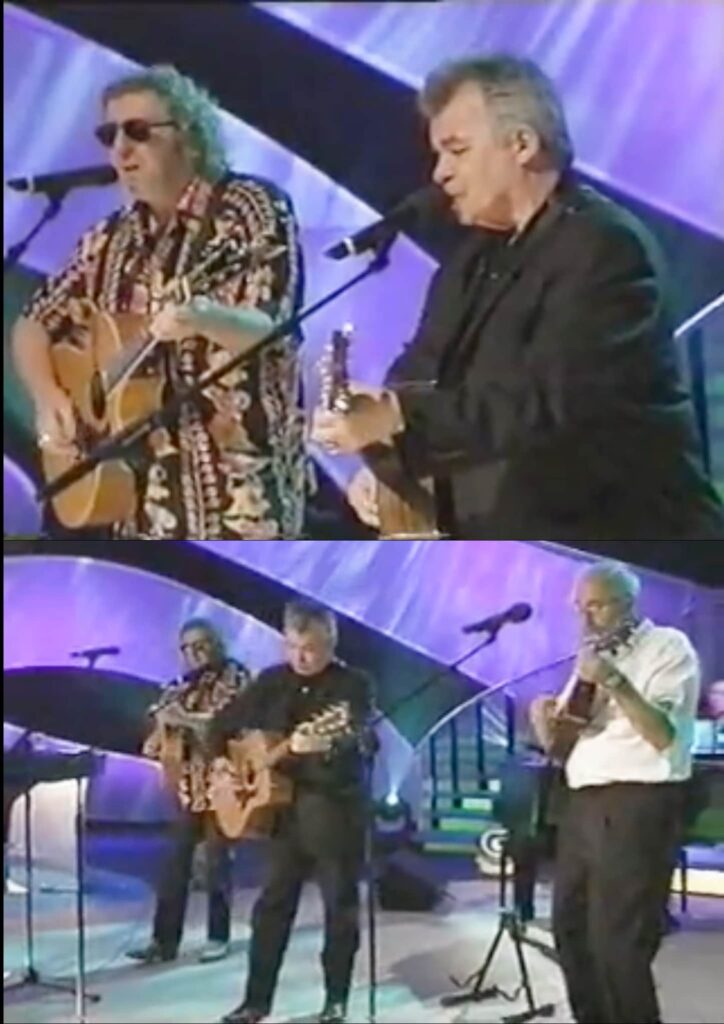
A weathered voice, a heartbreaking lyric, and three old friends sharing a stage turned “Speed of the Sound of Loneliness” into one of the most quietly devastating performances of John Prine’s later years.
In August 2003, John Prine sat beneath the studio lights of Irish television alongside longtime friends Roger Cook and Phil Donnelly and delivered a performance that seemed almost too simple for modern television. There were no dramatic stage effects, no soaring vocal theatrics, and no attempt to manufacture a memorable moment.
Yet more than twenty years later, their rendition of “Speed of the Sound of Loneliness” remains one of the most cherished live recordings in Prine’s vast catalog.
The reason lies in something that cannot be rehearsed.
Truth.
At first glance, the song tells a familiar story. A relationship has drifted into silence. Two people still occupy the same space, yet somehow live worlds apart. Prine sketches the entire emotional landscape with ordinary details.
“You come home late and you come home early.”
“You come home big when you’re feeling small.”
No grand declarations. No elaborate poetry.
Just the kind of observations that quietly reveal a marriage coming apart.
It was this remarkable ability to find profound meaning inside everyday language that made John Prine one of the most respected songwriters of his generation. While many writers searched for dramatic images, Prine often found greater power in ordinary conversations and small moments that listeners instantly recognized from their own lives.
Then comes the line that has fascinated audiences for decades:
“You’ve broken the speed of the sound of loneliness.”
It remains one of the most brilliant metaphors Prine ever created.
People talk about the speed of sound. They talk about the speed of light. But Prine imagined something entirely different: the speed of loneliness.
The phrase has no scientific meaning, yet emotionally it feels perfectly clear. Someone has drifted so far away that even loneliness itself cannot keep pace. It is the kind of lyric that makes listeners pause, smile at its cleverness, and then slowly realize how much pain it contains.
By the time of this performance, Prine had already survived one of the greatest battles of his life. Just a few years earlier, he had undergone surgery for throat cancer. The illness permanently altered his voice. The smoothness of his younger recordings had given way to a rougher, more weathered sound.
For many singers, such a transformation might have felt like a loss.
For Prine, it became part of the story.
His voice in 2003 carried scars. Every note seemed touched by experience. The songs no longer sounded like observations from a gifted songwriter. They sounded like reflections from someone who had walked through hardship and returned with a deeper understanding of life.
That quality is especially evident during this performance. Seated beside Roger Cook and Phil Donnelly, Prine never behaves like a star commanding attention. Instead, he appears as one member of a circle of friends, letting the song take center stage.
There is a beautiful irony in that image.
“Speed of the Sound of Loneliness” is a song about distance, disconnection, and emotional isolation. Yet here it is being performed among friends whose musical bond stretches back decades. The song speaks of separation while the stage itself reflects companionship.
Perhaps that contrast is part of what makes the performance so moving.
The Irish setting contributes something special as well. Audiences in Ireland have long embraced storytellers, folk singers, and writers whose songs value emotional honesty over spectacle. Throughout the performance, the crowd listens with remarkable attentiveness. The room feels less like a television studio and more like a gathering place where every lyric matters.
Looking back today, the broadcast carries an additional layer of emotion that nobody in the room could fully appreciate at the time.
We now know that John Prine would pass away in 2020. We know that many of the great songwriters who defined his era have also left the stage behind. What once appeared to be a routine television appearance has become something far more precious: a glimpse into a musical world that is slowly disappearing.
And perhaps that is why the performance continues to resonate.
Not because Prine sang louder.
Not because he sang higher.
Not because he tried to overwhelm the audience.
He simply sat down with friends and told the truth.
In an age increasingly dominated by spectacle, John Prine reminded listeners of something timeless: the most powerful songs are often the quietest ones. They do not demand attention. They earn it, one honest line at a time.
More than two decades later, “Speed of the Sound of Loneliness” remains one of the clearest examples of that gift, a song that proves the deepest heartbreak is not always found in tragedy. Sometimes it is found in two people who are still together, yet somehow no longer truly reach each other at all.