
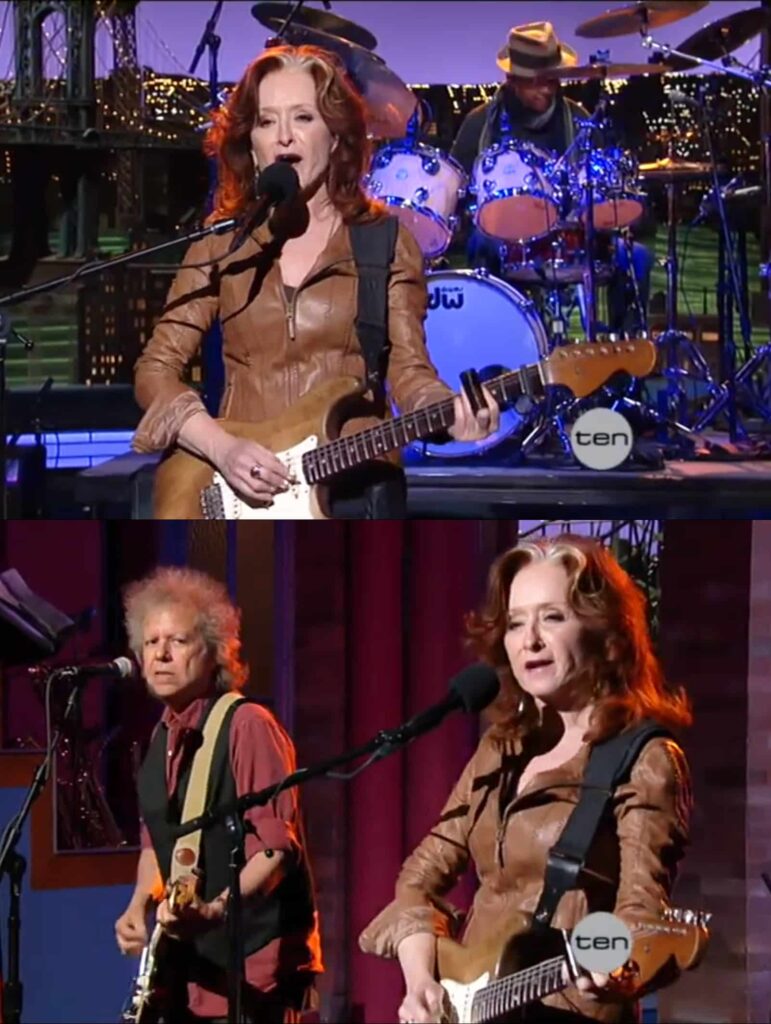
A timeless love song became a reflection on gratitude, endurance, and a life fully lived when Bonnie Raitt brought “Right Down The Line” to late-night television in 2012.
NEW YORK, April 13, 2012 — When Bonnie Raitt stepped onto the stage of The Late Show with David Letterman to perform “Right Down The Line,” it appeared at first to be a simple television appearance promoting her newly released album Slipstream. Yet more than a decade later, the performance remains one of the most cherished moments of her later career, remembered not for spectacle, but for its extraordinary sincerity.
Introduced by David Letterman as “the one, the only Bonnie Raitt,” the nine-time Grammy Award winner arrived at the historic Ed Sullivan Theater carrying the quiet confidence of an artist who no longer needed to prove anything. At 62 years old, she stood before the cameras and delivered a performance that felt less like a cover song and more like a deeply personal memoir set to music.
What made the moment especially remarkable was that “Right Down The Line” was never her song to begin with. Written and recorded by Gerry Rafferty in 1978, the beloved classic was originally a heartfelt tribute to enduring love and devotion. Many artists had performed Rafferty’s songs over the years, but Raitt approached this one differently. She did not attempt to reinvent it or overwhelm it with vocal flourishes. Instead, she seemed to inhabit every lyric.
As she sang lines such as “You’ve been as constant as a northern star” and “Every day I’m loving you so much more,” the song took on a different meaning than it had three decades earlier. In Rafferty’s hands, it was a love letter. In Raitt’s voice, it sounded like gratitude earned through experience, loss, resilience, and time.
That emotional weight was impossible to separate from the story of Slipstream itself. The album arrived after one of the most difficult periods of Raitt’s life. In the years leading up to its release, she had endured the deaths of her father, mother, and brother. She had also spent a long stretch away from the spotlight, leaving many to wonder when she might return with another major studio project.
For those who understood that history, the Letterman performance felt larger than a television appearance. It was a comeback. Not the dramatic kind often associated with pop culture headlines, but the quieter return of an artist who had weathered life’s storms and emerged with her voice, spirit, and artistry intact.
Perhaps the most memorable aspect of the performance was its restraint. There were no elaborate stage effects. No attempt to manufacture a viral moment. Raitt simply stood with her band and told a story. The power came from her ability to make listeners believe every word.
Looking back today, the clip also captures a disappearing era of music television. It was a time when artists still appeared on late-night programs backed by live musicians, performing complete songs before audiences willing to listen without distraction. The atmosphere feels almost archival now, a snapshot from the final years of traditional late-night music showcases.
There was another layer of nostalgia in the room as well. Both Bonnie Raitt and David Letterman were icons of the Baby Boomer generation who had spent decades shaping American culture. Watching them share that stage carried the feeling of witnessing two enduring careers intersecting once again.
For many fans, the enduring debate remains whether Raitt’s interpretation surpasses Rafferty’s original recording. Admirers of the original praise its authenticity and intimate warmth. Supporters of Raitt’s version argue that she brought an added depth that only comes with age and experience.
Whatever side one chooses, the performance endures because it transcends comparison. On that April evening in New York, Bonnie Raitt did more than sing “Right Down The Line.” She transformed a familiar classic into a reflection on loyalty, gratitude, and the people who remain beside us through the passing years. It was not merely a performance promoting Slipstream. It was a reminder that the finest artists eventually reach a point where every song they sing becomes part of their own life story.