
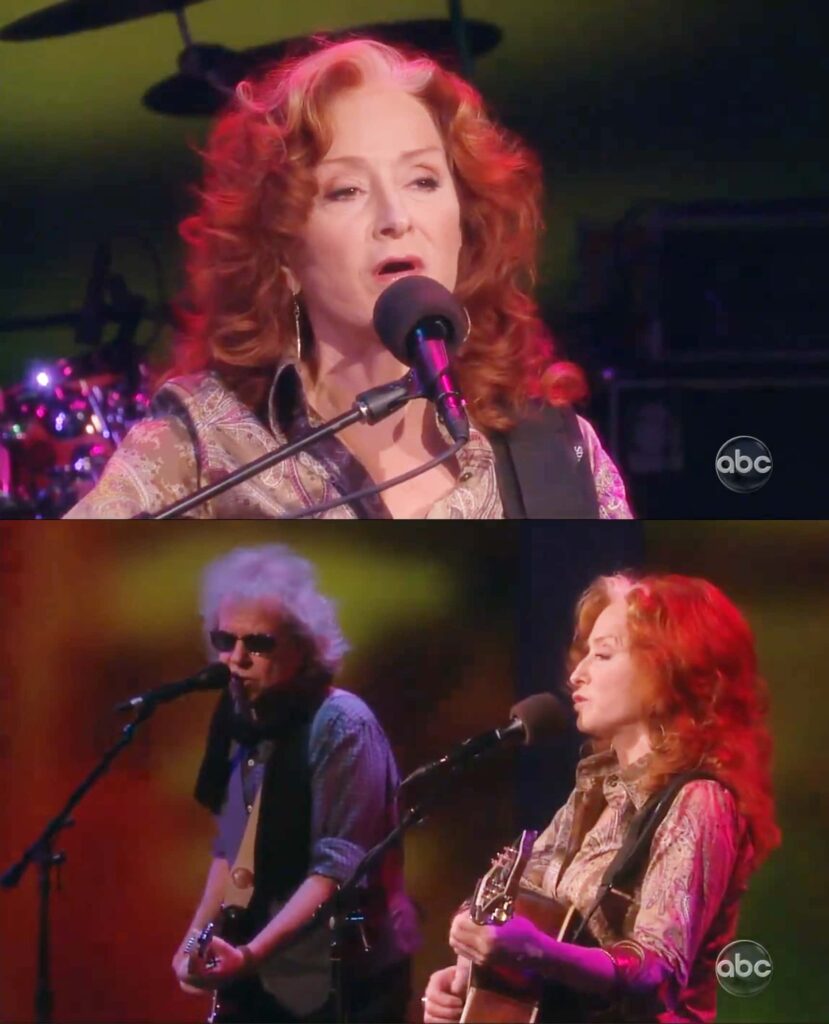
After seven years away from the spotlight, Bonnie Raitt returned not with a song of sorrow, but with a gentle reminder that love can still guide us through life’s darkest seasons.
On December 5, 2012, viewers of The View heard four simple words that carried the weight of an entire chapter in one artist’s life:
“Welcome back, Bonnie.”
The audience applauded warmly, but few introductions have ever contained so much history in so few words.
The performance marked the national television return of Bonnie Raitt, who was promoting Slipstream, her first studio album in seven years. Yet this was far more than a routine appearance to support a new release. It represented the reemergence of an artist who had spent much of the previous decade navigating profound personal loss.
During her absence from the recording studio, Raitt endured the deaths of her father, her mother, her brother, and one of her closest friends. The heartbreak was so significant that she stepped away from the relentless pace of the music industry, choosing instead to heal, reflect, and rediscover her creative spirit on her own terms.
That history gave extraordinary meaning to the song she chose to perform.
At first listen, “Take My Love With You” sounds like a warm and comforting message between people temporarily separated by distance. Its lyrics offer reassurance and encouragement:
“Take my love with you, let it be the light that sees you through.”
But on that December afternoon, the song seemed to carry a deeper resonance.
In the hands of Bonnie Raitt, it felt less like a conventional love song and more like a blessing. A message for those who were absent. A promise that affection, memory, and connection can survive even when life forces people apart. Rather than dwelling on grief, the song offered hope.
That spirit perfectly reflected the emotional heart of Slipstream.
Unlike many albums born from loss, Slipstream was never defined by despair. Instead, it became a meditation on resilience, gratitude, and the people who continue to accompany us, whether physically present or carried within our memories. The album arrived at a moment when Raitt seemed less interested in revisiting pain than in discovering what remained after it.
What made the performance particularly moving was its simplicity.
At sixty-three years old, Bonnie Raitt had nothing left to prove. She did not step onto the stage seeking to impress audiences with vocal acrobatics or dramatic gestures. There were no soaring climaxes designed to generate applause. No elaborate production. No attempt to compete with younger performers by appearing younger herself.
Instead, she did what she has always done best.
She told a story.
Her distinctive smoky alto moved through the song with quiet confidence, sounding less like a performer addressing a television audience and more like a trusted friend offering reassurance across a kitchen table. Every line felt conversational. Every phrase felt lived rather than performed.
That authenticity has always separated Raitt from many of her contemporaries. While other artists often relied on technical brilliance, she built her reputation on emotional credibility. Listeners believed her because she never sounded as though she was acting.
The closing moments of the performance revealed another reason audiences have loved her for decades. After delivering a song filled with warmth and encouragement, she playfully dismissed any hint of self-importance with a lighthearted remark.
“Don’t preach on it.”
The audience laughed.
In a matter of seconds, she dissolved the seriousness of the moment with the same humility and humor that have long defined her public persona. It was a reminder that even after decades of acclaim, Grammy Awards, and Hall of Fame recognition, Bonnie Raitt remained remarkably grounded.
Looking back now, the timing of the performance feels especially significant. Slipstream was rapidly becoming one of the most celebrated albums of her later career. Critics embraced it. Fans welcomed her return. Within months, the album would earn major industry recognition and reaffirm her place among America’s most respected artists.
Yet what lingers most from this appearance is not the success that followed.
It is the feeling.
The image of a woman who had endured tremendous loss stepping back into the public eye and choosing to sing not about heartbreak, but about love.
Not about endings, but about endurance.
More than a decade later, “Take My Love With You” remains one of the most overlooked treasures from Slipstream. And this performance remains a beautiful reminder that some of the strongest voices in music are not the loudest.
They are the ones that know how to comfort, heal, and quietly illuminate the road ahead.