
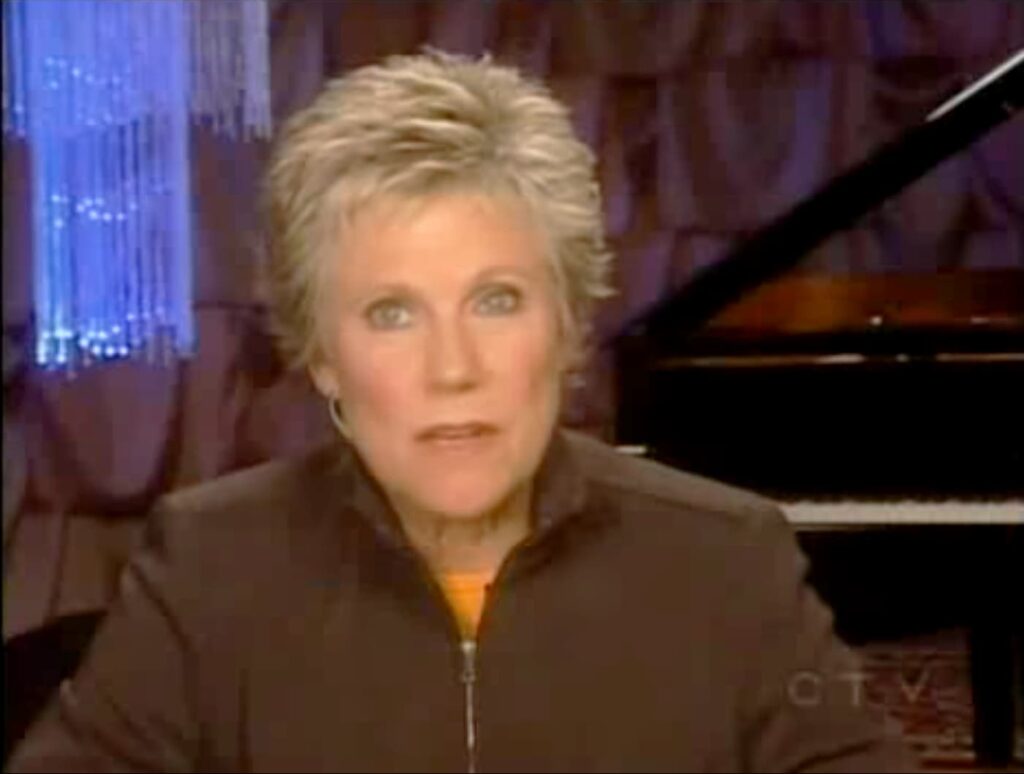
More than a mentoring session, Anne Murray’s visit to Canadian Idol became a masterclass in why authenticity and restraint can outlast trends, technology, and generations.
When Anne Murray appeared on Canadian Idol, viewers were expecting advice from one of Canada’s most celebrated recording artists. What they received instead was a rare glimpse into the philosophy that helped her remain relevant for more than four decades in one of the world’s most unpredictable industries.
The program opened with a reminder of Murray’s extraordinary accomplishments. By that point, she had earned four Grammy Awards, a record-setting collection of Juno Awards, induction into the Juno Hall of Fame, the prestigious Order of Canada, more than 50 million records sold worldwide, and a career that had become woven into the cultural fabric of Canada itself.
Yet the most revealing moment arrived not in a performance, but in a simple statement.
“The only sound I have is me.”
Those seven words may explain Anne Murray’s success better than any trophy ever could.
Throughout her career, critics and industry executives struggled to define her. Was she country? Pop? Folk? Adult contemporary? Murray spent decades crossing musical boundaries while refusing to belong entirely to any one category. Rather than chasing labels, she focused on something far more enduring: developing a voice listeners could recognize within seconds.
That lesson quietly shaped every piece of advice she offered the contestants.
What surprised many viewers was how little emphasis she placed on impressing people. Modern talent competitions often reward bigger notes, bigger personalities, and bigger moments. Murray consistently encouraged the opposite.
With contestant Mitch MacDonald, she did not focus on vocal power or stage presence. Instead, she immediately identified a problem many inexperienced singers overlook.
Breathing.
“You run out of steam,” she told him.
It was the observation of someone who had spent thousands of nights on stage. Murray understood that great performances are often built on fundamentals that audiences never consciously notice. Before a singer can communicate emotion, they must first have the breath to sustain it.
Her advice to Earl Stevenson revealed another principle she clearly valued.
“Remember there’s an audience there.”
At first glance, the comment sounded simple. In reality, it touched on one of the most important truths in performance. Many young artists become so absorbed in their own feelings that they forget music is an act of communication. Murray reminded him that a song is not a private conversation. It is a connection between performer and listener.
Perhaps her most insightful observations came when working with Drew Wright.
“He’s trying to do too much.”
The remark highlighted a challenge faced by countless talented musicians. Young performers often feel pressure to showcase every skill they possess at once. They want audiences to notice the guitar playing, the vocal runs, the technical ability, and the complexity.
Murray had learned something different during her long career.
Listeners remember songs.
They rarely remember how many techniques were used to perform them.
That philosophy reached its clearest expression when she spoke with Theo Tams.
“Do fewer licks. Make them tasty. Make them count.”
It was advice about vocal embellishments, but it also sounded like a summary of Murray’s entire artistic approach.
She never built her reputation on vocal acrobatics or dramatic showmanship. Instead, she became beloved for qualities that are often harder to teach: warmth, sincerity, elegance, and emotional honesty. Every note served the song rather than the singer’s ego.
Another reason this episode remains so memorable is Murray’s demeanor. Despite the extraordinary list of achievements attached to her name, she never behaved like a distant legend. She did not discuss awards, sales figures, or industry recognition. Her focus remained on eye contact, breath control, communication, and musical judgment.
The basics.
Looking back today, the episode also feels like a meeting between two eras of the music business. When Anne Murray began her career in the late 1960s, there were no televised singing competitions, no social media followings, and no overnight viral success stories. Careers were built slowly, one performance at a time.
Now she sat across from a new generation pursuing fame through reality television.
The contrast made the moment fascinating, but it also highlighted something timeless. The tools may change. The platforms may change. The industry may change.
The fundamentals rarely do.
Years after the broadcast, one question continues to linger. Did Anne Murray become a legend because of her remarkable alto voice, or because of her extraordinary restraint?
Many would argue it was both.
Yet this episode suggests that her greatest gift was knowing what not to do. Knowing when not to over-sing. Knowing when not to over-perform. Knowing when not to draw attention away from the song itself.
After more than forty years at the top, Anne Murray did not teach aspiring singers how to become louder. She taught them how to become more memorable.
And perhaps that was the most valuable lesson of all.