
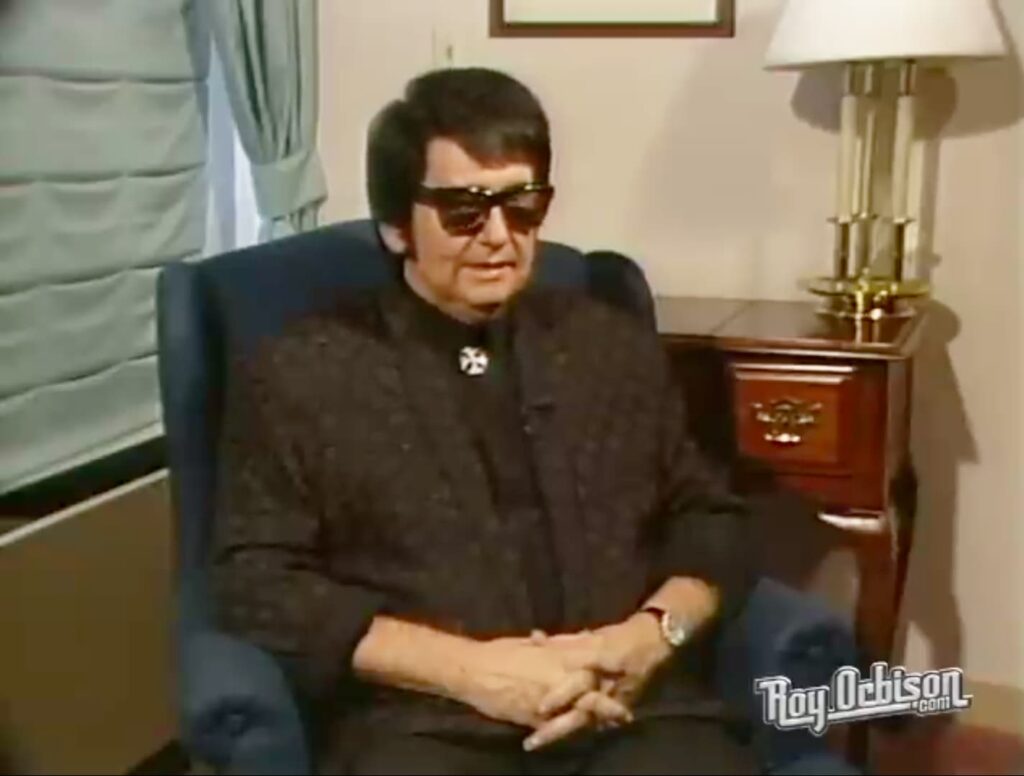
A humble farewell from the man who never claimed ownership of his own voice
There are interviews that reveal a celebrity, and there are interviews that reveal a human being. In a quietly moving conversation recorded near the final chapter of his life, Roy Orbison spoke not about fame, fortune, or chart success, but about gratitude, purpose, and the gifts he believed had been entrusted to him. Watching the interview today feels less like hearing a music legend reflect on his career and more like listening to a man gently summarize the journey of a lifetime.
By the time this interview was filmed, Roy Orbison had already secured his place among the most admired voices in popular music history. Songs such as “Only the Lonely,” “Crying,” “In Dreams,” “Blue Bayou,” and especially “Oh, Pretty Woman” had made him a global icon. Fellow musicians, including Elvis Presley, openly admired his extraordinary vocal ability. Yet when asked about the compliments he received and the words often used to describe him, including “legend” and “inspiration,” Orbison seemed almost uncomfortable with the praise.
His response revealed a humility that remains striking decades later.
“God gave me the voice. I didn’t have a lot to do with that.”
For an artist whose voice is still regarded as one of the greatest of the twentieth century, it was an astonishing statement. Many performers speak of discipline, training, sacrifice, and endless practice. Orbison did not deny the work required, but he viewed his voice differently. To him, it was not an achievement to be claimed. It was a gift to be appreciated.
That simple perspective helps explain why so many people admired not only the singer but also the man behind the dark sunglasses.
Perhaps the most touching moment arrived when Orbison spoke about what he believed should be done with such gifts.
“If I receive the gifts, I like to pass them along.”
Those words carry even greater weight when viewed against the backdrop of his life. Few artists endured tragedies as devastating as those experienced by Roy Orbison. He lost his first wife, Claudette, in a motorcycle accident. Later, two of his sons died in a house fire while he was away on tour. His career also endured periods of decline before experiencing a remarkable resurgence in the 1980s.
Yet bitterness never seemed to define him.
Instead, gratitude remained at the center of his outlook. Even after a successful concert, he recalled returning backstage and thinking not about applause or acclaim, but about what a wonderful gift it was to be able to do what he loved. It was a rare glimpse into the private thoughts of a performer who never appeared to take his success for granted.
The conversation also revealed another side of Orbison that longtime fans instantly recognize: his affection for the guitar.
Calling it “a good companion,” he spoke of the instrument not as a tool of fame but as a lifelong friend. Unlike many stars whose public image revolved around spectacle, Orbison described the simple comfort of picking up a guitar and playing for relaxation. It was the language of a songwriter rather than a celebrity.
One of the interview’s most memorable stories came from childhood. He recalled being six or seven years old when his father asked what he wanted to be when he grew up.
“I’ll be a singer.”
There was no uncertainty in the answer. No alternative plan. No hesitation.
Music, he explained, was something that gets inside you. Once it does, the path almost chooses itself.
Near the end, he was asked how he hoped to be remembered. It is the kind of question often posed to great artists, inviting reflections on awards, accomplishments, and influence. Orbison’s answer was surprisingly simple.
He wanted to be remembered through “Oh, Pretty Woman.”
Today, his legacy stretches far beyond a single song. Yet there is something wonderfully honest about that response. He understood the bond between artist and audience. He knew which melody would continue traveling through generations long after the spotlight faded.
Viewed now, with the knowledge that Roy Orbison would pass away suddenly in December 1988 at just 52 years old, the interview feels especially poignant. It is not a farewell in the traditional sense. There are no dramatic final words or grand declarations.
Instead, it is something far rarer.
A gifted artist looking back on his life with humility, a guitar at his side, gratitude in his heart, and the quiet understanding that the songs would keep speaking long after he was gone.