
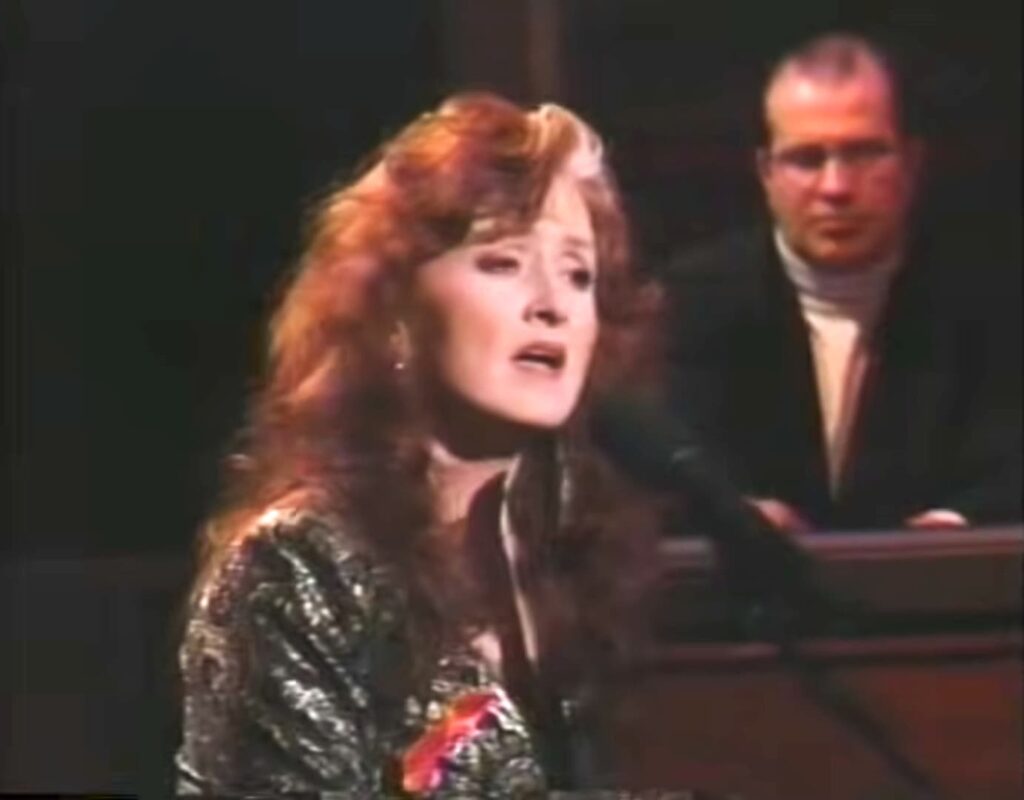
A song about letting go became the soundtrack of a hard-earned triumph
At the 34th Grammy Awards in 1992, the spotlight belonged to many of the biggest names in music. Yet one of the evening’s most unforgettable moments came from a woman who had spent nearly twenty years waiting for recognition that seemed destined to pass her by. When Bonnie Raitt stepped onto the stage to perform “I Can’t Make You Love Me,” she was not introducing herself to the world. She was finally being seen by it.
At 42 years old, Raitt was hardly the kind of artist record labels were betting on in the early 1990s. The music industry was increasingly focused on youth, trends, and fresh faces. Behind her stood a long road marked by commercially disappointing albums, personal struggles with alcohol, and the growing fear that her remarkable talent might never receive the audience it deserved. Then came Nick of Time, the album that changed everything. It was followed by Luck of the Draw, and suddenly one of music’s most respected veterans found herself at the center of an extraordinary comeback story.
What many listeners did not know was that “I Can’t Make You Love Me” was not written specifically for Bonnie Raitt. Songwriters Mike Reid and Allen Shamblin found inspiration in a startling newspaper story about a man arrested for drunken violence. As he was taken away, he reportedly told his wife, “You can’t make me love you if I don’t.” From that painfully cold remark emerged one of the most heartbreaking ballads ever written.
Yet what made Bonnie’s interpretation so remarkable was that she never sang the song as a victim. There was sadness in her voice, certainly. But there was also acceptance. She sounded less like someone begging for love and more like someone who had finally learned that some truths cannot be changed. That quiet wisdom elevated the song beyond a simple breakup ballad and transformed it into something universal.
That wisdom was on full display during her Grammy performance. Award shows are often remembered for grand productions, dramatic staging, and unforgettable spectacles. Bonnie chose a different path. She stood nearly motionless. There were no elaborate visual effects. No vocal gymnastics designed to draw applause. No attempt to force emotion from the audience. She simply sang.
And somehow that simplicity became powerful.
Many performers can sing about heartbreak. Bonnie Raitt made people believe she had lived through it. Every line felt earned. Every pause carried weight. The performance seemed less like an entertainment segment and more like a conversation between experience and memory.
The timing made it even more meaningful. Between 1990 and 1992, Bonnie Raitt became one of the most celebrated artists at the Grammy Awards, collecting some of the industry’s highest honors. But audiences were not witnessing the rise of a newcomer. They were watching the long overdue recognition of an artist who had spent decades refining her craft while the spotlight often shone elsewhere.
Looking back today, the performance carries an even deeper resonance. We now know that Bonnie Raitt would become a legend. We know that “I Can’t Make You Love Me” would endure as perhaps the signature recording of her career. We know that countless singers would later attempt to interpret the song. Yet many listeners still return to Bonnie’s version because it feels less like a performance and more like a truth being spoken aloud.
There is another reason the song continues to move people. At the time, Bonnie herself had emerged from a turbulent chapter of life. She had embraced sobriety, rebuilt her career, and discovered a new sense of purpose. As a result, the song seemed to carry a message larger than lost romance. It spoke about accepting what cannot be controlled. You cannot force someone to love you. You cannot demand success arrive on your schedule. You cannot make life unfold exactly as planned.
Sometimes all you can do is let go and keep moving forward.
On that Grammy stage in 1992, the audience believed they were watching a woman sing about the end of a relationship. History would later reveal that they were witnessing something much greater: the moment when perseverance, humility, and hard-earned wisdom finally found their reward. More than three decades later, the performance remains a reminder that some victories arrive late, but when they do, they mean everything.