
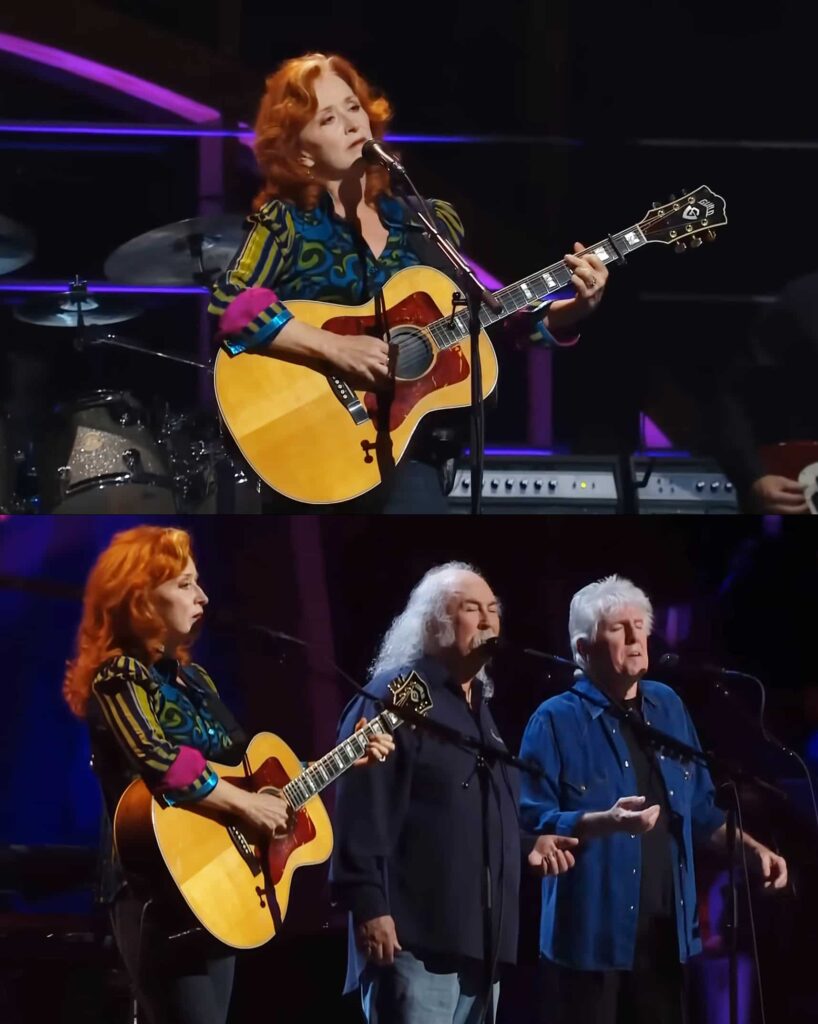
Four legendary voices revisited an old heartbreak, and in doing so captured the sound of an entire generation growing older
On a remarkable autumn night at Madison Square Garden in October 2009, the celebration of the 25th Anniversary Rock and Roll Hall of Fame Concert brought together many of the artists who had helped shape modern American music. Among the evening’s most memorable moments was a quietly powerful performance of “Love Has No Pride” by Bonnie Raitt alongside Crosby, Stills & Nash. It was not the loudest performance of the night. It was not designed to be. Yet more than fifteen years later, it remains one of the concert’s most emotionally resonant moments.
At first glance, the performance appeared simple. A beloved singer standing before thousands, singing a classic ballad about heartbreak and lingering devotion. But beneath that simplicity was something far more profound. This was not merely a song being performed. It was a gathering of artists whose lives and careers had become intertwined with the story of American music itself.
Sharing the stage were Bonnie Raitt, David Crosby, Stephen Stills, and Graham Nash, musicians whose collective histories stretched back to the folk, rock, and singer-songwriter revolution of the late 1960s and early 1970s. They had witnessed changing musical eras, cultural revolutions, personal triumphs, and painful losses. Seeing them together in 2009 felt less like a guest appearance and more like a reunion of old companions who had traveled the same long road.
If the spirit of Woodstock had ever returned in the twenty-first century, it might have looked something like this.
The choice of song was equally significant. “Love Has No Pride,” first popularized by Linda Ronstadt in the early 1970s, is a song about the painful surrender that often follows a broken relationship. It speaks of dignity lost, wounds carried forward, and emotions that refuse to disappear. When sung by younger artists, it can sound like a story of fresh heartbreak. When sung by performers who have spent decades navigating life, loss, and survival, the song takes on a different meaning entirely.
By 2009, Bonnie Raitt was no longer the young blues singer struggling for recognition. She had become one of the most respected artists in American music, a performer whose career had endured for generations. Her interpretation of the song that evening carried the weight of experience. Rather than emphasizing dramatic sorrow, she delivered the lyrics with the calm understanding of someone who knows that some scars never fully fade.
What made the performance even more moving was the presence of David Crosby. Long admired for his extraordinary harmonies, Crosby had also lived one of the most turbulent lives in rock history. Addiction, prison, health crises, and personal setbacks had all threatened to end his story more than once. Standing behind Bonnie Raitt and adding his unmistakable voice to a song about emotional wounds, he seemed to embody another layer of the song’s message: survival.
The harmonies from Crosby, Stills & Nash also reminded audiences why the trio had long been considered one of the greatest vocal groups in American music. There was no attempt to overwhelm the audience with volume or spectacle. Instead, they returned to the essence of what had made them legendary decades earlier. The voices blended gently, supporting the song rather than competing with it.
Perhaps that restraint is what makes the performance endure.
Many artists use major anniversary events to showcase vocal power or technical brilliance. Bonnie Raitt chose a different path. She sang almost as if she were telling a story to old friends. Every phrase felt intimate despite the enormous venue. The performance trusted the song and trusted the audience.
Viewed from 2026, the video carries an even deeper emotional significance. David Crosby passed away in 2023, transforming this performance into something more than a concert memory. It became a historical document, preserving one of the final chapters of a voice that helped define American popular music.
What remains most striking is that none of the performers sounded exactly as they had in their youth. Time had left its mark. Yet that reality only strengthened the song. “Love Has No Pride” is ultimately about wounds that remain long after the moment that caused them. Voices touched by decades of living told that story far more convincingly than youthful perfection ever could.
In the end, this was more than a performance of a classic ballad. It was the sound of four extraordinary artists carrying their histories onto a stage together. Their voices were older, softer, and perhaps more fragile than before.
But they had never sounded more truthful.