
Two Days Before His Death, Roy Orbison Was Still Planning the Next Chapter of His Life
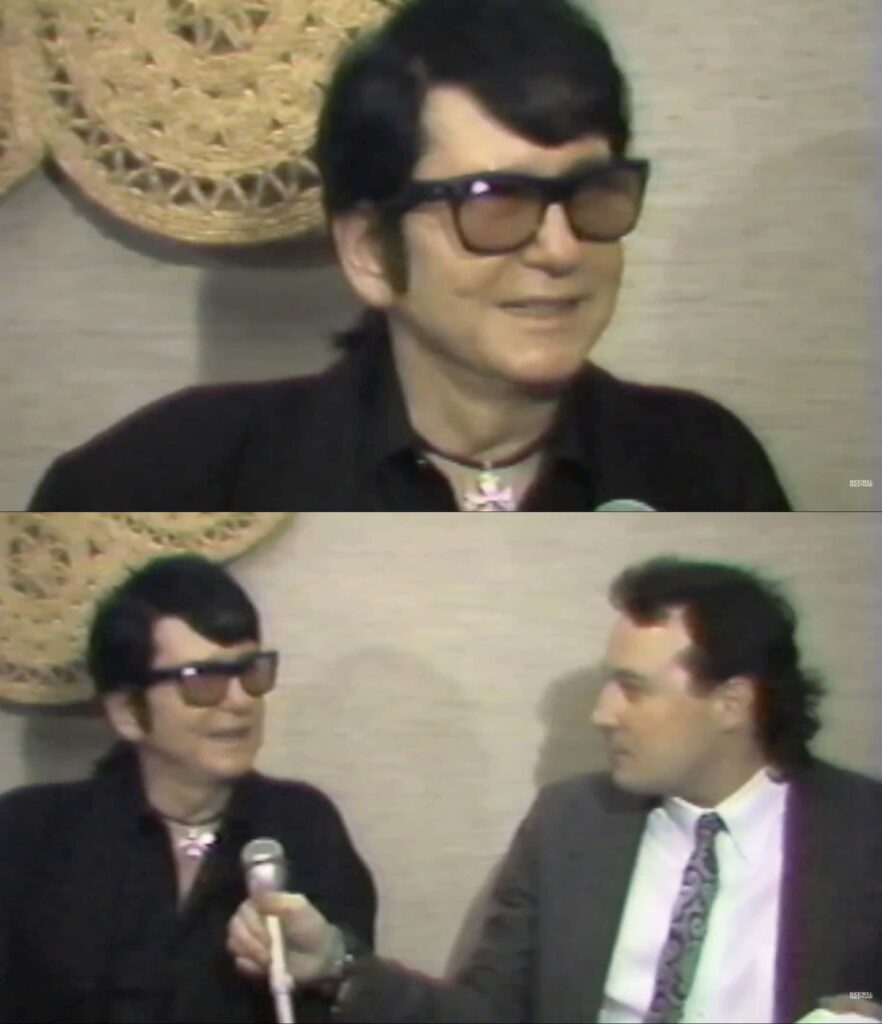
On the evening of December 4, 1988, Roy Orbison walked off the stage of the Front Row Theater in Highland Heights, Ohio, after what would unknowingly become the final concert of his life. That same night, he sat down for an interview, speaking not about the past that had already secured his place in music history, but about the future he believed was just beginning.
Watching that interview today is a deeply emotional experience. Not because Orbison offered a farewell message or reflected on his mortality. Quite the opposite. The man sitting before the camera was excited, optimistic, and remarkably busy. He talked about upcoming projects, a new album, international tours, and even the possibility of a film based on his life. There was no hint that only forty eight hours later, on December 6, 1988, he would die suddenly of a heart attack at the age of fifty two.
Perhaps the most heartbreaking moment comes when Orbison discusses his plans for the year ahead. He speaks enthusiastically about a major European tour in the spring and an extensive American tour in the summer. These were not distant dreams. They were concrete plans already taking shape. To modern viewers, every sentence carries an added weight because we know something he could not know. The seasons he was looking forward to would never arrive for him.
What makes the interview even more poignant is where Orbison stood in his career at that moment. Far from fading away, he was experiencing one of the most remarkable comebacks in rock history. After years of being overlooked by parts of the American music industry, he had suddenly become relevant to a new generation. As a member of the legendary Traveling Wilburys, alongside George Harrison, Bob Dylan, Tom Petty, and Jeff Lynne, Orbison was once again at the center of popular music.
His confidence shines through when he discusses the songs from Mystery Girl, the album he had recently completed. Smiling, he remarks that listeners would not be able to tell which songs were new and which were old. It was a simple observation, but it revealed something important. Orbison believed that after nearly three decades of recording, his songwriting voice remained intact. History would prove him right. Released after his death, Mystery Girl became one of the most successful albums of his later career and introduced classics such as “You Got It” to millions of listeners around the world.
Another fascinating moment arrives when the conversation turns to a possible film about his life. Orbison recalls that years earlier he had hoped actor Martin Sheen might portray him. The project had stalled, but he still imagined returning to it in the near future. He casually estimated that writing the story might take a couple of years and producing the film perhaps another year or two after that. It was the language of a man expecting more time, more opportunities, and more chapters still to be written.
That is ultimately what makes this interview so unforgettable. It does not feel like a final interview at all. There are no grand reflections, no dramatic goodbyes, and no sense of closure. Instead, there is only a hardworking musician discussing schedules, recordings, and plans for tomorrow.
Seen through the lens of history, the interview has become something far more powerful than a farewell. It is a reminder of how suddenly life can change and how the future remains unwritten for all of us. Roy Orbison’s final words on camera were not about what he had accomplished. They were about what he still hoped to do.
And perhaps that is why they continue to resonate so strongly today. They were not the words of a man reaching the end of his journey. They were the words of a man eagerly preparing for the next one.