
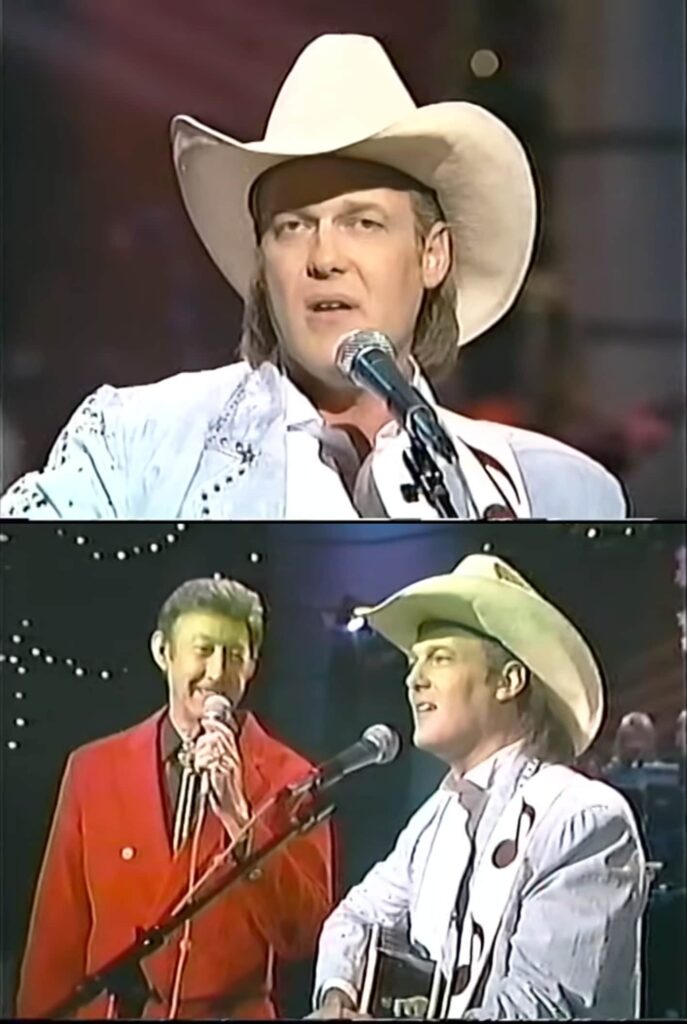
Twenty Years After Making It a Hit, Jack Greene Shared “Statue of a Fool” With the Man Who Brought It Back to Life
In 1989, a performance on television became something much greater than a duet.
When Ricky Van Shelton and Jack Greene stood side by side to sing “Statue of a Fool” on Ralph Emory’s popular country music program, audiences were witnessing two different eras of country music connected by the same song. It was not a passing of the torch in the dramatic sense. It was something gentler, rarer, and perhaps more meaningful: a living reminder of how great songs can travel across generations without losing their soul.
For Jack Greene, “Statue of a Fool” was one of the defining songs of his career. Released during the golden age of Nashville country, the song’s story of regret and self-reflection resonated deeply with listeners. Unlike many heartbreak songs, its narrator does not blame anyone else for his pain. He simply accepts responsibility for his mistakes and recognizes the foolishness of his own actions. That honesty helped the song endure long after its original chart success.
Two decades later, Ricky Van Shelton introduced the song to a new generation of country fans. By 1989, Shelton had become one of Nashville’s brightest stars. Traditional country music was experiencing a resurgence, and his rich baritone voice had made him one of the leading figures of the neo-traditional movement. Yet rather than distancing himself from the past, Shelton openly embraced it.
That decision revealed much about the artist he was.
Long before he became a star himself, Shelton admired the classic voices that shaped country music. Singers such as Jack Greene, George Jones, and Merle Haggard helped define the sound he loved. Sharing a stage with Greene was more than a professional collaboration. It was an opportunity to perform alongside one of the artists who had influenced his own musical identity.
Watching the performance today, another detail stands out. Shelton never tries to overpower the song or draw attention away from Greene. At the height of his popularity, he could easily have treated the duet as a showcase for his own voice. Instead, he sings with remarkable restraint and respect. The result feels less like a competition and more like a conversation between generations.
That dynamic gives the performance much of its emotional power.
For Greene, there must have been something deeply satisfying about standing next to the artist who helped revive one of his signature songs. Many performers watch their biggest hits gradually fade from public memory. Greene was fortunate enough to witness a younger star introduce his music to new audiences and keep it alive on country radio.
The timing also makes the performance historically significant. The late 1980s represented a period when Nashville still maintained a strong connection between its legends and its rising stars. Established artists were not pushed aside. They were celebrated, invited back into the spotlight, and recognized as part of country music’s continuing story.
Looking back now, the performance carries an added sense of nostalgia. Jack Greene passed away in 2013, while Ricky Van Shelton eventually stepped away from the music industry and public life. What remains is this brief television moment, preserved on video.
It is no longer simply a performance of “Statue of a Fool.”
It is a rare meeting of past and present, a moment when a beloved country standard united the man who made it famous with the man who ensured it would not be forgotten. For a few minutes in 1989, country music remembered exactly where it came from, and audiences were fortunate enough to watch it happen.