
Nearly Forty Years After Writing “My Old Friend the Blues,” Steve Earle Sang It at the Grand Ole Opry as a Man Who Had Finally Come Home
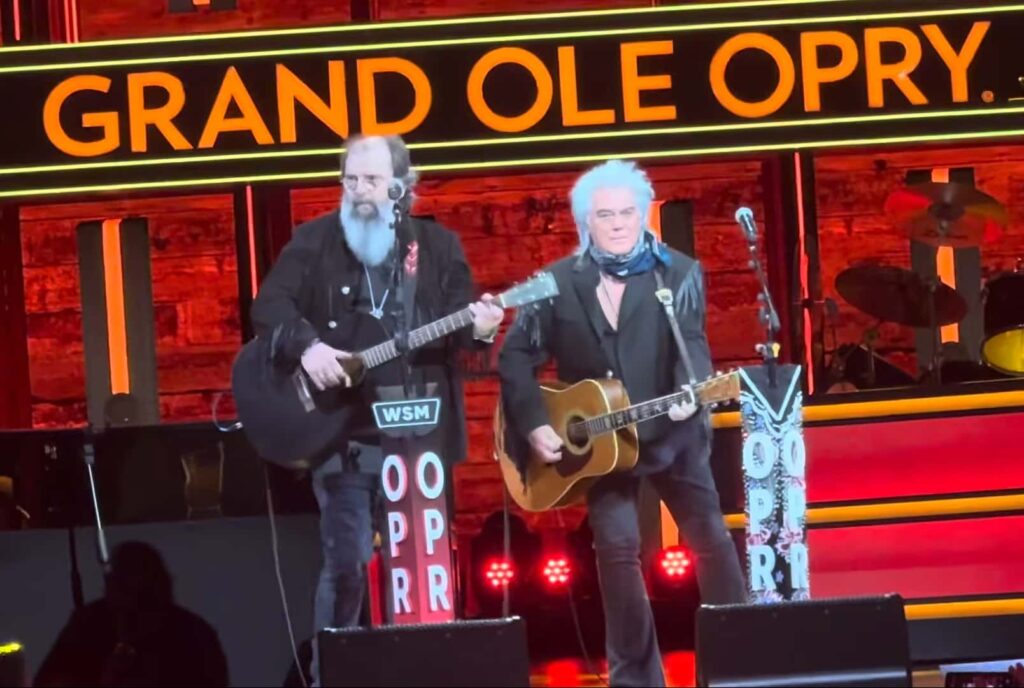
Some performances are remembered for their technical brilliance. Others endure because of the story surrounding them. When Steve Earle and Marty Stuart stood together at the Grand Ole Opry on September 17, 2025, to perform “My Old Friend the Blues,” the song carried far more weight than it did when Earle first wrote it nearly four decades earlier.
What audiences were witnessing was not simply another appearance on the Opry stage. It was the night Steve Earle officially became a member of the Grand Ole Opry, one of the highest honors in country music. Even more significantly, he was the first artist inducted during the Opry’s historic 100th anniversary year.
For many longtime fans, there was a powerful sense of symbolism in that moment. Earle spent much of his career existing just outside the traditional Nashville establishment. He became known as an outlaw spirit, a fearless songwriter, and a leading voice in Americana music. His path was rarely smooth, and he often seemed to belong to a different corner of the country music world. Yet on this night, he stood inside the institution that had defined country music for generations.
The choice of song made the moment even more moving.
Released on Earle’s landmark 1986 debut album “Guitar Town,” “My Old Friend the Blues” has never been a song about romantic heartbreak alone. It is a meditation on loneliness, memory, and the sadness that follows people through different chapters of life. The “old friend” in the title is not a person. It is sorrow itself. It is the familiar ache that returns when the noise fades and a person is left alone with their thoughts.
When Earle wrote the song as a younger man, it reflected the struggles and uncertainties of early adulthood. When he sang it again at age 70, the lyrics seemed transformed by everything that had happened in between.
Over the years, Earle experienced extraordinary success, personal collapse, addiction, prison time, artistic rebirth, and devastating loss. The death of his son, Justin Townes Earle, added a layer of grief that no songwriter could have imagined when first putting pen to paper decades earlier. As a result, every line of “My Old Friend the Blues” carried the weight of a life fully lived, with all its triumphs and scars.
Perhaps the most striking aspect of the performance was the contrast between the occasion and the song itself. Artists being honored often choose celebratory anthems or crowd-pleasing hits. Earle and Stuart chose a quiet, reflective ballad about sadness and endurance.
That decision created a beautiful paradox.
This was one of the happiest nights of Earle’s professional life, yet he marked the occasion with one of the most melancholy songs he ever wrote. Rather than celebrating victory, he seemed to be acknowledging the entire journey that led him there. The disappointments mattered. The struggles mattered. The losses mattered. Without them, the honor would not have carried the same meaning.
The presence of Marty Stuart made the moment even more significant. Few artists represent the traditions and history of Nashville more faithfully than Stuart. Throughout their careers, Stuart and Earle often appeared to occupy different worlds within country music. One became a guardian of tradition. The other became a restless songwriter constantly pushing boundaries.
Yet on that September evening, both stood on the same wooden circle at the heart of the Opry. In many ways, it felt like a meeting point between traditional country music and the broader Americana movement that Earle helped shape.
Looking back, the performance feels less like a conclusion than a reflection. It is the sound of an artist examining the road behind him while stepping into a new chapter. Some fans may even see it as the beginning of the final act of a remarkable career rather than a crowning achievement.
That is what makes the performance so memorable. After nearly forty years, the man who wrote “My Old Friend the Blues” finally stood inside country music’s most sacred institution and sang about the sorrow that had accompanied him every step of the way.