
Before Elvis Was Called the King, Fats Domino Was Already Changing the Sound of America with “Ain’t That a Shame.”
When Fats Domino sat behind his piano to perform “Ain’t That a Shame” in 1956, audiences were witnessing far more than a hit song. They were watching one of the defining moments of early rock and roll, a time when American popular music was beginning to cross racial and cultural boundaries in ways few could have imagined just a few years earlier.
Released in 1955, “Ain’t That a Shame” became the breakthrough that transformed Domino from a beloved New Orleans rhythm and blues artist into a national star. The record reached No. 1 on the Billboard R&B chart, climbed into the Top 10 of the Billboard Pop chart, and sold more than a million copies. More importantly, it introduced millions of white listeners to an artist whose roots were firmly planted in the rich musical traditions of New Orleans.
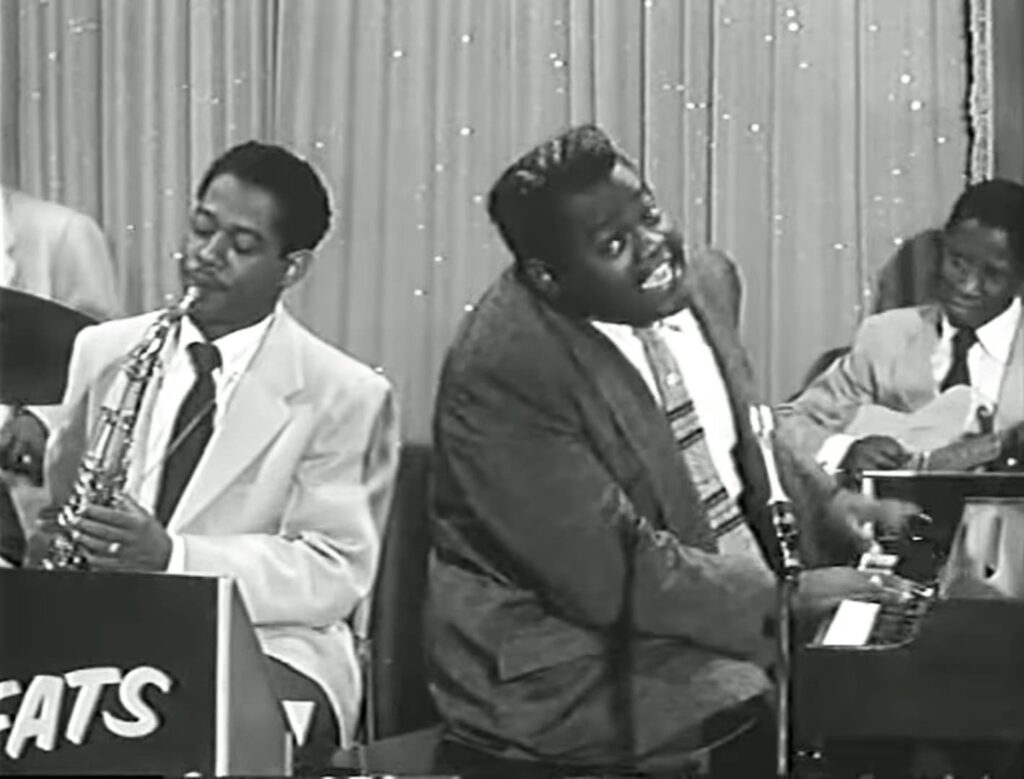
One of the most fascinating aspects of the performance is its striking contrast between sound and emotion. The lyrics tell a simple story of heartbreak. “You made me cry. You said goodbye. You broke my heart.” Yet Domino never performs the song with visible anguish. Instead, he smiles, rocks gently at the piano, and lets the infectious shuffle rhythm carry the melody forward. It is a perfect example of the New Orleans tradition of dancing through sorrow, where even heartbreak can swing with joy.
That effortless warmth became one of Fats Domino’s greatest strengths. Unlike many later rock performers, he never relied on dramatic stage movements or theatrical gestures. Throughout the performance, he remains seated at the piano, rarely looking away from the keyboard. In an era before elaborate lighting, giant video screens, or choreographed productions, his quiet confidence was enough to command the entire room. The music itself became the performance.
There is another intriguing story behind the song’s title. When the composition was first written, it was called “Ain’t It a Shame.” Domino’s natural Louisiana pronunciation consistently turned the phrase into “Ain’t That a Shame,” and that version ultimately became the title recognized around the world. It is a small detail, yet one that reflects how authentically Domino always remained himself, never reshaping his identity to fit commercial expectations.
The song also became the center of one of rock and roll’s earliest cultural debates. Shortly after Domino’s release, Pat Boone recorded a cleaner, pop-oriented cover aimed primarily at white audiences. Boone’s version became a major commercial success, prompting a conversation that has continued for decades. Were listeners embracing the song itself, or were many radio stations and consumers more comfortable hearing it performed by a white artist? The discussion remains an important chapter in the history of American popular music and the struggle for greater recognition of Black musicians.
Ironically, while history now recognizes Fats Domino as one of rock and roll’s founding architects, he rarely described himself as a rock artist. Throughout his life, Domino insisted he simply played the rhythm and blues that musicians had long performed in New Orleans. To him, the label mattered far less than the music.
His influence reached far beyond his own recordings. The Beatles admired his work, John Lennon later recorded “Ain’t That a Shame,” and Cheap Trick helped introduce the song to another generation decades later. Even Elvis Presley, often celebrated as the “King of Rock and Roll,” once referred to Domino as “the real king of rock ‘n’ roll,” a remarkable tribute from one legend to another.
Looking back nearly seventy years later, this 1956 performance remains captivating precisely because of its simplicity. There are no visual distractions, no elaborate effects, and no attempt to overwhelm the audience. There is only a piano, an unmistakable voice, a timeless groove, and a songwriter who understood that the strongest music does not need spectacle to survive.
That is why “Ain’t That a Shame” still resonates today. It reminds us that some of the greatest revolutions in music did not begin with fireworks or grand declarations. Sometimes they began with a man sitting quietly at a piano, smiling through a broken heart, and unknowingly helping change the course of American music forever.