
In “Blame It On Me,” Bonnie Raitt Proves That the Quietest Songs Often Carry the Deepest Truths
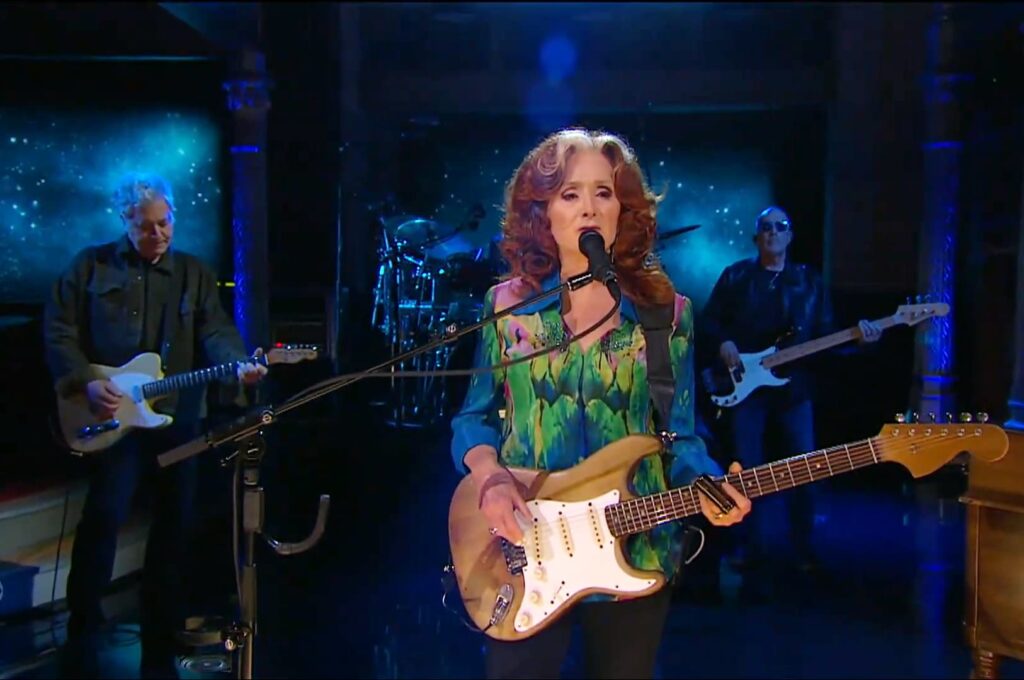
When Bonnie Raitt stepped onto the stage of The Late Show to perform “Blame It On Me” from her acclaimed 2022 album Just Like That…, she did not arrive with a blazing guitar solo or a thunderous blues-rock anthem. Instead, she brought something far rarer.
She brought perspective.
For more than five decades, Raitt has been celebrated as one of America’s most distinctive voices, a musician capable of igniting a room with her slide guitar and commanding stage presence. Yet this performance revealed another side of her artistry, one that has become increasingly powerful with time. Rather than raising her voice, she lowered it. Rather than overwhelming the audience with force, she drew them closer with honesty.
That contrast is what makes this performance so remarkable.
At first glance, “Blame It On Me” appears to be a song about the end of a relationship. The narrator finds herself carrying the burden of another person’s accusations, hearing blame placed squarely on her shoulders. But beneath the heartbreak lies a deeper reflection on how people explain loss, disappointment, and the collapse of love.
The song moves through a series of striking images. Blame it on the stars. Blame it on time. Blame it on fate. Anything but the painful truth that sometimes relationships simply fall apart. Raitt’s lyrics explore the human tendency to search for explanations when our hearts are unwilling to accept reality.
One of the most compelling aspects of the performance is how naturally it fits the stage of life from which Raitt now sings. In her younger years, heartbreak songs often carried urgency, anger, or desperation. Here, there is none of that. The emotion remains, but it has been filtered through experience.
When she asks, “How can you talk that way?” the question lands with unusual weight. It is not shouted in frustration. It arrives almost as a quiet expression of disbelief, the kind that comes only after years of learning how fragile human connections can be.
That emotional restraint gives the song extraordinary power.
The performance also serves as a reminder of why Bonnie Raitt remains one of the most respected interpreters of song in modern music. She has never relied solely on vocal gymnastics or technical displays. Her greatest gift has always been her ability to inhabit a lyric completely, making listeners feel as though every word emerged from lived experience.
By the time she reaches the song’s final twist, where the narrator ultimately turns the blame back toward the person who left, the moment feels less like revenge and more like acceptance. There is sadness, certainly, but also clarity.
That sense of hard-earned wisdom has become one of the defining qualities of Raitt’s later work. It is a quality that cannot be manufactured. It arrives only through years of living, loving, losing, and continuing forward.
Watching the performance today, it is impossible not to recognize how much Raitt has evolved while remaining unmistakably herself. The fiery performer who once electrified audiences with blues-rock classics is still present. Yet she now possesses something equally compelling: the confidence to let silence, space, and understatement do the work.
In an era when many performances compete for attention through spectacle, “Blame It On Me” succeeds by doing the opposite. It asks the audience to listen carefully. To lean in. To hear every word.
And perhaps that is the greatest lesson of this performance.
As artists grow older, they may lose some of the raw power that first made them famous. But the finest among them gain something far more valuable. They learn how to tell the truth with fewer words, fewer notes, and fewer gestures.
On this night, Bonnie Raitt demonstrated exactly that. She did not sing louder than she once did.
She simply told the story more clearly.
And in doing so, she reminded everyone why great songs never depend on volume to leave a lasting mark.