
When the Piano Survived the Flood, So Did the Soul of New Orleans
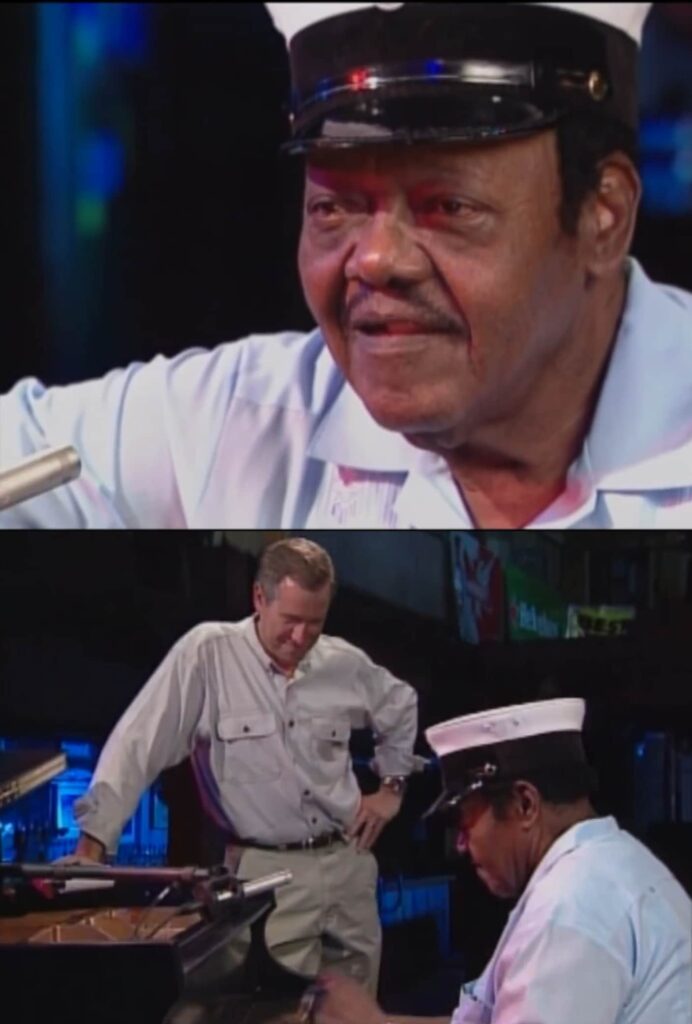
In 2006, just months after the devastation of Hurricane Katrina, Fats Domino sat down with Brian Williams of NBC News for an interview that carried far more weight than a typical television segment. For a brief and troubling time during the storm’s aftermath, rumors had spread across the country that Fats Domino, one of America’s foundational rock and roll pioneers, had been lost in the floodwaters of New Orleans. The truth, as this interview gently reveals, is that he endured. And in enduring, he became something even larger than a musician. He became a living symbol of a wounded city’s survival.
The setting itself tells a quiet story. His modest home in the Lower Ninth Ward, a neighborhood that suffered some of the worst flooding, stands in stark contrast to his legacy of 21 gold records and international fame. There is no grandeur here, only humility. When asked about the rising المياه, Domino responds with the same understated calm that always defined him. No dramatics, no embellishment. Just a man who lived through something unimaginable and chose to speak of it plainly.
What gives this interview its emotional gravity is not only the disaster behind it, but the way Fats Domino carries New Orleans within him. When Williams remarks that the city is a part of him, Domino quietly turns it around. New Orleans, he insists, belongs to everyone. That simple exchange reveals the essence of who he was. A man deeply rooted in place, yet never claiming ownership of it. Instead, he saw himself as one voice among many in a musical tradition that stretched far beyond his own fame.
The most unforgettable moment arrives when he sits at the piano. Even after displacement, loss, and uncertainty, his hands find the keys as if nothing has changed. He turns slightly away, as though playing not for the cameras, but for memory itself. And in those few notes, the years fall away. The sound is familiar, warm, and unbroken.
For those who grew up with his music, this interview is not simply about survival. It is about continuity. The storms may come, the waters may rise, but some voices remain steady, carrying the spirit of a place long after the silence should have taken hold.