
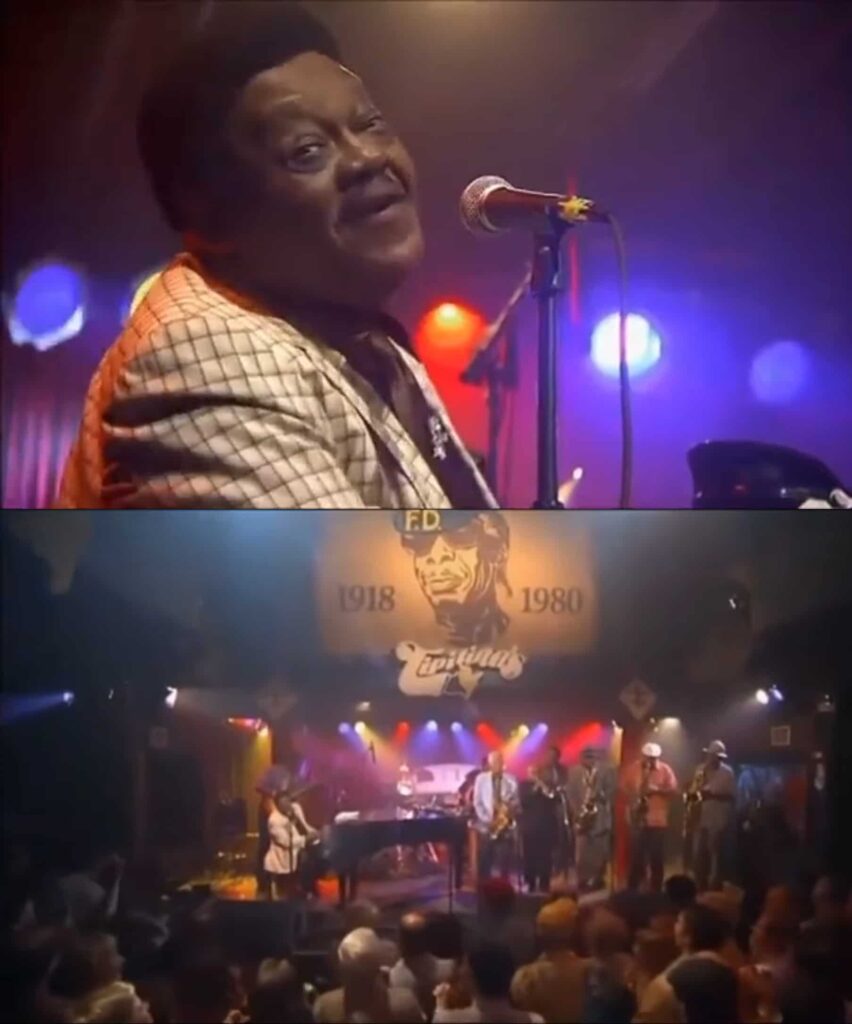
When the Piano Came Home Again: Fats Domino and a City Finding Its Soul at Tipitina’s
On May 19, 2007, inside the legendary club Tipitina’s in New Orleans, something more profound than a concert took place. Fats Domino, the gentle architect of rhythm and blues, returned to the piano before a live audience in a moment that felt less like performance and more like restoration.
In the years following Hurricane Katrina, New Orleans was still searching for pieces of itself. Streets were quieter, traditions disrupted, and the familiar rhythms of the city had been shaken. Yet that night, as Domino sat at the piano, there was a sense of something returning to its rightful place. For decades, the image of him playing in New Orleans had been part of the city’s identity. To see it again was to feel a kind of normalcy that words could not fully capture.
The music itself carried that feeling. Domino did not rely on spectacle. His style, always rooted in simplicity, allowed every note to breathe. Songs like “I’m Walkin’” and “Blueberry Hill” drifted through the room with a warmth that felt both familiar and deeply needed. His voice, aged yet unmistakable, still held that rolling, easy charm. And the piano, steady beneath his hands, spoke in the language he had helped define.
What made the night unforgettable was not technical perfection, but presence. Each chord seemed to say that the city’s spirit had endured. Fellow musicians and observers would later reflect that to understand New Orleans music, one must look to Domino, much as earlier generations looked to Louis Armstrong. His influence was not just historical. It was living, audible in every rhythm that echoed through the club.
There was also something deeply human in the performance. Domino, never one for grand declarations, simply played. Yet in that simplicity lay a powerful message. Recovery does not always arrive with noise. Sometimes it comes quietly, in the return of a familiar sound, in the sight of a beloved figure doing what he has always done.
Looking back, that evening at Tipitina’s stands as a small but meaningful chapter in the story of a city and its music. Fats Domino did not just perform. He reminded New Orleans of itself. And for those who were there, that reminder felt like hope finding its melody again.