
A Gentle Longing for a Love That Lives Somewhere Beyond the Hills
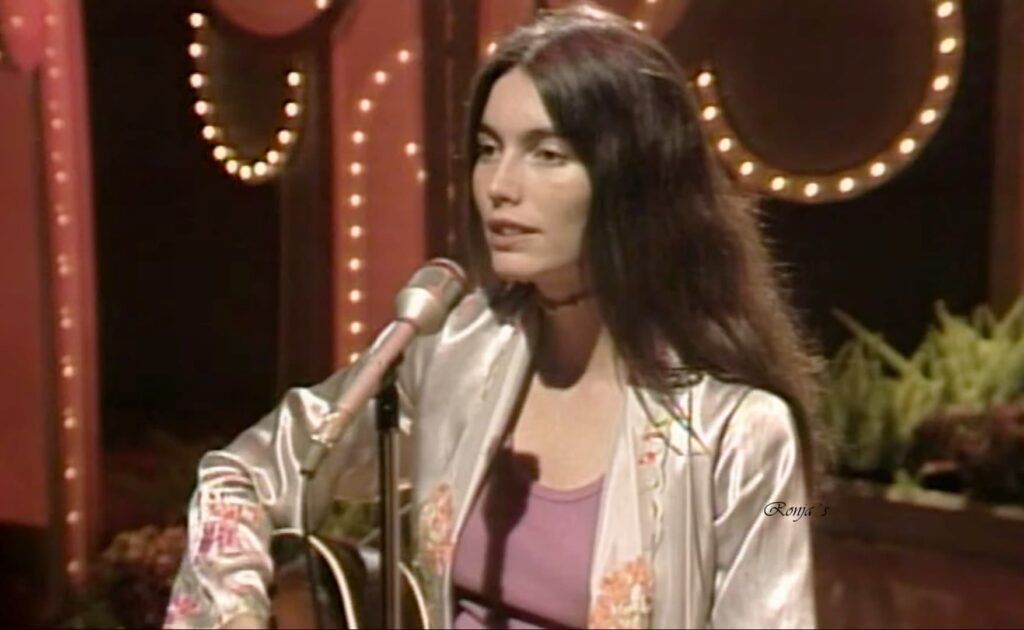
In “Blue Ridge Mountain Boy”, Emmylou Harris returns to one of the most enduring themes in American roots music, the quiet pull of home, love, and the distance that separates them. The song, originally written and recorded by Dolly Parton in 1969, found a new emotional depth when Emmylou brought it into her own repertoire during the mid-1970s, a period when she was carefully shaping her identity as one of country music’s most expressive interpreters. Though not tied to a single defining album in her catalog, this rendition reflects the same artistic spirit that marked records like “Pieces of the Sky”, where tradition and personal feeling meet with remarkable clarity.
From the very first line, there is a sense of quiet yearning that runs through “Blue Ridge Mountain Boy”. The story is simple, almost timeless. A young woman waits, holding onto the memory of a love tied to a distant place, the Blue Ridge Mountains. Yet what makes the song linger is not its narrative, but its feeling. This is not a dramatic heartbreak. It is something softer, more persistent. A kind of longing that settles into everyday life and becomes part of it.
Emmylou Harris approaches the song with her characteristic restraint. Her voice, clear and slightly fragile at the edges, carries the melody with a natural ease that never feels forced. She does not push the emotion outward. Instead, she draws it inward, allowing the listener to step quietly into the story. For older audiences, this approach feels deeply familiar. It recalls a time when songs trusted the listener to feel rather than be told what to feel.
There is also a strong sense of place woven into the performance. Even without elaborate description, the mention of the Blue Ridge Mountains evokes a landscape that feels both real and symbolic. It represents distance, memory, and a kind of rooted identity that cannot easily be replaced. In Emmylou’s hands, that setting becomes almost tangible, a place you can imagine but perhaps never fully return to.
What gives this rendition its lasting power is its emotional honesty. “Blue Ridge Mountain Boy” does not offer resolution. The waiting continues. The love remains just out of reach. And yet, there is no bitterness in that waiting. Only a quiet acceptance, a recognition that some feelings are meant to endure without conclusion.
Looking back, this performance stands as a beautiful example of Emmylou Harris’s gift for interpretation. She does not simply revisit a song. She inhabits it, allowing its meaning to unfold gently over time. And in doing so, she reminds us that the most powerful stories in music are often the simplest ones, told with care, carried by memory, and held close long after the final note fades.