
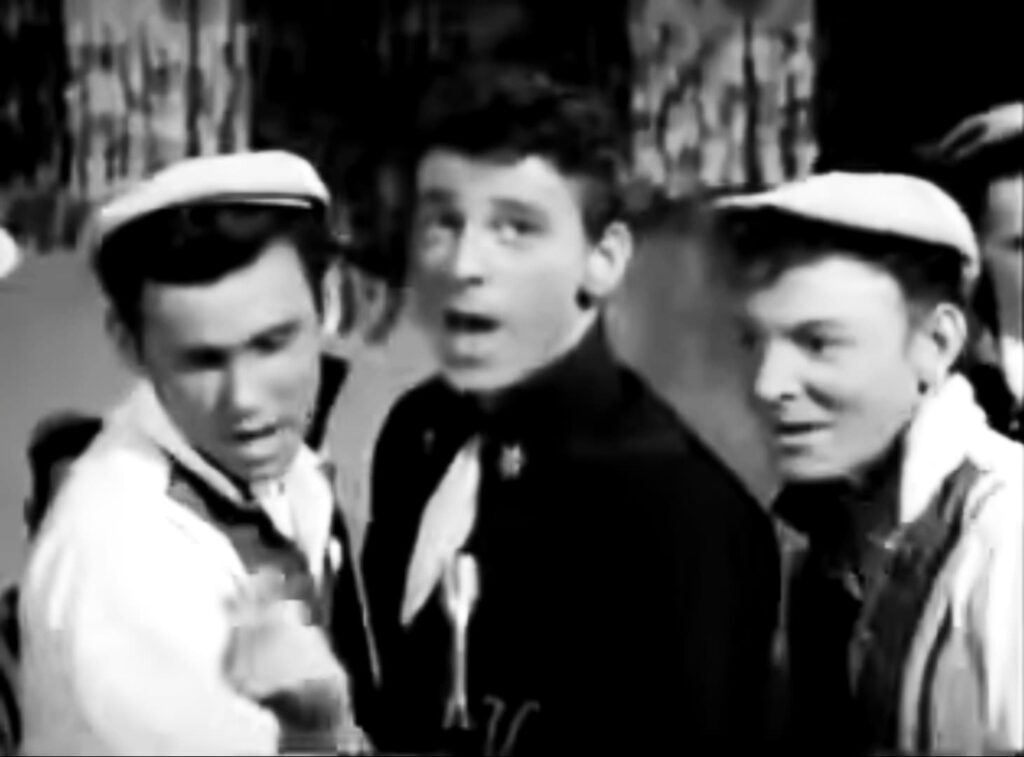
Before Rock Became Mainstream, Gene Vincent’s “Baby Blue” Captured the Wild Spirit That Changed Youth Culture Forever
In 1958, Gene Vincent was not simply performing songs. He was helping define what rock and roll looked, sounded, and felt like. His electrifying rendition of “Baby Blue” stands today as a vivid reminder of an era when rock music still carried an element of danger, unpredictability, and youthful rebellion that shocked older generations and thrilled younger audiences.
Watching the performance now feels like opening a time capsule from the early days of the rock and roll revolution. Long before elaborate stage productions, giant video screens, and arena-sized spectacles became standard, artists like Vincent relied on something much simpler: presence, attitude, and an undeniable connection with the audience.
That connection is immediately apparent in “Baby Blue.”
Standing before the crowd with his unmistakable swagger, Vincent projected a confidence that set him apart from many performers of his generation. Dressed in the style that would become closely associated with rockabilly culture, he embodied a new kind of musical hero. He was not polished or carefully packaged. He seemed real, unpredictable, and slightly dangerous, qualities that made him irresistible to young fans searching for something different from the music their parents had grown up with.
The timing of the performance is important. By 1958, rock and roll had already exploded across America, but it was also beginning to face increasing pressure from television networks, radio programmers, and cultural critics who wanted the music to become more respectable and commercially acceptable. Against that backdrop, performers such as Gene Vincent continued to preserve much of the genre’s original edge.
That is one reason “Baby Blue” remains so compelling.
The song moves with relentless energy, driven by the outstanding musicianship of The Blue Caps, one of the most influential backing bands in rockabilly history. Their guitar work provides the performance with a sense of urgency that never lets up. Every note feels alive, creating the impression that the music could burst beyond the confines of the stage at any moment.
Yet the true focal point remains Vincent himself.
Rather than simply delivering the lyrics, he inhabits them. His distinctive vocal style combines tenderness and intensity in equal measure. One moment he sounds vulnerable, the next completely untamed. That contrast became one of his greatest strengths and helped distinguish him from many of his contemporaries.
Looking back, it is easy to understand why Gene Vincent inspired such devotion among young listeners. He represented freedom, individuality, and a willingness to challenge expectations. For many teenagers of the late 1950s, artists like Vincent offered a glimpse of a new cultural identity that was beginning to emerge across America and beyond.
What makes the footage especially valuable today is the historical perspective it provides. Modern audiences know that rock and roll would eventually become one of the most dominant musical forms in the world. The people watching Gene Vincent in 1958 could not have known that. They were witnessing a movement still in its formative years, before its influence would spread across generations and continents.
The performance also reminds viewers of Gene Vincent’s lasting influence on countless musicians who followed. While artists such as Elvis Presley often received greater mainstream attention, Vincent’s raw style, vocal delivery, and rebellious image helped shape the development of rockabilly, British rock, and later generations of rock performers.
More than six decades later, “Baby Blue” remains far more than a nostalgic curiosity. It captures a moment when rock and roll still felt new, unpredictable, and transformative. It preserves the sound of a young culture discovering its own voice and a performer whose charisma could turn a simple song into something unforgettable.
For anyone seeking to understand the original spirit of rock and roll, Gene Vincent’s “Baby Blue” is not merely a performance. It is a snapshot of a revolution in progress, delivered in just a few unforgettable minutes.