
A Song Written in Grief and Carried in Silence: James Taylor and the Enduring Truth of “Fire and Rain”
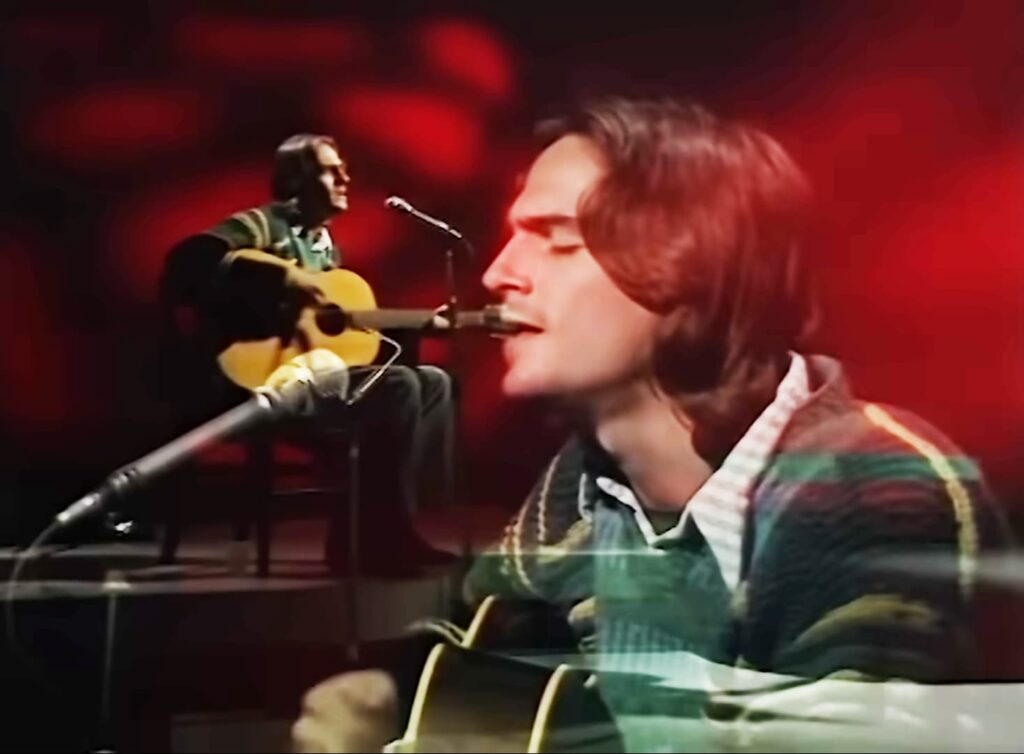
On November 16, 1970, during a BBC In Concert session, James Taylor sat with his guitar and introduced a song he had written “mostly here and partially in the United States.” What followed was “Fire and Rain,” a performance that felt less like a broadcast and more like a private reckoning shared in public.
By that time, the song had already begun to define Taylor’s early career, appearing on his album Sweet Baby James earlier that year. But in this stripped-down setting, its meaning becomes even clearer. There is no distance between the singer and the story. Every line feels immediate.
“Fire and Rain” was born from real loss. The opening verse refers to the death of Suzanne Schnerr, a childhood friend whose passing Taylor learned about too late. That sense of delayed grief lingers throughout the song. It is not loud or dramatic. It is quiet, disorienting, and deeply personal.
Taylor’s vocal delivery reflects that emotional state. His voice does not strain for effect. Instead, it moves gently, almost carefully, as if each word carries weight. The guitar accompaniment remains steady, grounding the performance while allowing the lyrics to lead.
What sets this rendition apart is its intimacy. In a live setting, many artists lean into projection. Taylor does the opposite. He draws the listener closer, reducing the space between performer and audience. The result is a feeling of shared solitude.
The song’s chorus, with its now-iconic lines about seeing “fire and rain,” captures a broader emotional spectrum. It speaks not only of loss, but of endurance. Moments of despair, moments of clarity, and the long stretches in between where nothing feels certain. That balance gives the song its universality.
For audiences in 1970, James Taylor represented a new kind of songwriter. One who did not hide behind metaphor or distance, but spoke plainly about vulnerability. This performance reinforces that identity. It is honest without being indulgent, reflective without losing structure.
Looking back, “Fire and Rain” remains one of the defining songs of its era, not because it seeks resolution, but because it does not. It accepts uncertainty as part of the human experience.
 Oldies Songs