
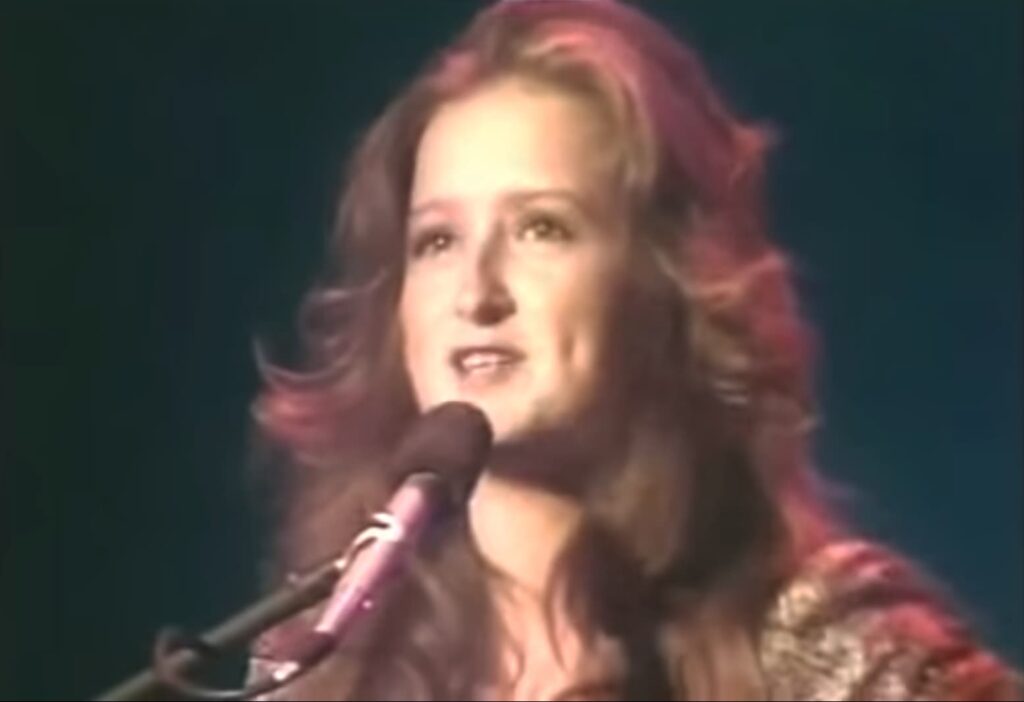
Before the Grammys and the Glory, “Give It Up Or Let Me Go” Revealed the Fearless Heart of Bonnie Raitt
Long before she became one of America’s most celebrated singer-songwriters, before the Grammy triumphs of Nick of Time, and before songs like “Something to Talk About” and “I Can’t Make You Love Me” turned her into a household name, Bonnie Raitt was already electrifying audiences with a fiery blend of blues, roots rock, and uncompromising independence.
One remarkable glimpse into that early chapter survives in a spirited 1970s performance of “Give It Up Or Let Me Go.” Watching the footage today feels less like revisiting a familiar star and more like discovering the origin story of a future legend.
The first thing that stands out is how different this Bonnie Raitt appears from the artist many later came to know. The silver streak that would become her trademark had not yet defined her image. The reflective balladeer who would one day move millions with songs of heartbreak and resilience was still years away. Instead, the young Raitt storms the stage with relentless energy, her slide guitar slicing through the air while her voice carries the grit and confidence of a seasoned blues veteran.
At the center of the performance is a song whose message remains striking decades later. “Give It Up Or Let Me Go” is not a plea for affection. It is an ultimatum. Raitt sings from the perspective of a woman unwilling to settle for half-hearted commitment, making it clear that if love is not genuine, she is prepared to walk away.
In the early 1970s, such a direct declaration carried particular weight. Popular music still offered relatively few female voices expressing independence with this level of confidence and clarity. Yet Raitt delivered the message without hesitation, transforming the song into a statement of self-respect as much as a blues-rock anthem.
The performance also serves as a reminder of where Bonnie Raitt’s musical roots truly lie. Though some listeners later associated her with adult contemporary ballads and mainstream success, her foundation was built firmly upon the traditions of Delta Blues, Chicago Blues, and classic Rhythm and Blues. Every phrase in this performance reflects those influences. Yet she never sounds like an imitator. Instead, she reshapes those traditions into something uniquely her own.
Another charming moment arrives midway through the performance when Raitt introduces her pianist, affectionately acknowledging “Jeff on the piano.” It is a small detail, but one that captures the spirit of live music during that era. There are no giant video screens, elaborate stage effects, or carefully choreographed spectacles. The focus remains on musicians playing together, feeding off one another’s energy in real time.
That sense of authenticity gives the performance much of its enduring appeal. The audience is not witnessing a polished superstar production. They are watching a gifted young artist and a tight-knit band building something organically, one song at a time.
Perhaps the most fascinating aspect of the video is what history allows us to see. The crowd gathered that day could not have known they were watching a future Hall of Fame artist. They could not foresee the awards, the acclaim, or the remarkable career that lay ahead. Yet from a modern perspective, all the essential ingredients are already there: the confidence, the originality, the musicianship, and the unmistakable command of the stage.
More than forty years later, “Give It Up Or Let Me Go” remains a thrilling time capsule. It captures Bonnie Raitt at a moment when fame had not yet caught up with talent, when the road ahead was still unwritten, and when every performance carried the excitement of possibility. Looking back now, it feels like witnessing the first sparks of a fire that would burn brightly for decades.