
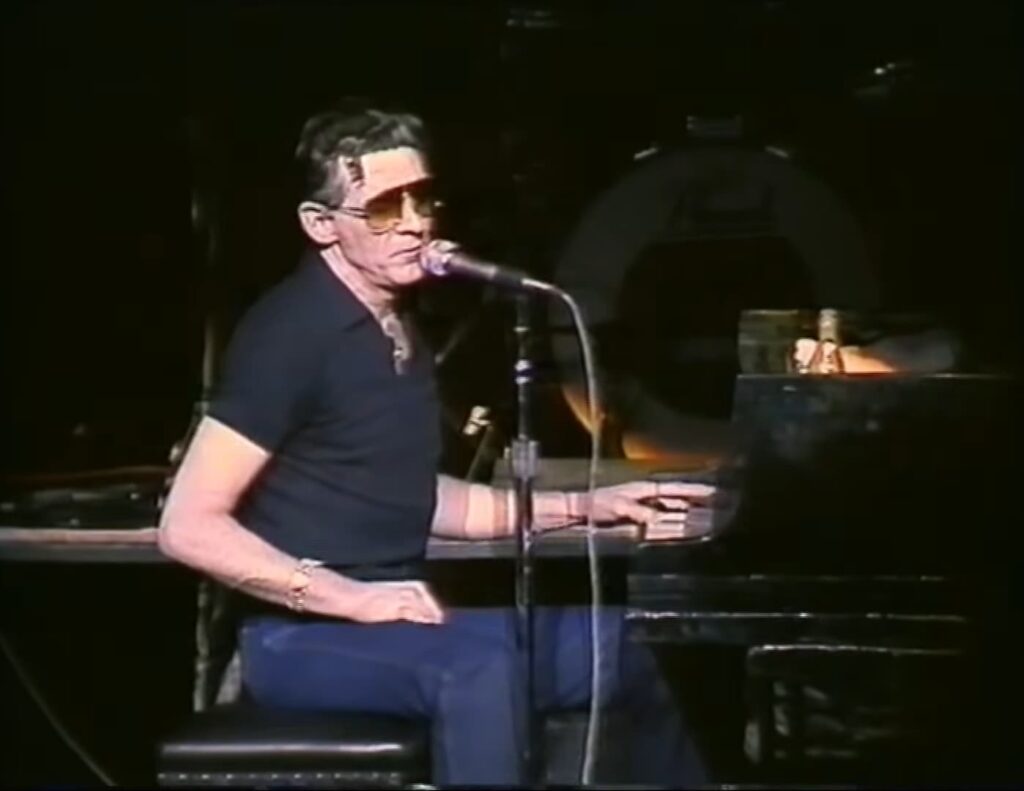
When Jerry Lee Lewis Took the Stage in London, “What’d I Say” Became a Reminder That Rock and Roll Was Never Meant to Grow Old
By the time Jerry Lee Lewis walked onto the stage of London’s Hammersmith Odeon in April 1983, he no longer had anything to prove. He was already one of rock and roll’s original revolutionaries, a performer whose wild piano playing had inspired generations of musicians. Yet when he launched into “What’d I Say” before a sold out crowd, it became clear that “The Killer” had lost none of the explosive energy that made him a legend. The performance was less a nostalgic trip than a thrilling reminder that genuine rock and roll never depends on age. It depends on attitude.
Originally written and recorded by Ray Charles in 1959, “What’d I Say” forever changed the landscape of American popular music. Blending rhythm and blues, gospel, jazz, and early rock and roll, it broke musical boundaries while introducing a call and response style that became one of the genre’s defining signatures. Few artists were better suited to reinterpret that landmark recording than Jerry Lee Lewis, whose own career had been built on fearlessly mixing country, boogie woogie, blues, and rock into a sound that belonged entirely to him.
From the opening moments, Lewis commanded the stage with the confidence of someone who had spent decades living inside the music. Seated behind the piano that had become his trademark, he attacked the keys with relentless drive while delivering every lyric with playful swagger. His hands moved effortlessly across the keyboard, reminding the audience that his piano was never merely an accompaniment. It was the heartbeat of the entire performance.
What made this concert especially memorable was its remarkable honesty. There were no elaborate visual effects, no choreographed spectacle, and no attempt to modernize the music for changing tastes. The sold out audience had come for one reason alone: to witness one of rock and roll’s true founders doing what he had always done best. Every cheer echoed with appreciation for an artist whose influence stretched far beyond his own recordings.
Although Jerry Lee Lewis had become one of country music’s biggest stars during the late 1960s and 1970s with hits such as “Another Place, Another Time”, “To Make Love Sweeter for You,” and “Would You Take Another Chance on Me,” performances like this proved he could instantly return to the raw excitement of his rock and roll roots. There was never a clear dividing line between the genres in his music. Country, blues, gospel, and rock all flowed together naturally, creating a style that few performers have ever matched.
Watching this performance today also brings a sense of nostalgia for an era when live concerts relied almost entirely on musicianship. The camera stays focused on Lewis, the band, and the audience sharing the same electric moment. Nothing distracts from the sound. Nothing competes with the performance itself. It is simply a master entertainer feeding off the enthusiasm of a packed theatre.
Perhaps the most remarkable aspect of “What’d I Say” in London is how effortlessly Jerry Lee Lewis makes the song his own. He never imitates Ray Charles, nor does he attempt to overshadow the original. Instead, he filters the classic through his unmistakable personality, combining pounding piano rhythms, infectious humor, and fearless showmanship into something uniquely his.
More than four decades after this unforgettable evening at the Hammersmith Odeon, the performance remains a vivid reminder of why Jerry Lee Lewis earned the nickname “The Killer.” His energy was contagious, his musicianship uncompromising, and his passion completely authentic. In just a few exhilarating minutes, “What’d I Say” becomes more than a classic song. It becomes living proof that the spirit of rock and roll can never be confined to a single generation.