
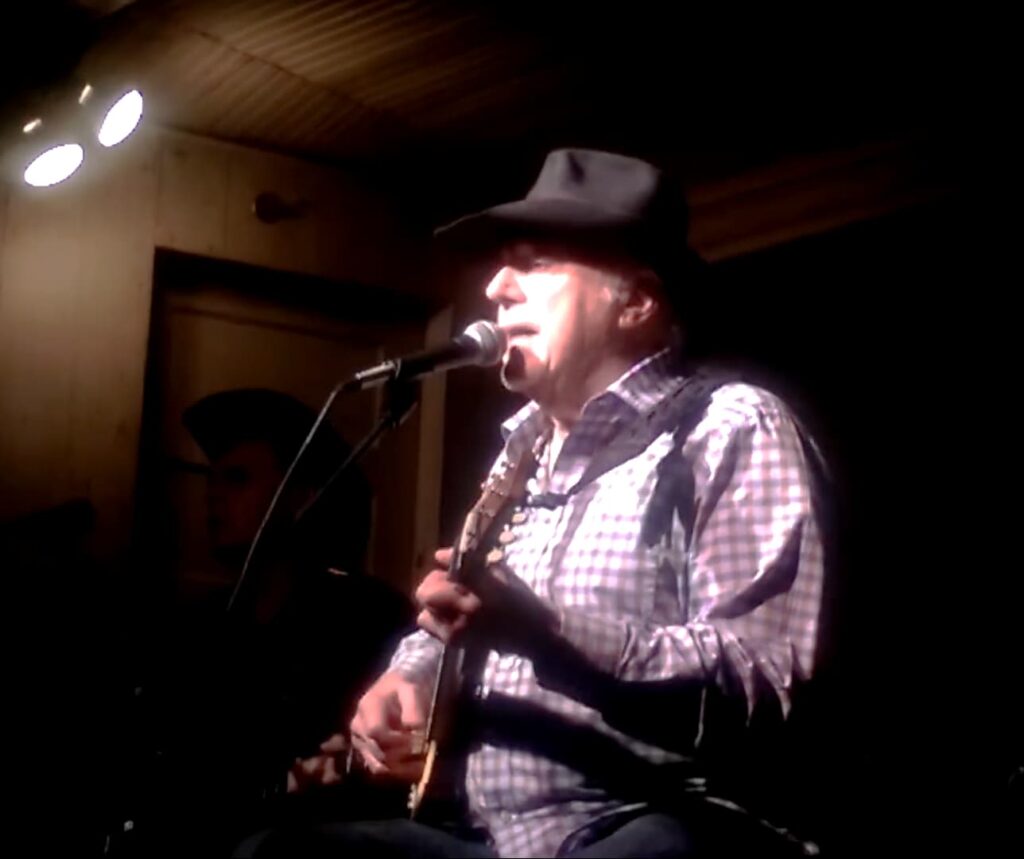
In the Worn Wooden Air of Gruene Hall, Jerry Jeff Walker Sang Like a Man Speaking to Time Itself
When Jerry Jeff Walker performed “Little Bird” at Gruene Hall in 2015, it felt less like a concert and more like the final chapter of a long conversation between a wandering songwriter and the road that shaped him. The old Texas dance hall, with its creaking floorboards, faded walls, and century-old ghosts lingering in the rafters, could not have offered a more fitting backdrop. Everything about the evening carried the feeling of survival, memory, and weathered grace.
By then, Jerry Jeff Walker was no longer merely a musician in the eyes of his audience. He had become part of Texas folklore itself.
Born Ronald Clyde Crosby in New York in 1942, Walker spent decades reinventing the idea of what a singer-songwriter could be. Long before the “outlaw country” movement became a marketing phrase, he was already living outside the boundaries of Nashville polish. He hitchhiked across America, played in bars and street corners, rode freight trains, drifted through New Orleans, and absorbed the stories of ordinary people who rarely appeared in mainstream country songs. That wandering life eventually became his greatest songwriting education.
Though many listeners first discovered him through the immortal “Mr. Bojangles,” written after a haunting encounter in a New Orleans jail cell and later turned into a worldwide hit by artists like Nitty Gritty Dirt Band and Sammy Davis Jr., Jerry Jeff’s deeper legacy belonged to Texas. He helped transform Austin’s cosmic cowboy scene in the 1970s into one of the most influential regional music movements in America. Without Jerry Jeff Walker, the careers of artists like Guy Clark, Townes Van Zandt, and even a young Jimmy Buffett might have unfolded very differently.
By 2015, however, Walker carried the visible marks of time. His voice had roughened into something deeply human, fragile in places yet somehow more powerful because of it. When he sang at Gruene Hall that night, there was no attempt to hide age or weariness. Instead, he leaned into them. Every line sounded lived through rather than merely performed.
That honesty is what made “Little Bird” resonate so deeply in that setting.
The song itself reflects themes that ran through much of Jerry Jeff’s work: freedom, escape, emotional restlessness, and the quiet ache that often accompanies a life spent moving from one horizon to another. Like many of his finest compositions, “Little Bird” does not rely on dramatic storytelling or grand lyrical twists. Its strength lies in atmosphere. It feels like a conversation overheard at dusk between people who have traveled too far to explain themselves fully.
Inside Gruene Hall, the song seemed to float differently than it would have in a modern arena or theater. Opened in 1878, Gruene Hall remains the oldest continually operating dance hall in Texas, and its simplicity is part of its magic. No elaborate glamour. No unnecessary spectacle. Just wood, history, sweat, and music. Over the decades, legends like Willie Nelson, George Strait, Lyle Lovett, and Merle Haggard all stood on that same stage. Yet Jerry Jeff always felt uniquely connected to places like Gruene because his music depended on intimacy rather than distance.
Watching the audience during performances like this is often as moving as the music itself. People do not behave like passive spectators at a Jerry Jeff Walker show. They lean forward. They smile quietly to themselves. Some close their eyes as though hearing fragments of their own youth returning through the songs. Many in that room had likely spent decades carrying his music through marriages, divorces, road trips, lonely nights, and old friendships that faded with time.
And Jerry Jeff understood exactly who he was singing to.
There was never anything artificial about him. Unlike many performers who eventually become trapped inside their public image, Walker remained startlingly recognizable throughout his life. The scruffy charm, the relaxed humor, the storyteller’s cadence, the sense that he might disappear into another highway tomorrow even after all the fame — it stayed with him until the very end.
By 2015, his performances carried an additional emotional layer because audiences understood they were witnessing one of the last living connections to a disappearing era of American songwriting. These were artists who valued stories over branding, imperfections over polish, and emotional truth over technical precision.
In many ways, “Little Bird” at Gruene Hall became symbolic of Jerry Jeff Walker himself. The song moves gently, almost drifting, but beneath its calm surface lies a lifetime of searching. His voice no longer soared the way it once had decades earlier, but that hardly mattered. If anything, the cracks and rough edges made the performance more devastatingly beautiful. Age had stripped away everything unnecessary until only the truth remained.
And perhaps that is why the performance still lingers so strongly for those who revisit it today.
In that old Texas hall, beneath spinning ceiling fans and dim lights, Jerry Jeff Walker was not trying to impress anyone anymore. He was simply telling the truth the only way he knew how — through a guitar, a weathered voice, and songs that carried the dust of a thousand miles inside them.
For a few quiet minutes, “Little Bird” stopped being just another song.
It became the sound of an aging troubadour looking back at the long road behind him while still keeping one eye on the sky.