
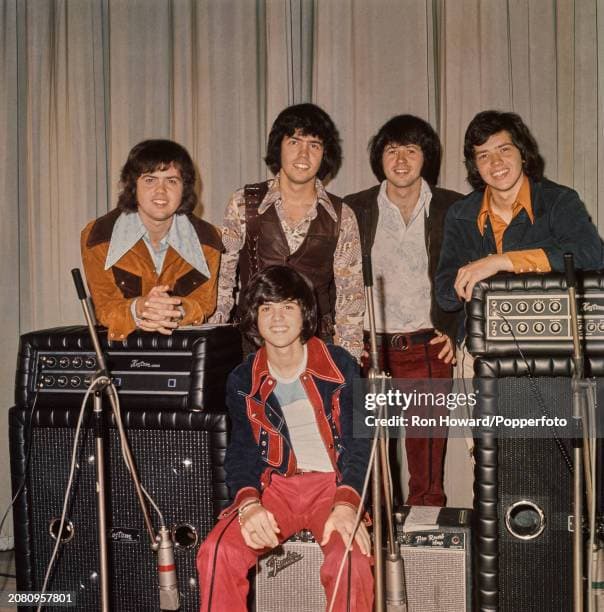
A spiritual rock journey where The Osmonds dared to ask what happens after the battle between good and evil — and turned faith, fear, and hope into one of the most ambitious songs of the 1970s.
When people remember The Osmonds, many immediately think of bright smiles, synchronized harmonies, and upbeat pop hits that dominated radio in the early 1970s. Songs like “One Bad Apple” or “Crazy Horses” often define the group in public memory. But hidden deeper within their catalog lies something far more daring, philosophical, and emotionally weighty: “War In Heaven.” Released as part of the 1973 concept album The Plan, the song remains one of the boldest artistic statements the group ever attempted.
At the time of its release, The Plan was not a conventional commercial project. It was deeply influenced by the spiritual beliefs of Alan Osmond and the group’s commitment to exploring moral and existential themes through music. Unlike their earlier chart-friendly singles, this album leaned heavily into progressive rock, orchestral arrangements, and conceptual storytelling. Although the album itself did not become a massive chart sensation compared to their previous successes, it reached respectable positions internationally and has since developed a strong cult reputation among listeners who appreciate ambitious 1970s albums with substance and emotional depth.
“War In Heaven” was never released as a major standalone hit single in the way some of the group’s earlier records were, so it did not achieve a notable Billboard chart position on its own. Yet over the decades, the song has become one of the most discussed and admired tracks among devoted Osmonds fans — precisely because it revealed a side of the group many people never expected to hear.
Musically, the song feels enormous. There is tension in every corner of the arrangement. The guitars roar with urgency, the percussion drives forward almost like a marching force, and the harmonies carry both anxiety and hope at the same time. Listening to it today, one can hear echoes of the era’s progressive and theatrical rock movements. There are moments that almost resemble the ambition of bands like Yes or The Moody Blues — groups who used rock music not merely for entertainment, but for spiritual and philosophical exploration.
What makes “War In Heaven” especially fascinating is its lyrical perspective. Rather than offering a simple religious message, the song paints a dramatic cosmic struggle between light and darkness, temptation and redemption. It reflects the uncertainty and searching spirit that marked much of the early 1970s. The world was still processing the social upheavals of the previous decade, the lingering shadow of war, cultural transformation, and widespread questioning of traditional values. In that climate, The Osmonds attempted something remarkably sincere: they asked listeners to think about morality, eternity, and human purpose through the language of rock music.
There is also something deeply human beneath the grandeur of the song. Despite its heavenly imagery and dramatic themes, the emotional core feels personal — almost like an internal battle inside every individual. That may be why the track continues to resonate with listeners decades later. The “war” described in the song does not only belong to heaven; it belongs to every conscience struggling between despair and hope.
For many longtime listeners, discovering “War In Heaven” after only knowing the group’s pop hits can feel almost shocking. It reveals how determined Alan Osmond was to push the band beyond the expectations placed upon them by the music industry. He was not content with merely repeating safe formulas. In many ways, The Plan became his artistic manifesto — a project that risked commercial comfort in favor of spiritual and creative honesty.
The production itself also deserves recognition. The layered instrumentation, dynamic tempo changes, and dramatic vocal performances show how much effort the group invested into the album. During a period when many teen idols faded quickly, The Osmonds tried to evolve artistically, even if the mainstream audience did not fully follow them on that journey. Looking back now, that courage feels admirable.
Over time, “War In Heaven” has become one of those hidden treasures of 1970s music — the kind of song rediscovered late at night by listeners who crave albums with deeper emotional and philosophical weight. It belongs to that special category of songs that grow richer with age. Youth may hear its spectacle, but experience hears its questions.
And perhaps that is the enduring beauty of the song.
Beneath the dramatic title, beneath the thunderous instrumentation and spiritual imagery, “War In Heaven” is ultimately about longing for peace — not only in the universe, but within oneself. In an era when so much popular music chased temporary trends, The Osmonds created something strangely timeless: a song unafraid to wrestle with the soul itself.