
A Gentle Ode to Life’s Shifting Shades
In the quiet resonance of “Colours”, Donovan and Joan Baez weave a timeless folk ballad that captures the delicate beauty and transient emotions of youth, love, and hope.
When Donovan released “Colours” in May 1965, it climbed to #4 on the UK Singles Chart, matching the success of his earlier hit Catch the Wind. In the United States it peaked more modestly at #61, yet the song nevertheless became deeply rooted in the folk revival of the 1960s, not only as one of Donovan’s signature compositions, but also through a memorable live performance with Joan Baez.
The story behind the song carries a quiet intimacy. Donovan reportedly wrote “Colours” in just a few minutes. In interviews he reflected on the generation he was speaking to: the uncertain, hopeful young people of the mid‑60s, living in what he described as “my rags and my ideals.” He hoped, through the simplicity of his guitar and gentle lyrics, to reach them—even if only briefly—and let them feel they were understood. (While specific quotes vary, this theme is consistent in discussions of his early career.)
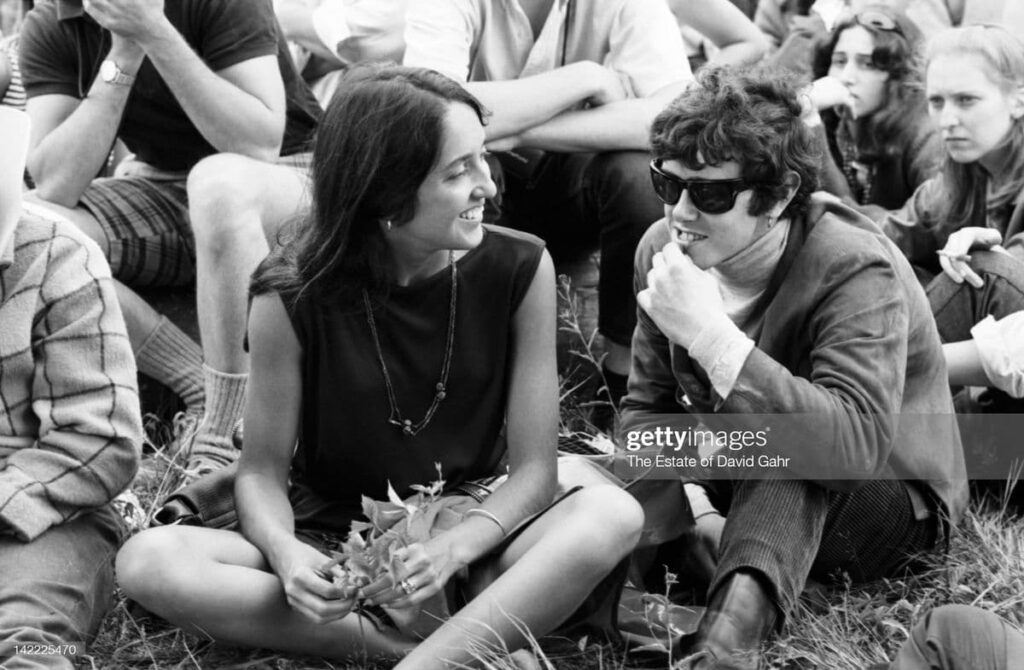
One of the most striking moments in the life of the song came at the 1965 Newport Folk Festival, when Donovan performed “Colours” together with Joan Baez. That duet carried with it not just musical harmony, but a deeper unity of ideals: both artists voices for peace, for social justice, for something beyond mere pop stardom. Baez, already a towering figure in the folk scene, embraced the song so fully that she would later include her own studio version on her 1965 album Farewell, Angelina.
Musically, “Colours” feels like a tender conversation. The melody flows in a simple, lilting folk rhythm; Donovan’s original single features a harmonica, lending a breath of wistful longing. There is a certain purity in the way the lyrics unfold—images of blue of sky, green of leaves, and all the natural palette that life offers—yet beneath the surface lies something more: an existential yearning, an appeal for understanding, for peace, for beauty even amid uncertainty.
To listen to Donovan and Baez’s duet is to step back into a moment in time when folk music was not just art, but a bridge between people. Their voices—his warm, earnest; hers bright, clear—merge into a gentle tapestry of sound, like two streams converging, carrying with them the hope of a better world.
Over the years, “Colours” has remained more than just a charting single. Its emotional resonance has kept it alive in folk circles, covered by other musicians, adapted, revisited. Donovan himself re‑recorded the song in 1968 for his Greatest Hits, because the record label couldn’t secure the rights to the original version. That new studio take featured a fuller backing band, produced by Mickie Most, with Big Jim Sullivan on guitar. Yet many fans still gravitate toward the original—with its raw intimacy and harmonica flutter—and the legendary live Newport rendition with Baez.
The meaning of “Colours” touches on more than just romantic sentiment. In its simple appreciation of nature’s hues, it becomes a metaphor for diversity, for differences in human experience. It calls us to recognise beauty in subtlety and to cherish the fragile, fleeting moments of connection. For listeners who lived through the 60s—and for those who remember that era—the song is also a gentle reminder of a time of social awakening, when artists like Donovan and Baez used their voices not just for fame, but for calling hearts to something more profound.
Listening to “Colours” today is like opening a delicate diary from another era. You hear not just the notes, but the hopes, the innocence, the longing. There is nostalgia there, yes—but also a timeless message: life’s true richness lies in its simple shades, its quiet reflections, and in our willingness to see and feel them.
In that sense, the collaboration between Donovan and Joan Baez on “Colours” remains a gentle beacon—a folk lullaby for the soul, whispering that all the colours of our world matter, and that each one tells a part of our human story.
 Oldies Songs