
A Haunting Meditation on Hope and Disillusion at the Edge of the American Dream
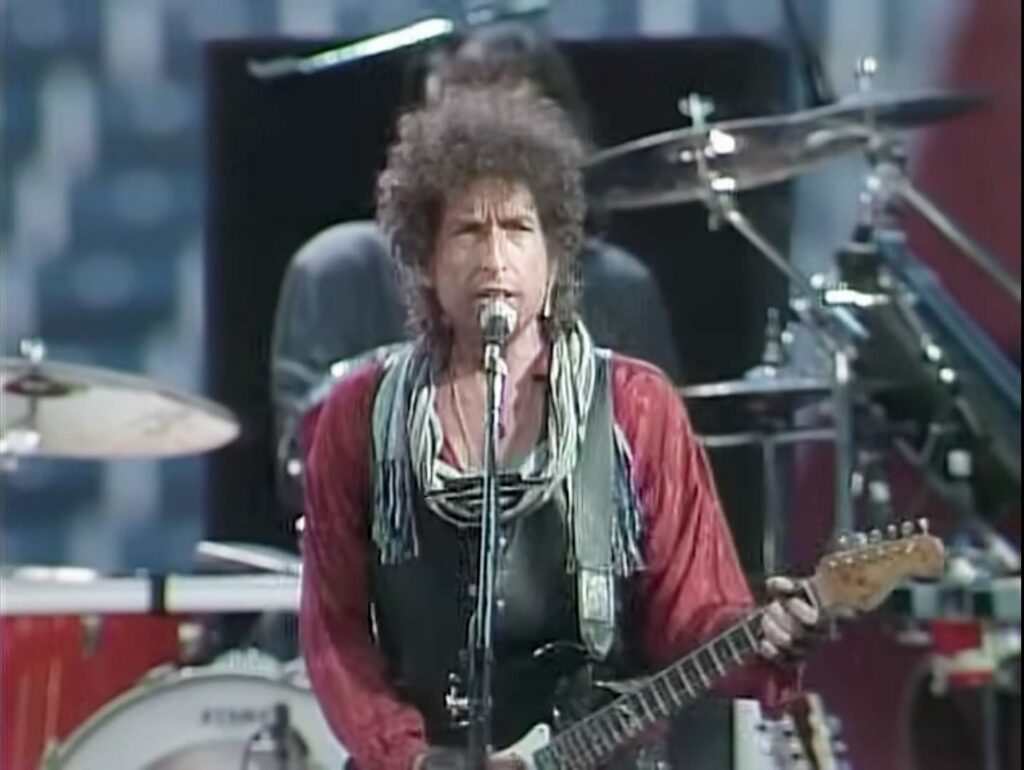
At the 1986 Farm Aid, Bob Dylan delivered a stark and deeply reflective performance of Across the Borderline, a song that captures the fragile boundary between hope and reality. On a stage dedicated to the struggles of American farmers, Dylan’s interpretation carried an added layer of meaning, resonating far beyond its original context.
“Across the Borderline” had already established itself as a powerful narrative about migration, longing, and the elusive promise of a better life. In Dylan’s hands, the song became even more stripped down and contemplative. His voice, raw and weathered, did not aim for perfection. Instead, it leaned into the imperfections, allowing the lyrics to feel immediate and unvarnished.
From the opening lines, the imagery of “streets paved with gold” suggested a dream that has lured countless people forward. Yet as the song unfolded, that dream began to unravel. Dylan emphasized the quiet warnings embedded in the lyrics, the idea that crossing into a promised land often comes at a cost that cannot be undone. His phrasing lingered on key lines, giving space for the weight of those words to settle.
The Farm Aid setting intensified this message. Founded to raise awareness for the hardships faced by rural communities, the concert itself was rooted in themes of survival, displacement, and resilience. Dylan’s performance aligned seamlessly with that purpose. Though the song speaks of geographic borders, its emotional core lies in the universal experience of chasing something just out of reach.
What made this moment particularly striking was its restraint. There was no theatricality, no attempt to elevate the song beyond its natural tone. Dylan trusted the material. He allowed silence, space, and subtle shifts in delivery to carry the emotion. The audience, in turn, responded with a quiet attentiveness, absorbing rather than reacting.
As the final refrain faded, the lingering impression was not one of resolution, but of reflection. The journey described in “Across the Borderline” does not end neatly. It leaves questions behind, about what is gained, what is lost, and what remains when the dream no longer matches reality.
In that performance, Bob Dylan did not offer answers. He offered something more enduring: a moment of truth, shaped by music, memory, and the uneasy distance between hope and what lies on the other side.
 Oldies Songs