
A Timeless Blessing Set to Music — “Forever Young” as a Gentle Prayer for Life’s Journey
Few songs in the vast catalog of popular music carry the quiet weight of a benediction quite like “Forever Young” by Bob Dylan. First released in 1974 on the album Planet Waves, the song was not initially issued as a major commercial single in the United States, and therefore did not achieve a prominent position on the Billboard Hot 100 at the time of its release. However, its enduring power lies far beyond chart placements—it became one of Dylan’s most cherished compositions, later reaching wider audiences through live performances and reinterpretations, including those by Bruce Springsteen, who often infused it with a deeply personal resonance during his concerts.
The origins of “Forever Young” are as intimate as they are universal. Dylan is widely believed to have written the song as a heartfelt message to his eldest son, Jesse. At a time when his life was shifting away from the turbulence of the 1960s into a more grounded, family-oriented phase, the song emerged not as a protest or a poetic riddle, but as something disarmingly direct: a father’s wish for his child’s future. In fact, Dylan recorded two versions of the song for Planet Waves—one slow and hymn-like, the other more upbeat—suggesting that the sentiment itself could live comfortably in both solemn reflection and gentle optimism.
Lyrically, “Forever Young” reads like a series of blessings. “May God bless and keep you always,” Dylan sings, invoking a tone that feels closer to scripture than to conventional songwriting. There is no irony here, no mask—just a sequence of hopes: that one stands upright, remains truthful, and builds a ladder to the stars while keeping one’s feet firmly planted on the ground. These are not grand political statements or abstract philosophies, but simple, enduring values. And perhaps that is why the song has aged so gracefully; it speaks to something fundamental that does not erode with time.
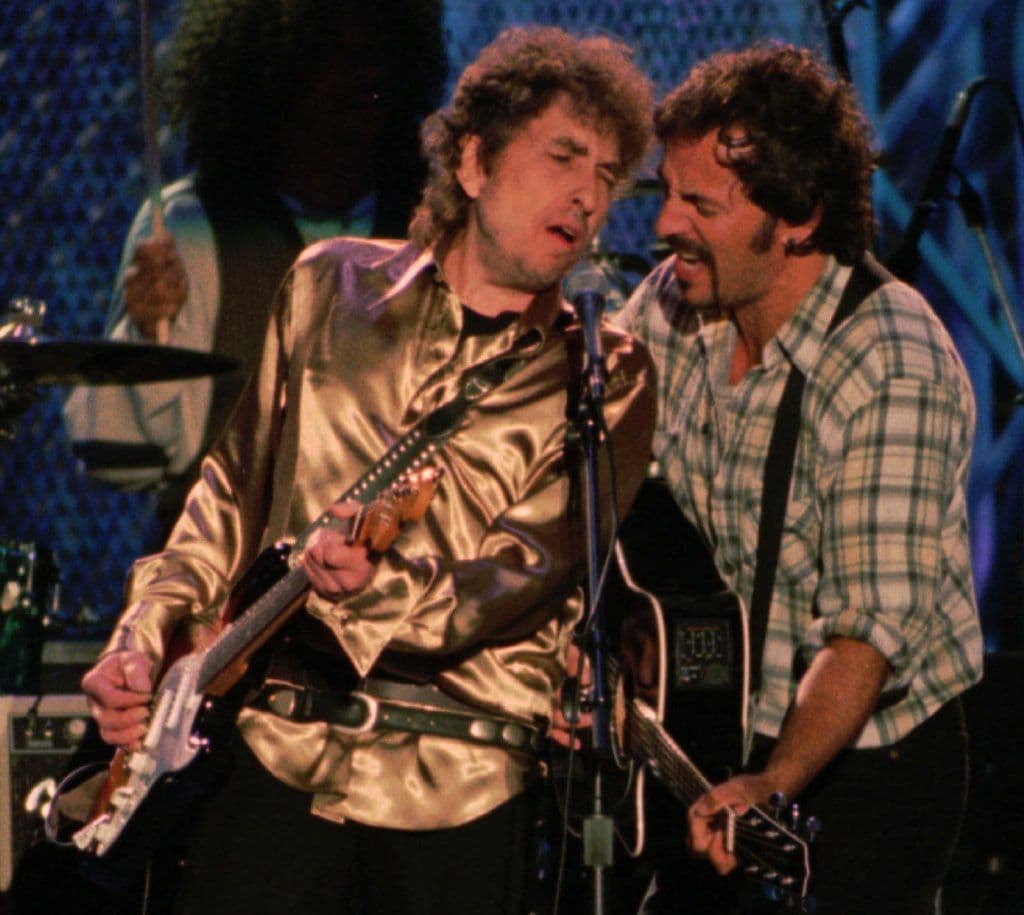
When Bruce Springsteen performed “Forever Young”, particularly in tribute settings or during reflective moments in his shows, he brought with him a different kind of emotional gravity. Where Dylan’s original feels like a quiet whisper, Springsteen’s interpretations often feel like a communal embrace—his voice carrying the weight of shared memory, of lives lived and lessons learned. Though Springsteen never officially released a definitive studio version of the song as a single, his live renditions helped introduce it to a new generation of listeners who may have discovered its meaning later in life.
Over the decades, “Forever Young” has taken on a life far beyond its initial recording. It has been played at weddings, farewells, and memorials—moments where words often fail, but music can still speak. Its meaning shifts subtly depending on the listener: to some, it is a song for children; to others, a reflection on aging; and to many, a reminder that youth is not merely a matter of years, but of spirit.
What makes “Forever Young” so enduring is its sincerity. In an era when Dylan was known for his complexity and elusiveness, this song stands out for its clarity. It does not ask questions—it offers comfort. It does not challenge—it reassures. And in doing so, it becomes something rare in popular music: a song that feels less like a performance and more like a quiet conversation across generations.
Listening to it now, decades removed from its creation, one cannot help but feel a gentle pull toward the past—toward moments when life seemed simpler, or perhaps just more hopeful. And yet, the song does not dwell in nostalgia alone. It reaches forward, extending its blessings into the unknown future, reminding us that no matter how much time passes, the wish to remain “forever young”—in heart, in courage, in kindness—never truly fades.