
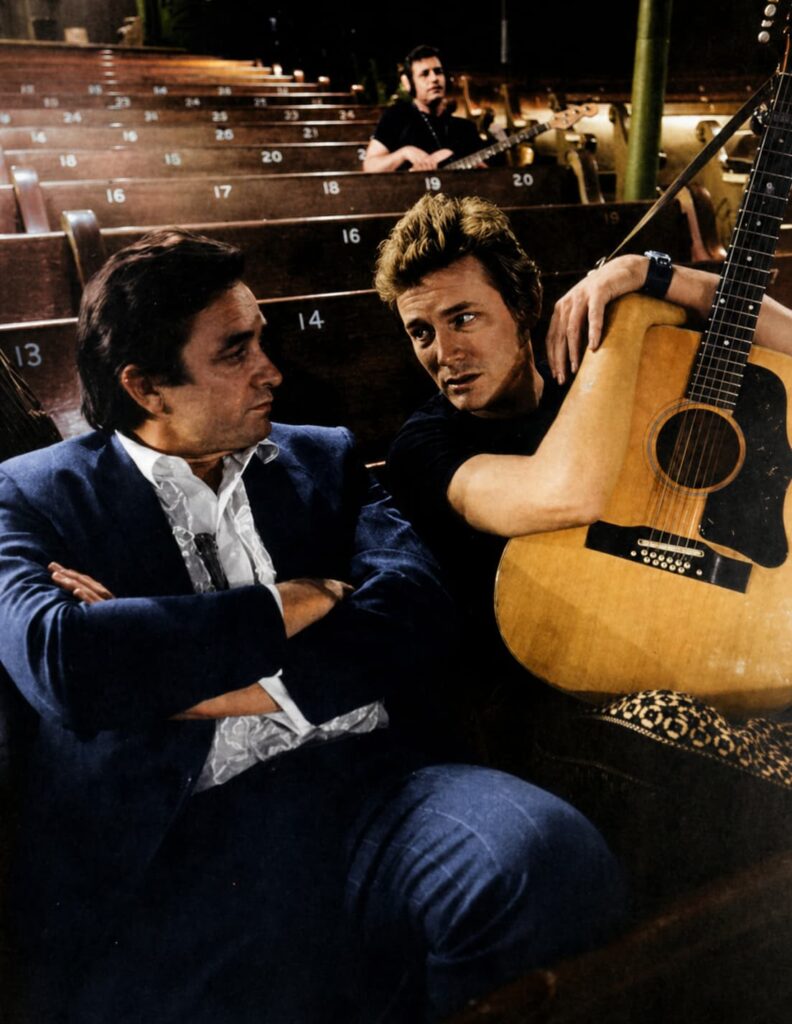
A Quiet Farewell to Love — When Regret Finds Its Voice Too Late
Few songs capture the ache of emotional distance with such stark honesty as “For Lovin’ Me”, a composition by Gordon Lightfoot that found a striking second life through the voice of Johnny Cash. Written in the mid-1960s and first appearing on Lightfoot’s 1966 debut album Lightfoot!, the song did not storm the charts as a major hit in its original form. Yet, its impact was never meant to be measured in numbers alone. It quietly settled into the consciousness of listeners, especially through the many artists who chose to interpret it. Among them, Cash’s version—featured on his 1966 album Happiness Is You—stands as one of the most emotionally resonant.
While neither Lightfoot’s original nor Cash’s rendition achieved high chart positions in the way mainstream pop singles often did, the song gained enduring recognition through its repeated reinterpretations. Artists like Peter, Paul and Mary, whose version reached No. 30 on the Billboard Hot 100 in 1965, helped bring the song to a broader audience. But it is in the contrasting sensibilities of Lightfoot and Cash that the song’s true emotional depth is revealed.
At its heart, “For Lovin’ Me” is a confession—though not the kind that seeks forgiveness. Instead, it is a cold, almost detached acknowledgment of a pattern: a man who leaves just as love begins to take root. “That’s what you get for lovin’ me,” he says, turning the blame outward while quietly exposing his own inability to stay. In Lightfoot’s hands, the song feels introspective, tinged with a kind of quiet sorrow. His gentle phrasing suggests a man aware of his flaws, yet resigned to them.
When Johnny Cash takes on the song, however, something shifts. His deep, weathered voice strips away any lingering softness, replacing it with a stark sense of inevitability. Cash does not merely sing the words—he embodies them. There is no apology in his tone, no hesitation. The departure feels final, almost ritualistic, as if this cycle has repeated too many times to count. In this way, Cash transforms the song from a personal reflection into something more universal: a portrait of emotional restlessness that transcends any single story.
The origins of the song lie in Lightfoot’s early songwriting years, a period marked by prolific creativity and a keen eye for human vulnerability. It was a time when folk music served as a mirror to the complexities of love and identity, and Lightfoot stood among its most thoughtful voices. Unlike many love songs of the era that celebrated devotion, “For Lovin’ Me” dared to explore its opposite—the quiet unraveling that comes not from conflict, but from detachment.
What makes the song endure is not just its melody, but its emotional truth. It speaks to a kind of love that was never meant to last, and to the people who, knowingly or not, are incapable of holding on. There is no dramatic climax, no reconciliation—only the steady rhythm of departure. And perhaps that is why it lingers. Because in its simplicity, it reflects a reality many have known but few have expressed so plainly.
In the end, “For Lovin’ Me” is less about heartbreak and more about recognition—the moment one sees themselves clearly, even if they choose not to change. Through the voices of Gordon Lightfoot and Johnny Cash, the song becomes a quiet companion to those reflective moments, when memory and music intertwine, and the past feels just close enough to touch.