
A Rockabilly Pioneer Reclaims His Fire: Carl Perkins Brings “Matchbox” Back to Life
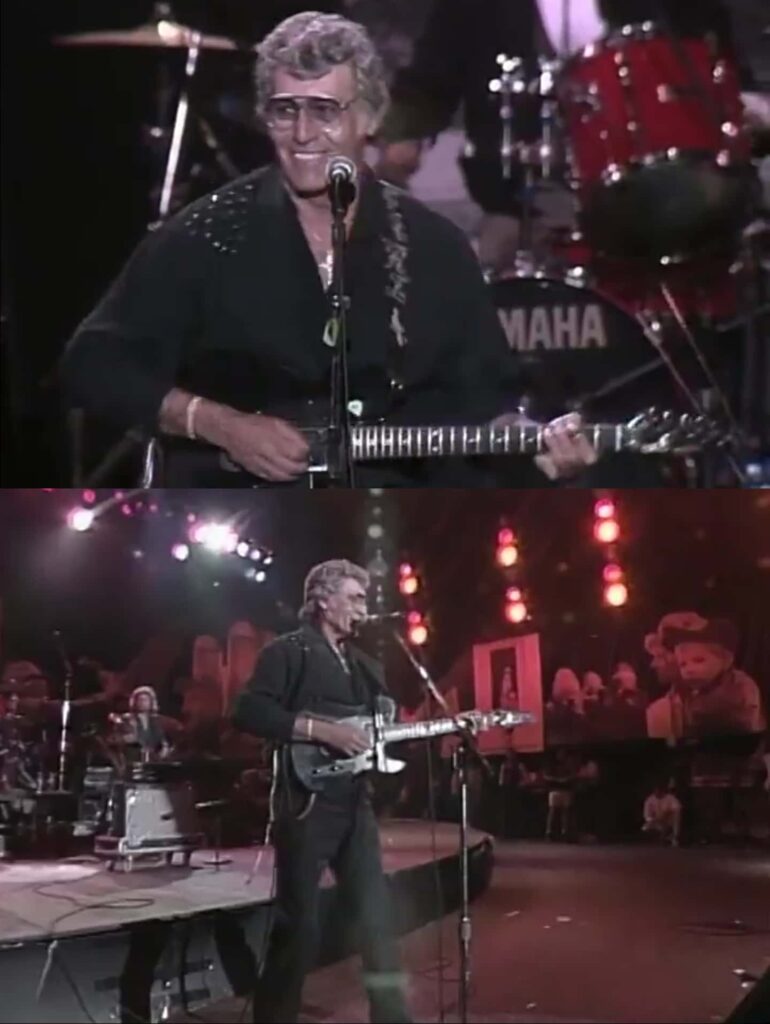
On April 7, 1990, at the Farm Aid concert in Indianapolis, Carl Perkins stepped onto the stage not just as a performer, but as a living cornerstone of rock and roll history. Introduced with reverence, his legacy was already firmly etched into music culture. Elvis Presley had taken “Blue Suede Shoes” to worldwide fame. Johnny Cash had carried his songwriting into another generation. Even The Beatles had recorded his material, helping spread his influence across the Atlantic. Yet on this particular evening, none of that overshadowed the simple truth unfolding on stage. This was Perkins, in his own voice, reclaiming “Matchbox.”
Originally recorded in 1957, “Matchbox” was built on a much older blues foundation, echoing the rural sounds of the American South. By 1990, when Perkins performed it at Farm Aid, the song had traveled decades, but it had lost none of its restless energy. If anything, time had deepened its meaning.
From the first lines, there is a raw, unpolished drive in his delivery. “I ain’t got no matches, but I got a long way to go” is more than a lyric. It feels like a statement of identity. A man still moving forward, regardless of what he lacks. His voice, aged but resilient, carries a kind of lived-in authority that younger artists can only imitate.
What stands out in this performance is the looseness, the sense that the song is not being recreated but relived. The band follows his lead with a steady, rolling groove, allowing Perkins to stretch phrases, lean into rhythms, and inject small bursts of humor and grit. There is a playful edge in lines like “let me be your little dog,” a reminder of the song’s blues roots, where wit and hardship often walk side by side.
For an audience that likely knew his legacy as much as his music, this performance becomes something more than entertainment. It is a reunion with a sound that helped shape modern popular music. And yet, there is nothing nostalgic in the tired sense. Perkins does not treat the song like a relic. He treats it like something still alive, still breathing.
By the final moments, when he repeats that central line about having “a long way to go,” it lands with quiet power. Not as defiance, but as endurance. In 1990, Carl Perkins was no longer chasing success. He was embodying it in the most honest way possible. Still playing, still singing, still moving forward down that long road.