
A Voice That Breaks Without Shattering, Carrying Heartache Into Eternity
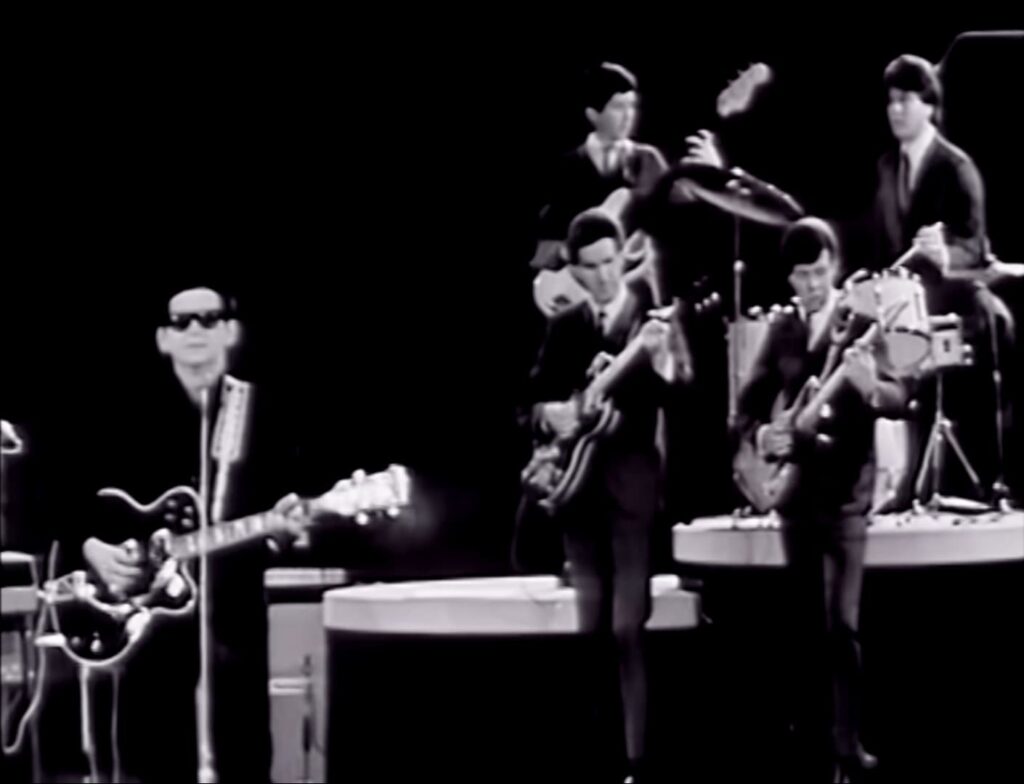
In 1965, during what is often referred to as the Monument Concert era, Roy Orbison delivered a live performance of “Crying” that remains one of the purest expressions of heartbreak ever captured on stage. Originally released in 1961 under Monument Records, the song had already established itself as a defining piece in Orbison’s catalog, reaching high positions on international charts and solidifying his reputation as a master of emotional balladry. But in this live setting, removed from the controlled environment of the studio, “Crying” takes on an even deeper resonance. It becomes less of a recording and more of a lived moment.
From the opening line, there is a quiet vulnerability in Roy Orbison’s voice that feels almost disarming. “I was alright for a while, I could smile for a while” is delivered not as a statement, but as a fragile attempt at reassurance, one that quickly unravels as the story unfolds. For listeners who have carried the memory of lost love across the years, this progression feels painfully familiar. It is not the sudden heartbreak that wounds the most, but the realization that the feeling never truly left.
What sets Orbison apart in this performance is his extraordinary control over dynamics and phrasing. He does not rush the emotion. Instead, he allows it to build slowly, almost imperceptibly, until it reaches those soaring high notes that seem to exist somewhere between strength and collapse. His voice does not crack in the conventional sense. It bends, stretches, and rises, carrying the listener with it. By the time he reaches the repeated refrain of “crying,” the word itself begins to lose its literal meaning and becomes something more elemental, a sound of release, of surrender.
There is also a striking stillness in the way Roy Orbison presents himself. Much like in his other performances, he stands nearly motionless, dressed in dark clothing, hidden partially behind his signature sunglasses. There are no dramatic gestures, no visible attempt to perform the pain. And yet, the emotion is overwhelming. This contrast between restraint and intensity is what gives “Crying” its lasting power.
For older audiences, especially those who grew up in the early 1960s, this performance carries an added layer of memory. It recalls a time when songs were allowed to linger, when heartbreak was not rushed to resolution. In “Crying”, there is no closure, no comforting conclusion. The love remains unreturned, the feeling unresolved.
Looking back now, this 1965 live rendition stands as one of the clearest examples of Roy Orbison’s unique gift. He did not simply sing about heartbreak. He gave it shape, voice, and space to exist. And in doing so, he created something timeless, a song that does not fade with the years, but deepens, quietly, with every listen.