
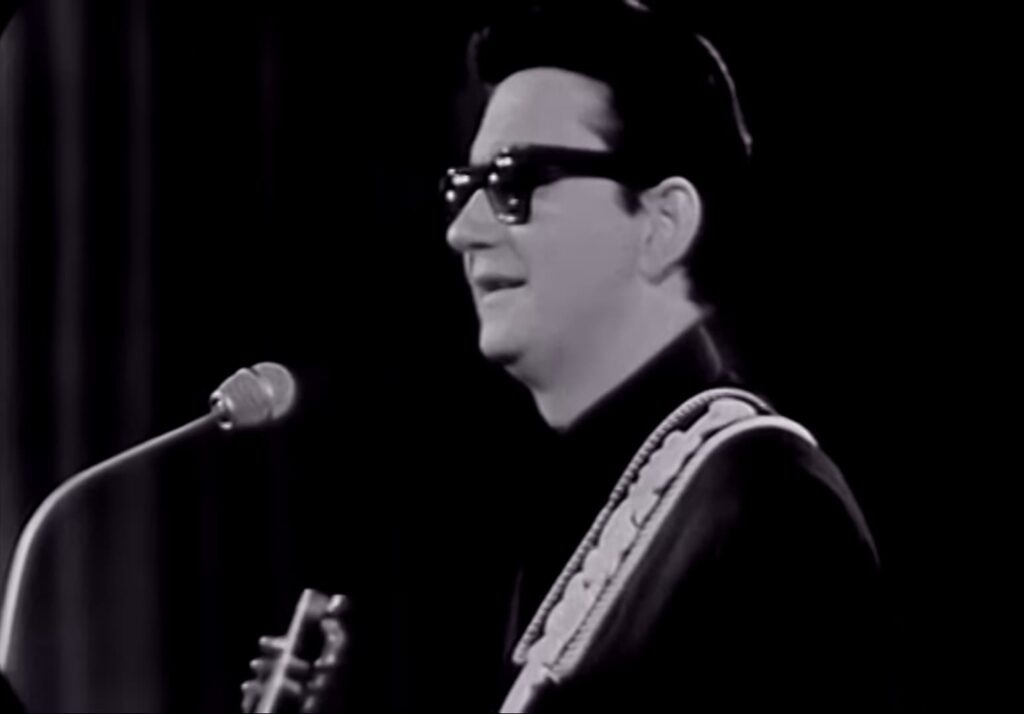
When Roy Orbison Let Loose: A Rare Moment Where “What’d I Say” Turned Precision into Pure Energy
In 1965, at the Monument Concert, Roy Orbison stepped briefly outside the sound that made him famous and delivered an electrifying performance of “What’d I Say.” Originally written and popularized by Ray Charles, the song was already a cornerstone of rhythm and blues. But in Orbison’s hands, it became something unexpected. A controlled explosion of energy from an artist better known for restraint.
From the opening moments, the atmosphere shifts. The familiar Orbison stillness gives way to movement, rhythm, and a playful looseness rarely seen in his performances. The band locks into a driving groove, and Orbison responds with a vocal delivery that feels freer, almost conversational. It is not about vocal perfection here. It is about feel, timing, and connection.
As the song builds, the call-and-response structure takes over. Orbison leans into repetition, urging the energy higher with each refrain. Lines like “tell me what’d I say” are not just lyrics. They become cues, invitations for the audience to join in. The performance grows organically, louder and more animated, yet never chaotic. There is still discipline beneath the surface.
What makes this moment particularly striking is the contrast it creates within Orbison’s broader catalog. Known for songs like “Crying” and “Only the Lonely,” he rarely ventured into this kind of raw, rhythmic territory on stage. Yet here, he proves his versatility without abandoning his identity. Even in a high-energy R&B number, his phrasing remains deliberate, his tone unmistakable.
The audience response reflects this shift. What begins as attentive listening turns into audible excitement. Applause and cheers rise as the tempo and intensity increase. By the final moments, the performance feels less like a recital and more like a shared experience, driven equally by performer and crowd.
In retrospect, this 1965 rendition of “What’d I Say” stands as a fascinating counterpoint in Orbison’s career. It reveals an artist fully capable of stepping beyond his established image, embracing spontaneity without losing control.
And perhaps that is why it lingers. Not because it defines him, but because it shows another side. A reminder that even the most composed voices can, at the right moment, choose to let go and simply play.