
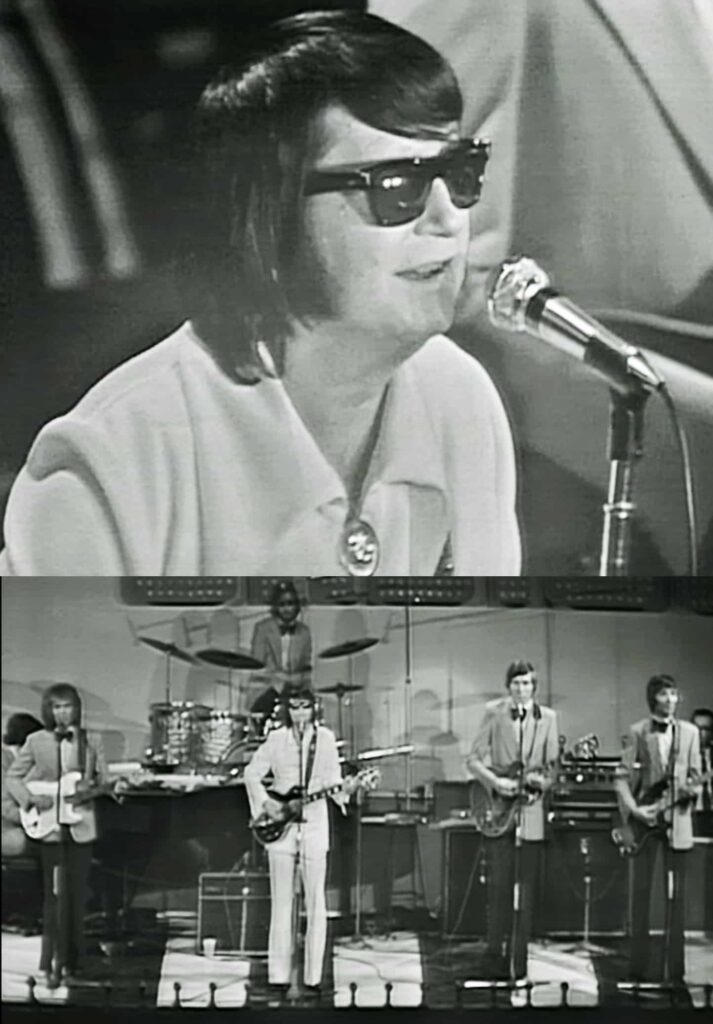
A Voice That Carries You Home: How “Blue Bayou” Became a Living Memory on Stage in 1972
In 1972, during his Australian tour, Roy Orbison delivered a live performance of “Blue Bayou” that quietly reaffirmed his unmatched vocal authority at a time when popular music was rapidly evolving. Recorded as part of Live From Australia, 1972, the performance captures Orbison in a phase of artistic resilience, standing apart from trends and leaning fully into the emotional clarity that defined his career.
Originally released in 1963, “Blue Bayou” had already established itself as one of Orbison’s most evocative recordings. But on this stage, nearly a decade later, the song took on a different dimension. The arrangement remained faithful, yet the passage of time had deepened its meaning. Orbison’s voice, still remarkably controlled, carried a slightly heavier emotional timbre, suggesting not just longing, but experience.
The setting itself was modest. There were no elaborate stage effects or distractions. What held the audience was the precision of his phrasing and the almost operatic rise of his tenor. Each note felt measured, intentional, and anchored in the storytelling tradition that Orbison never abandoned. The audience response was attentive rather than explosive, a sign of quiet reverence rather than spectacle.
What distinguishes this performance is the way Orbison navigates vulnerability without losing composure. The song’s central theme, a yearning for return and belonging, becomes more than narrative. It feels lived-in. His delivery does not push emotion outward. Instead, it unfolds gradually, allowing the listener to settle into its atmosphere.
In retrospect, this 1972 rendition stands as more than a live recording. It is a document of continuity. While the music industry shifted toward louder and more immediate forms of expression, Orbison remained committed to structure, melody, and emotional precision.
That is why this performance endures. Not because it is louder or grander than others, but because it preserves something increasingly rare: a moment where a voice, a song, and a feeling align perfectly, without the need for anything more.