
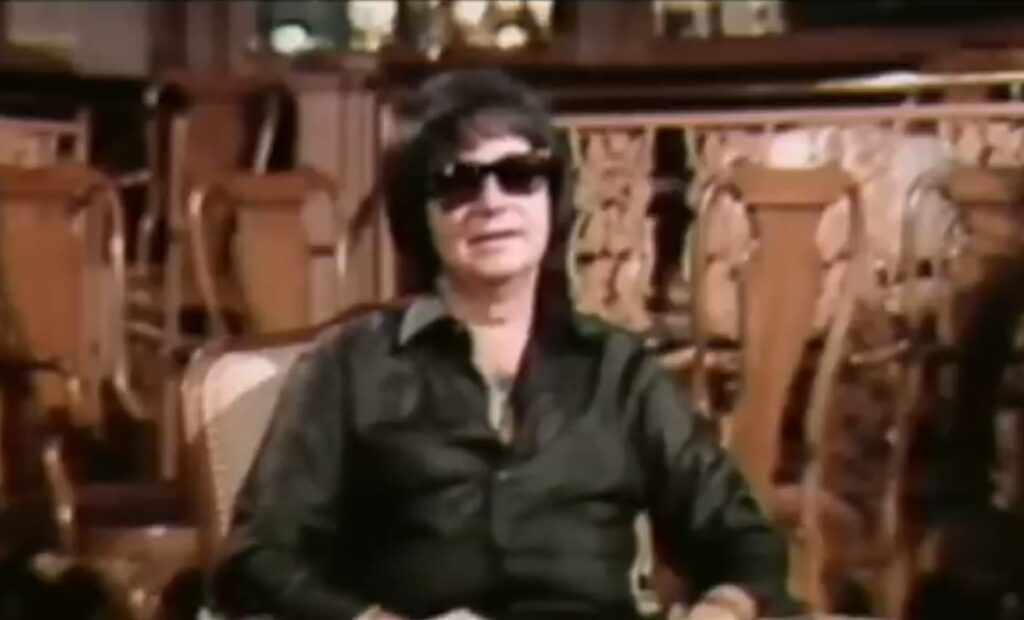
THE DAY ROY ORBISON WROTE “OH, PRETTY WOMAN” IN JUST 30 MINUTES… BEFORE THE BEATLES TOOK OVER THE AIRWAVES
By 1964, Roy Orbison was already one of the most respected voices in popular music, known for operatic heartbreak ballads like “Only the Lonely,” “Running Scared,” and “It’s Over.” His dark sunglasses, trembling vibrato, and lonely melodies had created a style unlike anyone else in rock and roll. But even Orbison understood that the music world was changing rapidly. The British Invasion was beginning to reshape radio forever, and a new wave led by The Beatles was about to dominate the airwaves.
Then, almost casually, Orbison created one of the most recognizable songs in music history.
In this wonderfully relaxed interview, Roy Orbison recalls how “Oh, Pretty Woman” came together with astonishing speed. He had gone into the studio needing an uptempo hit after the success of “It’s Over,” his first major number one in both America and England in years. Record executives wanted something energetic, something immediate. Orbison listened.
What happened next became legend.
According to Orbison, the song took only about thirty minutes to write. With his usual dry humor, he added, “All the good ones don’t take long. The bad ones take about six months.” It is the kind of simple remark only a master songwriter could make. There is no grand mythology in the way he tells the story. No dramatic lightning strike. Just instinct, timing, and experience.
And perhaps that is exactly why the song worked so perfectly.
Unlike Orbison’s earlier ballads filled with emotional vulnerability, “Oh, Pretty Woman” exploded with swagger and rhythm from the very first guitar riff, which Orbison proudly remembered playing himself in the studio. The song sounded confident, playful, and alive. Yet underneath that upbeat energy was still the unmistakable voice of Roy Orbison, carrying just enough longing to make the song feel human rather than merely catchy.
Listening to him describe the release strategy decades later is equally fascinating. Orbison immediately sensed the urgency of the moment. He warned the record company not to delay because The Beatles were about to arrive in America for another tour. “The airwaves will be taken up,” he predicted.
That single comment captures how quickly the music industry was evolving during the mid-1960s. Even artists as successful as Roy Orbison understood that popular music had become a race against time and attention. But Orbison’s instincts proved exactly right. The record was rushed out within days and, within three weeks, “Oh, Pretty Woman” was the number one song in both America and England.
For older listeners, there is something deeply nostalgic about hearing Orbison recount this story so modestly. Today, songs are often introduced with marketing campaigns, streaming strategies, and endless promotion. But in 1964, a timeless classic could still emerge from a half-hour burst of inspiration inside a recording studio.
And what a classic it became.
More than sixty years later, that opening guitar figure still stops people in their tracks. The song crossed generations, survived changing musical eras, and became permanently woven into popular culture. Yet Orbison s
Perhaps the most touching moment comes at the very end when he notes that the last artist to achieve a simultaneous number one in America and England before him was “my good friend Elvis.”
That small remark says a great deal about Orbison himself. Even while discussing one of the biggest records of his life, he still paused to honor another legend. There was never arrogance in Roy Orbison’s storytelling. Only gratitude, quiet confidence, and the wisdom of someone who understood how rare true success really was.
And maybe that is why “Oh, Pretty Woman” still feels so alive today.
It was not manufactured in a boardroom or calculated by trends. It came from talent meeting the perfect moment, written quickly by a man who already knew exactly who he was.