
When Roy Orbison Sang “Oh, Pretty Woman” In The 1980s, Time Suddenly Rolled Back To The Golden Age Of Rock And Roll
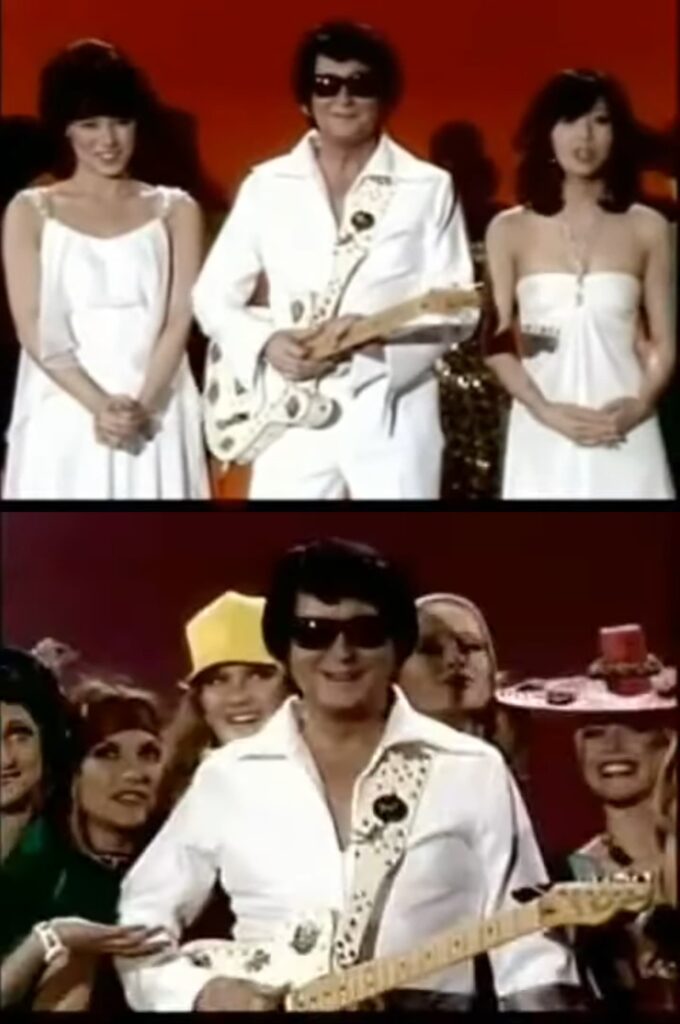
By the time Roy Orbison appeared on the television program Pink Lady and Jeff in the early 1980s, popular music had changed dramatically.
Disco lights filled television studios. Synthesizers dominated radio. New wave artists were rapidly reshaping the sound of mainstream entertainment. Yet the moment Orbison stepped forward to perform “Oh, Pretty Woman,” none of that seemed to matter anymore.
For a few magical minutes, the clock turned backward.
Dressed in black with his signature dark sunglasses, Roy Orbison carried the same mysterious presence that had made him one of the most unforgettable voices of the 1960s. Unlike many rock stars who relied on movement or flashy charisma, Orbison hardly needed to do anything at all. The moment he opened his mouth, the performance belonged entirely to him.
And that voice still sounded extraordinary.
Originally released in 1964, “Oh, Pretty Woman” had already become one of the defining songs of early rock and roll. Written by Roy Orbison and Bill Dees, the song exploded to No. 1 around the world with its instantly recognizable guitar riff and playful energy. But what truly separated the record from countless other hits of the era was Orbison’s remarkable ability to combine strength and vulnerability inside the same performance.
Even decades later, that emotional magic remained untouched.
The television setting itself added an unusual charm to the moment. Pink Lady and Jeff, hosted by Japanese pop duo Pink Lady alongside comedian Jeff Altman, existed during one of television’s stranger eras, where international variety shows mixed comedy sketches, celebrity appearances, and live musical performances into wonderfully unpredictable entertainment.
Yet amid all the bright studio energy and variety-show atmosphere, Orbison stood almost motionless, calm and dignified, letting the song carry the entire performance.
And it did.
From the opening “Pretty woman, walking down the street,” the audience instantly recognized they were witnessing one of rock music’s truly immortal songs. The performance carried none of the desperation artists sometimes show when revisiting old hits. Orbison never chased nostalgia. He simply sang the song honestly, trusting its timeless melody and emotional pull.
That confidence came from the strength of the material itself.
Unlike many upbeat rock songs from the 1960s, “Oh, Pretty Woman” contains surprising emotional depth beneath its playful exterior. Orbison always sang as though the woman passing by represented something larger than simple attraction. In his voice, admiration carried loneliness. Hope carried uncertainty. Even joy sounded slightly fragile.
That emotional complexity became Roy Orbison’s signature throughout his career.
Songs like “Crying,” “Only the Lonely,” and “In Dreams” revealed a performer unafraid to sound wounded or emotionally exposed during an era when male rock singers often projected toughness above all else. Orbison instead built his entire legacy around vulnerability, heartbreak, and longing.
And audiences loved him for it.
Watching this performance now feels especially moving because Orbison belonged to a generation of artists who carried themselves with remarkable humility. There was no arrogance in the way he performed. No attempt to overpower the room. Just extraordinary musicianship and complete faith in the emotional truth of a song.
By the early 1980s, Roy Orbison had already endured difficult personal tragedies and major career ups and downs. Yet performances like this quietly reminded audiences that truly great artists never disappear completely. They simply wait for the right song, the right room, and the right moment to reconnect with people again.
And when Roy Orbison sang “Oh, Pretty Woman,” that connection still felt immediate.
The audience smiled. The studio came alive. For a few brief minutes, viewers were transported back to jukeboxes, drive-in nights, transistor radios, and a generation that first fell in love with rock and roll when songs still sounded innocent, hopeful, and impossibly alive.
Because some voices never really age.
They simply carry their memories forward with them.