
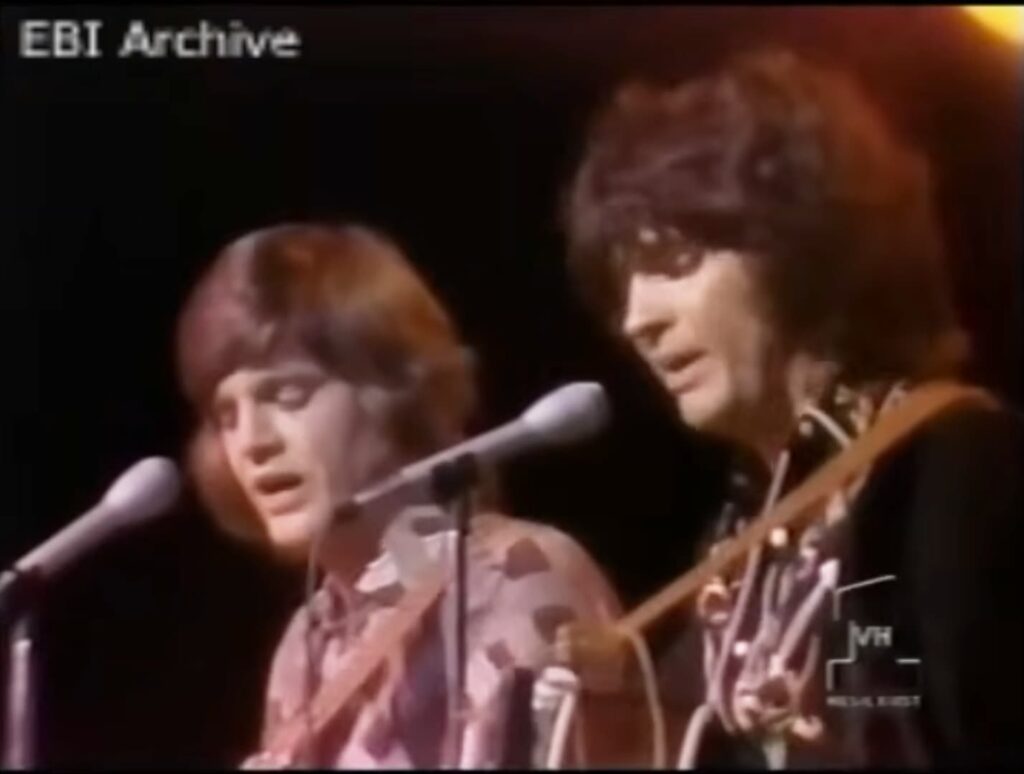
A Last Moment of Perfect Harmony: The Everly Brothers Look Back While the Future Quietly Slips Away
In August 1972, viewers tuning in to the debut episode of The Midnight Special witnessed more than just another television performance. They were watching two pioneers of rock and roll standing at a crossroads they could not yet see. Introduced by John Denver, The Everly Brothers took the stage to perform two songs that seemed to summarize their entire journey: the youthful dream of “All I Have to Do Is Dream” and the reflective wisdom of “Stories We Could Tell.”
Denver’s introduction set the tone perfectly. Referring to a famous Sunset Strip billboard promoting the brothers’ latest album, he quoted the memorable slogan: “If they could turn your parents on, they can wipe you out.” It was a playful acknowledgment of the duo’s extraordinary influence. By 1972, Don and Phil Everly were no longer simply hitmakers from the golden age of rock and roll. They had become living architects of popular music whose harmonies had inspired generations of artists, from folk singers to country stars and rock bands.
What makes this performance so fascinating today is its place in history. Just one year later, the brothers would suffer their famous onstage breakup during a concert at Knott’s Berry Farm, bringing their original partnership to a dramatic and painful end. Viewed through that lens, this appearance now feels like a poignant snapshot of two musicians still finding magic together before the curtain temporarily fell.
The opening selection, “All I Have to Do Is Dream,” instantly transported audiences back to 1958. The song remains one of the most beloved recordings of the rock and roll era, and hearing it performed in 1972 revealed how little the brothers’ vocal chemistry had faded. Their harmonies still blended with remarkable ease, creating the same dreamy atmosphere that had captivated listeners more than a decade earlier. It was a reminder that some musical partnerships possess a kind of timelessness that survives changing trends and passing years.
Yet it was the second song that carried the deepest emotional weight. Drawn from their then-current album Stories We Could Tell, the title track offered a very different perspective from the innocence of their early hits. Written by John Sebastian, the song reflects on life spent chasing music across highways, stages, hotel rooms, and countless miles of road.
As Don and Phil sang about old guitars covered in scratches, forgotten melodies, and the endless cycle of touring, the lyrics felt less like a performance and more like a shared conversation. There was no trace of youthful fantasy here. Instead, there was experience, memory, and a quiet understanding of the sacrifices hidden behind a life in music.
One verse recalls sitting on a hotel bed and sharing stories after another long night on the road. Another reflects on a battered guitar whose scars tell their own history. These images resonated because they mirrored the brothers’ own journey. By 1972, they had already experienced enormous success, changing musical fashions, industry pressures, and personal tensions that few outsiders fully understood.
What makes the performance so moving today is the contrast between the two songs. “All I Have to Do Is Dream” celebrates youthful longing and possibility. “Stories We Could Tell” looks backward, acknowledging the miles traveled and the memories accumulated along the way. Together, they form a musical bridge between who the Everly Brothers were and who they had become.
Following the deaths of both Don and Phil, this appearance has taken on an even deeper significance. It now feels like a preserved moment in time, capturing two brothers whose voices remained inseparable even as their personal relationship grew increasingly fragile.
More than fifty years later, the performance stands as one of the finest documents of The Everly Brothers during their later years. It is not merely a concert clip. It is a living memory of two musical legends reflecting on their past while unknowingly approaching one of the most difficult chapters of their remarkable story. For anyone who loves the history of American music, it remains an unforgettable reminder that sometimes the most powerful stories are the ones artists tell without ever speaking them aloud.