
In New Orleans, Allen Toussaint and Bonnie Raitt Found the Most Beautiful Answer to a Lifelong Question: What Is Success?
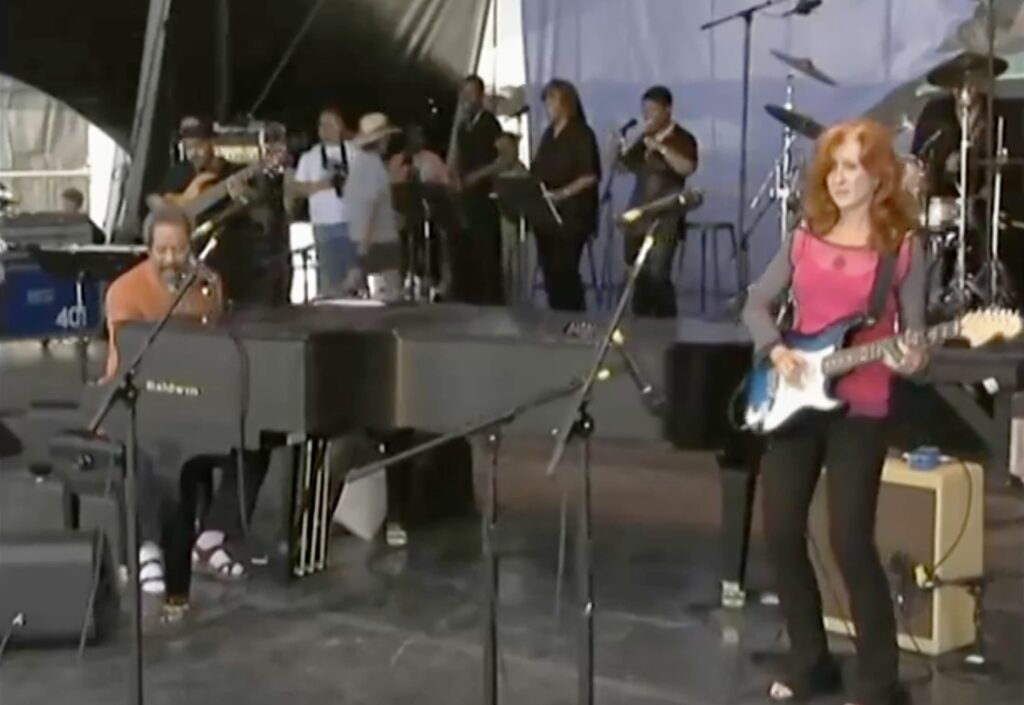
At the New Orleans Jazz & Heritage Festival in 2000, two of America’s most respected musicians shared a stage and transformed a thoughtful song into something even more profound. When Allen Toussaint welcomed Bonnie Raitt to join him on “What Is Success,” the performance became more than a duet. It became a reflection on legacy, friendship, admiration, and the meaning of a life spent making music.
The title itself invites contemplation. “What Is Success?” is not merely the name of a song. For many listeners, it feels like a question Allen Toussaint spent much of his career exploring.
By the time he wrote the song in the early 1970s, Toussaint was already one of the most influential figures in American music. As a songwriter, producer, arranger, and pianist, he helped shape the sound of New Orleans rhythm and blues. Yet unlike many artists whose names dominated marquees and magazine covers, Toussaint often worked behind the scenes. His fingerprints were everywhere, even when his face was not.
That reality gives the song a deeply personal quality. The question at its center seems almost autobiographical. Is success measured by fame, record sales, and awards? Or is it measured by influence, respect, and the ability to leave something meaningful behind?
Standing beside him at Jazz Fest was an artist who offered part of the answer.
Bonnie Raitt was not a random guest star. For decades, she had admired Toussaint’s songwriting and regularly performed his material. Her appearance carried the warmth of a longtime admirer sharing the stage with one of her musical heroes. Watching the performance today, it becomes clear that she was not there to command attention. She was there to celebrate a man whose work had shaped her own musical journey.
That spirit of mutual respect gives the performance its emotional power.
The setting could not have been more appropriate. New Orleans was not simply Toussaint’s hometown. It was the city woven into every chapter of his career. While many artists leave home in pursuit of success, Toussaint became a cultural icon precisely because he remained connected to the city that inspired him. Performing “What Is Success” in New Orleans felt less like a concert appearance and more like a homecoming.
Musically, the pairing was fascinating. Toussaint represented the rich traditions of New Orleans rhythm and blues, soul, and funk. Raitt brought the language of blues, roots rock, and Americana. On paper, they seemed to come from different worlds. On stage, those differences disappeared. Their voices, instruments, and instincts met effortlessly in a shared tradition of authentic American music.
Looking back today, the performance carries an even deeper emotional resonance. Audiences in 2000 saw a living legend at the piano, guiding the song with his trademark grace and understated confidence. Modern viewers watch with the knowledge that Allen Toussaint would pass away in 2015, making moments like this feel increasingly precious.
The video now serves as a reminder of everything that made him special. The elegance. The humility. The quiet authority. The ability to make every note feel meaningful.
Perhaps the most moving aspect of the performance is that it seems to answer its own question. Success is not always found in chart positions or trophy cases. Sometimes it is found in the respect of fellow artists. Sometimes it is found in the opportunity to return home and share a song with people who understand its meaning. And sometimes it is found in a moment when a musician looks across the stage and sees that his work has inspired generations that followed.
On that warm New Orleans afternoon, Allen Toussaint and Bonnie Raitt offered a beautiful definition of success. It was not spoken. It was played, sung, and felt. More than twenty-five years later, the answer still echoes through every note of “What Is Success.”