
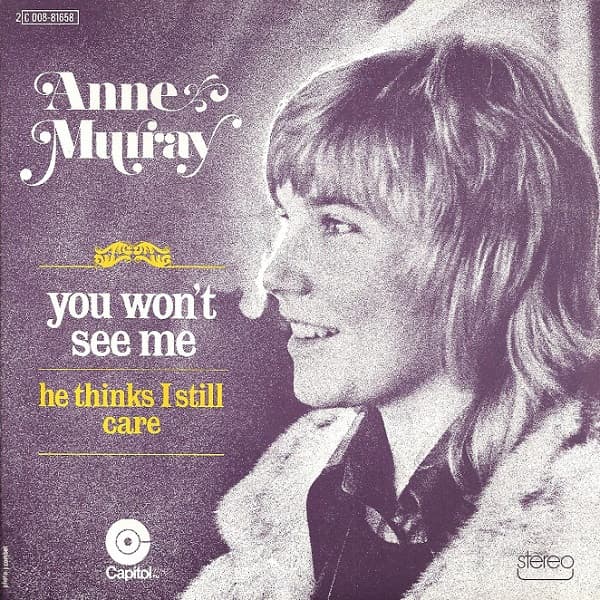
A Gentle Heartbreak Wrapped in Warm Country-Pop Grace, Anne Murray’s “You Won’t See Me” Turned Quiet Frustration Into One of the Softest Yet Saddest Hits of the 1970s
When Anne Murray released “You Won’t See Me” in 1974, she did something very few artists could truly accomplish: she took a beloved Beatles song and transformed it into something entirely her own. Originally written by Paul McCartney and released by The Beatles on their landmark 1965 album Rubber Soul, the song had already carried the unmistakable emotional tension of Lennon and McCartney’s songwriting. But in Anne Murray’s hands, it became softer, lonelier, and somehow even more human.
Released as a single from her album Love Song, Anne Murray’s version climbed to No. 8 on the Billboard Hot 100 in the United States and reached No. 1 on the Adult Contemporary chart in early 1975. In Canada, where Murray had already become one of the nation’s most treasured voices, the song also performed strongly and further solidified her reputation as one of the defining crossover artists of the decade. At a time when country music and pop music were slowly learning how to coexist on mainstream radio, Anne Murray stood in the middle of both worlds with remarkable elegance.
What made her recording so memorable was not power or dramatic vocal acrobatics. It was restraint.
Anne Murray never sang as if she were trying to impress anyone. Her voice carried calmness, patience, and emotional maturity. On “You Won’t See Me,” that quality became the song’s secret weapon. The frustration in the lyrics never exploded into anger. Instead, it lingered quietly beneath the surface, sounding like someone sitting alone late at night, replaying unanswered conversations in their mind.
“When I call you up, your line’s engaged
I have had enough, so act your age…”
Those lines, simple as they may seem, captured a kind of emotional exhaustion that many listeners immediately recognized. Long before texting, social media, or instant replies, there was the painful silence of waiting near a telephone, wondering if someone still cared enough to answer. That feeling runs deeply through the song. It is not about dramatic betrayal. It is about distance slowly growing between two people who once understood each other perfectly.
The story behind the original Beatles recording adds another layer of melancholy. Paul McCartney reportedly wrote the song during a difficult period in his relationship with actress Jane Asher. According to McCartney, he felt ignored and emotionally shut out, and the song became an outlet for those frustrations. Even within the groundbreaking brilliance of Rubber Soul, “You Won’t See Me” stood out because it sounded unusually vulnerable. Beneath its upbeat rhythm was genuine emotional confusion.
Nearly a decade later, Anne Murray approached the song from an entirely different emotional angle. Where The Beatles version moved with youthful energy and subtle irritation, Murray’s interpretation felt reflective and weary, as if the pain had settled into acceptance. Her phrasing slowed the emotional pulse of the song. Every line sounded lived-in.
That was one of Anne Murray’s greatest gifts as an interpreter of songs. She understood that heartbreak does not always arrive loudly. Sometimes it comes quietly, through small disappointments repeated over time. A missed call. A delayed reply. A conversation avoided. A growing realization that affection is fading.
By the mid-1970s, Anne Murray had already become internationally famous through hits like “Snowbird,” “Danny’s Song,” and “A Love Song.” Yet “You Won’t See Me” showed another side of her artistry. It proved she could take material written by the biggest band in the world and filter it through her own emotional identity without losing the song’s soul.
The production itself remains beautifully understated even today. The warm electric piano, the gentle rhythm section, the smooth harmonies — nothing feels excessive. The arrangement leaves room for the emotion to breathe. In many ways, it represents the sound that defined adult contemporary radio during the 1970s: polished, melodic, sincere, and deeply comforting.
There is also something timeless about the song’s emotional message. Relationships often do not collapse in one dramatic moment. More often, they slowly erode through silence and emotional absence. “You Won’t See Me” understands that painful truth better than many grand love ballads ever could.
Listening to Anne Murray sing it now feels almost like opening an old photograph album. The emotions remain familiar even after decades have passed. The production carries the warmth of another era, yet the loneliness inside the lyrics still feels immediate. That is why the song continues to endure. Not because it shouts, but because it quietly remembers.
And perhaps that is why Anne Murray’s version still resonates so deeply today. In a world that often moves too fast and speaks too loudly, her voice reminds listeners of a gentler emotional honesty — the kind that lingers long after the music fades into silence.