
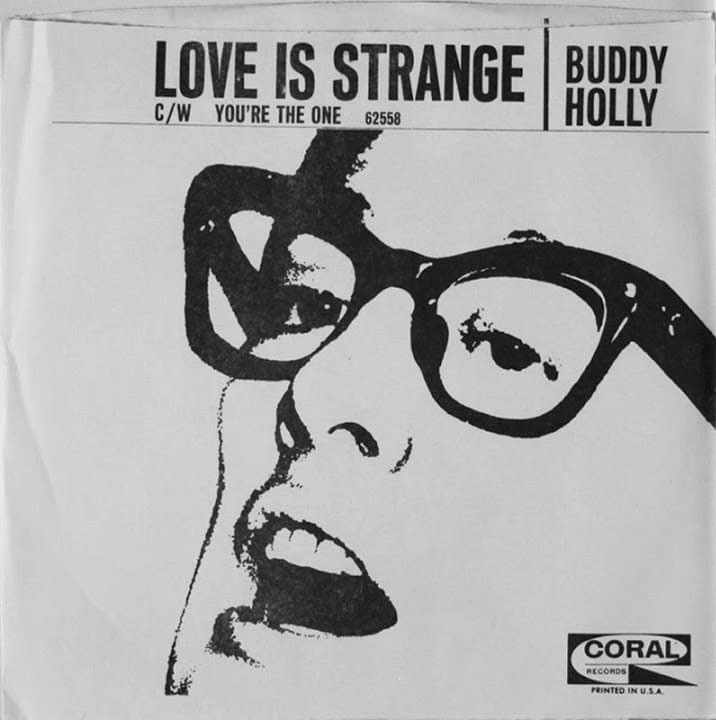
“Love Is Strange” a quietly haunting echo of longing and love’s strange mysteries
When you hear Buddy Holly’s version of “Love Is Strange”, you sense at once that this is more than a simple cover it is a whisper from a past era, a soft farewell from a voice lost too soon, and a bridge between the R&B roots of the 1950s and the rock-and-roll spirit that defined a generation.
Though “Love Is Strange” was originally a hit song by Mickey & Sylvia in late 1956 topping the R&B singles chart and reaching #11 on the Billboard Hot 100 in March 1957. Buddy Holly’s take on the song was recorded later and released only after his death, on his posthumous album Giant (1969). On the charts, Holly’s version never gained the same mainstream success it reached only the “Bubbling Under Hot 100” (around #105) and found modest reception on Canada’s RPM chart at #76.
But numbers don’t tell the full story. The true significance of Holly’s version lies in the atmosphere he created one of wistful tenderness, of memories lingering in the air.
🎶 The story behind the song
Originally, “Love Is Strange” was built on a guitar riff by Jody Williams, later turned into the song by Bo Diddley (credited under the name of his then-wife, Ethel Smith). The earliest version was recorded by Diddley himself in May 1956 though it remained unreleased until decades later.
It fell to Mickey & Sylvia to give the song its iconic voice: recorded October 17, 1956, their rendition introduced the now-famous spoken-word exchange (“Sylvia!” / “Yes, Mickey.” / “Come here, Lover Boy!”) a playful, intimate dialogue between two lovers, before drifting into the melodic chorus. That charming interplay, plus the upbeat guitar and sax backing, captured audiences’ hearts and made the song a crossover hit.
Over the years, “Love Is Strange” has been covered many times by country acts, soul duos, and rock artists. But perhaps none of those versions carries quite the same bittersweet aftertaste as the one by Buddy Holly.
Buddy Holly’s version a haunting echo
Buddy Holly recorded his version around 1959 shortly before his tragic plane crash on February 3 that year. Yet, like so many of his final efforts, it remained in the vault unreleased until 1969, when the album Giant compiled various overdubbed recordings.
When you listen to Holly’s “Love Is Strange”, you hear a gentler tempo, a slightly more reflective tone the youthful energy of the original mellowed by time, or perhaps by destiny. The melody drifts, the voice resonates with a softness, almost like he’s singing directly to you across decades. It’s not meant to chart or dominate the airwaves it’s meant to linger, to evoke memories.
In that sense, Holly’s version becomes a kind of elegy: not of himself, but of a moment in music history when R&B, rockabilly, and rock-and-roll were intermingling, evolving when songs like this carried both innocence and emotional weight.
A final thought for those who remember
If you close your eyes and let the gentle strumming and soft voice of Buddy Holly’s “Love Is Strange” wash over you, you might find yourself transported back maybe to a teenage dance hall in the ’50s, maybe to a memory you’ve long tucked away. That’s the magic here: not the chart position, not the cover art, but the small ache of nostalgia, the fragile beauty of a voice that still reaches out across time.
In the tapestry of early rock and roll, this track is a quiet thread subtle, melancholic, but enduring. And for those who listen with their hearts, it reminds us that even in the loudest eras, sometimes the gentlest song lingers the longest.