
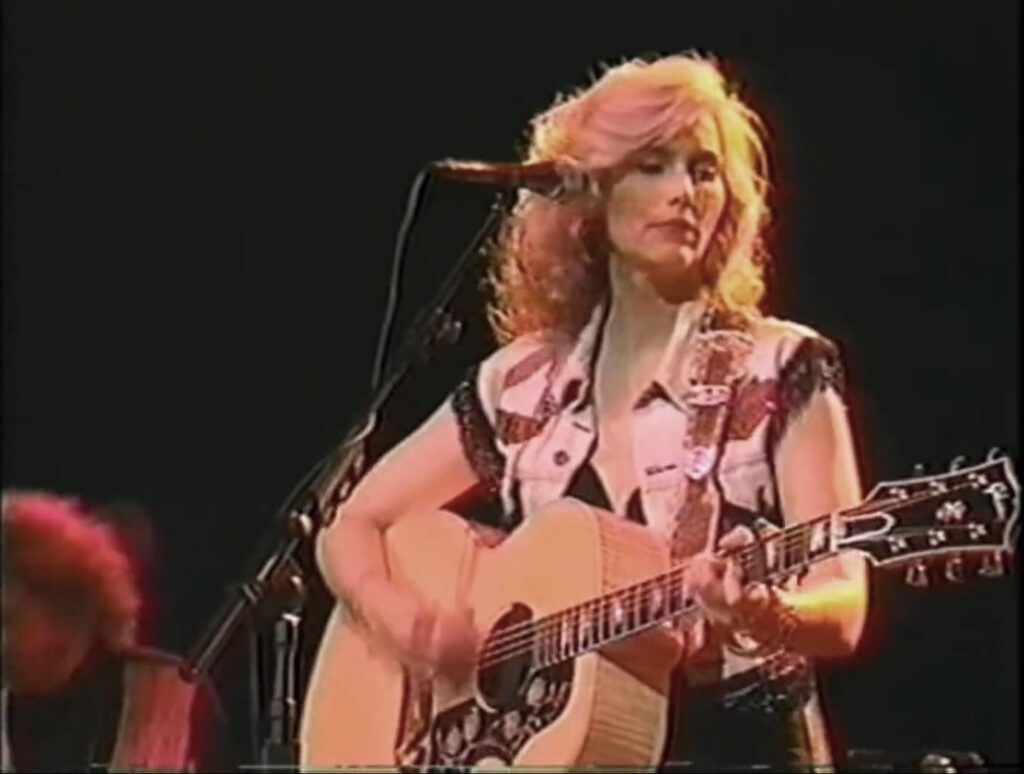
A joyful country anthem became a homecoming celebration of memory, tradition, and a singer revisiting the song that helped define her life.
In February 1995, Emmylou Harris stepped onto the stage of Nashville’s legendary Ryman Auditorium and transformed a familiar country hit into something far greater. Her performance of “Two More Bottles of Wine” with The Nash Ramblers was not merely another live rendition of a chart-topping favorite. It became a celebration of a remarkable journey, a tribute to country music’s roots, and a moment that now feels even more precious when viewed through the lens of time.
For many listeners, “Two More Bottles of Wine” is simply an upbeat country classic with an irresistible rhythm. Yet the song carries a much deeper significance in the story of Emmylou Harris. Written by Delbert McClinton, the tune became Harris’s first No. 1 country hit in 1978, helping establish her as one of the defining voices of her generation. By the time she returned to it on the Ryman stage seventeen years later, she was no longer a rising artist searching for success. She was revisiting a chapter of her own history.
The setting made the occasion even more meaningful. The Ryman Auditorium, often called the “Mother Church of Country Music,” had recently emerged from years of decline following an extensive restoration. During the early 1990s, many artists worked to reintroduce audiences to the magic of the historic venue, and Harris was among the most passionate champions of its revival. Her concerts with The Nash Ramblers helped remind the music world why the old building remained one of country music’s most sacred spaces.
Watching the performance today, it is impossible to separate the song from its surroundings. The worn wooden stage, the warm acoustics, and the sense of history lingering in every corner of the auditorium give the music an emotional weight that no modern arena could replicate. The audience was not simply hearing Emmylou Harris sing. They were witnessing a beloved artist standing inside one of country music’s greatest landmarks, surrounded by the echoes of generations who came before her.
The timing of the concert adds another fascinating layer. Only months later, Harris would release Wrecking Ball, the groundbreaking album that reinvented her artistic identity and introduced her to a new generation of listeners. That record would move beyond traditional country into atmospheric and alternative territory. Looking back, the Ryman performance now feels like a graceful farewell to one era before the beginning of another.
One of the enduring strengths of “Two More Bottles of Wine” is the contrast at its heart. The melody sparkles with energy and movement, encouraging smiles and foot-tapping enthusiasm. Yet beneath the lively arrangement lies a story of loneliness, heartbreak, and a restless search for comfort. Few artists understood that classic country balance better than Harris. She had a gift for making sorrow sound beautiful and resilience sound effortless.
The contribution of The Nash Ramblers also helped make this version unforgettable. Their bluegrass-inspired musicianship gave the song a fresh vitality that differed noticeably from the radio-friendly 1978 recording. The performance moved with the excitement of a live gathering, turning a familiar hit into a joyful celebration of American roots music. Many admirers still consider it the finest filmed performance of the song.
At nearly forty-eight years old, Harris brought a different perspective to the lyrics than she had in her younger years. In 1978, she sang as if she were living the story. In 1995, she seemed to be reflecting upon it. The wisdom in her voice gave the song added depth, making every line feel earned rather than imagined.
Viewed today, the performance serves as a beautiful snapshot of a Nashville that was rapidly changing. It captures an artist deeply connected to the traditions shaped by figures such as Gram Parsons, Hank Williams, and Loretta Lynn. More than three decades later, “Two More Bottles of Wine” at the Ryman remains a reminder that great country music is never only about the song itself. It is also about the stories, places, and memories that continue to live inside every note.