
He Never Sang About Fame. He Sang About a Man Who Took Good Care of His Tools. That May Be Why Guy Clark’s Songs Still Endure.
There are performances that impress with virtuosity, and there are performances that linger because they remind us of people we once knew.
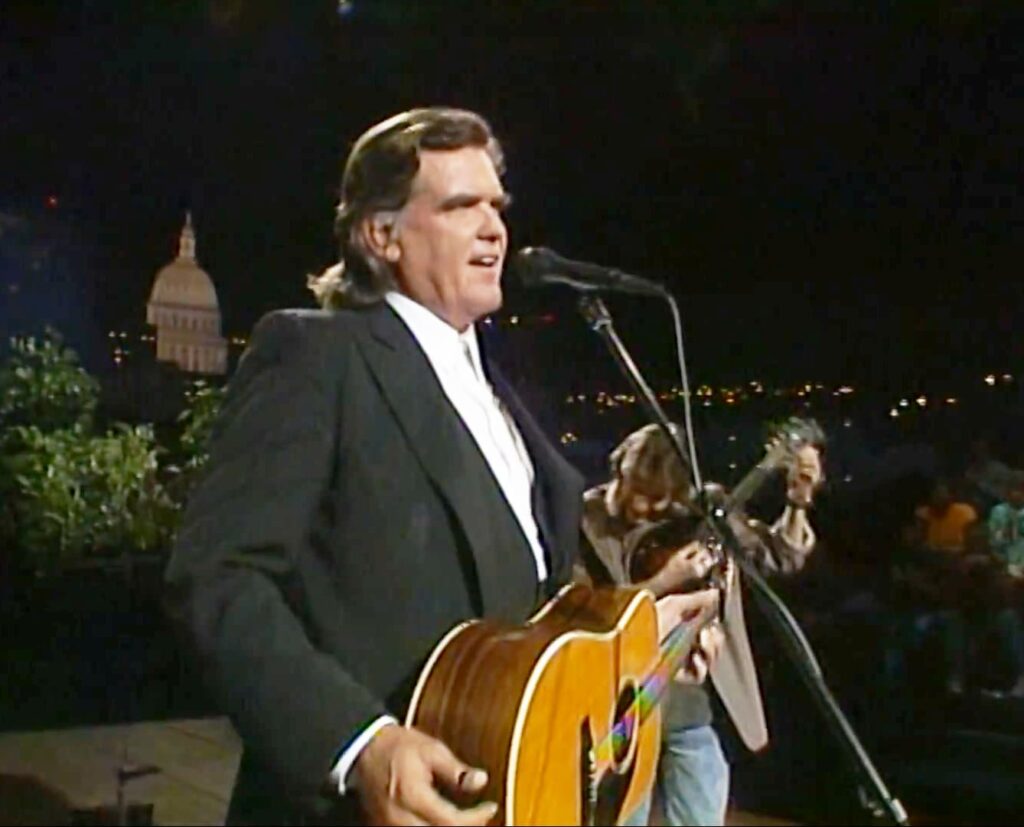
When Guy Clark sat down in Austin, Texas, to perform “The Carpenter,” he did not rely on spectacle, grand gestures, or elaborate arrangements. Instead, he did what he had always done best. He told a story.
At first glance, “The Carpenter” seems to be a simple tribute to a skilled craftsman. The lyrics describe a man who works with wood, builds boats and birdhouses, earns an honest living, and treats his tools with care. But beneath that straightforward portrait lies something much deeper.
For many listeners, the carpenter is not merely a tradesman. He is a father. A grandfather. A neighbor. A representative of a generation of working people whose values were forged through labor, responsibility, and quiet dignity.
From the opening line, Clark immediately elevates his subject beyond ordinary biography.
“Let us now praise the carpenter…”
The phrase carries a subtle spiritual weight. Some listeners have long wondered whether Clark intentionally echoed the image of Jesus, the carpenter of biblical tradition. Yet as the song unfolds, the character becomes unmistakably human. He works in shipyards, builds homes, teaches lessons, and leaves behind wisdom earned through experience rather than sermons.
That ambiguity is part of the song’s enduring power.
Every listener is free to see someone different in the carpenter.
Perhaps a father who came home each evening with worn hands and sawdust on his shirt. Perhaps a grandfather who could fix anything that broke. Perhaps a mentor who taught that doing a job properly mattered more than receiving recognition for it.
The performance itself captures everything that made Guy Clark one of America’s most beloved songwriters. There is no attempt to overwhelm the audience emotionally. He sits comfortably, almost casually, delivering the lyrics as though sharing memories across a kitchen table.
The effect is remarkable.
The less he appears to perform, the more authentic the story becomes.
One lyric stands at the heart of the song:
“He took good care of his tools.”
On the surface, it refers to hammers, chisels, planes, and measuring squares. Yet many admirers of Clark’s writing have interpreted the line as a metaphor for something larger.
The tools are also character.
They are integrity, craftsmanship, patience, responsibility, and skill.
They are the qualities a person develops over a lifetime and passes on to the next generation.
The lyric feels especially personal when viewed through the lens of Clark’s own life. Long before becoming one of the most respected songwriters in Nashville, he was a craftsman in the truest sense. Friends and fellow musicians often spoke about his ability to build guitars, create leather goods, and work with his hands. Unlike many artists who merely wrote about working people, Clark understood that world intimately.
That authenticity gives “The Carpenter” an emotional credibility few songwriters could achieve.
As the song progresses, the carpenter offers practical advice that sounds almost timeless.
“Anything it’s worth cutting down a tree for, it’s worth doing right.”
It is the kind of lesson that once passed naturally from one generation to another. Simple words. Lasting wisdom.
Looking back today, “The Carpenter” feels like more than a song. It feels like a preservation of values that many fear are disappearing. It honors people who measured success not by fame or wealth, but by the quality of their work and the honesty of their lives.
After finishing the performance, Clark casually introduced “Old Friends,” noting that he had written it with his wife Susanna Clark and songwriter Richard Dobson. It was a brief moment, but it reflected another truth about his career. His music was never built around celebrity. It grew from friendship, family, community, and shared stories.
That is why this performance continues to resonate.
When Guy Clark sang “The Carpenter,” he was not simply celebrating a man who worked with wood. He was honoring an entire generation of people who built lives, families, and communities with their hands.
And in doing so, he created one of the most moving portraits in American folk and country music.