
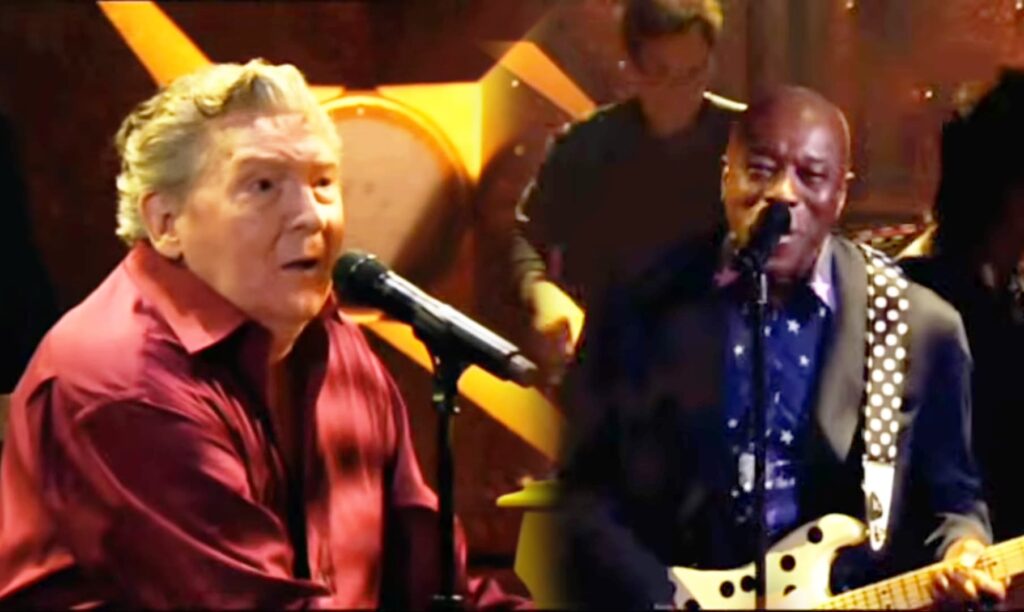
When Jerry Lee Lewis Met Buddy Guy, “Hadacol Boogie” Became a Fiery Celebration of the Music That Started It All.
Some performances feel less like concerts and more like joyful reunions between musical pioneers. During Last Man Standing Live! in 2006, Jerry Lee Lewis welcomed legendary blues guitarist Buddy Guy to the stage for an electrifying rendition of “Hadacol Boogie.” The performance was far more than a revival of an old rock and roll favorite. It became a celebration of the blues, boogie-woogie, and the explosive energy that gave birth to modern American popular music.
Originally recorded by Jerry Lee Lewis in the 1950s, “Hadacol Boogie” was inspired by the boogie-woogie piano tradition that shaped early rock and roll. The song itself takes its name from Hadacol, a once-famous patent medicine that became a cultural phenomenon across the American South during the late 1940s and early 1950s. Like many songs from rock’s earliest years, it blended humor, rhythm, and infectious energy into a performance designed to make audiences move.
By 2006, Jerry Lee Lewis no longer needed to prove why he had earned the nickname “The Killer.” His reputation had already been secured through decades of unforgettable performances. Yet the moment he settled behind the piano, the familiar fire immediately returned. His pounding left hand drove the rhythm with unmistakable authority, while his vocals carried the same swagger that had made him one of rock and roll’s original revolutionaries.
Standing beside him, Buddy Guy brought an entirely different but equally powerful musical voice. Widely regarded as one of the greatest blues guitarists of all time, Guy answered Lewis’ driving piano with sharp, expressive guitar lines filled with Chicago blues tradition. Rather than competing for attention, the two legends engaged in an effortless musical conversation. Every piano phrase invited a guitar response, creating the feeling of two lifelong friends speaking a language only great musicians truly understand.
What makes the performance especially memorable is the shared history represented on stage. Jerry Lee Lewis helped define early rock and roll through explosive piano-driven recordings, while Buddy Guy became one of the most influential blues guitarists of the modern era, inspiring generations that included Eric Clapton, Jimi Hendrix, and Stevie Ray Vaughan. Watching them perform together is a reminder that rock and roll and blues have always been deeply connected, each drawing strength from the other.
Unlike heavily produced modern concerts, Last Man Standing Live! thrives on spontaneity. There is a sense that every smile, every improvised flourish, and every playful exchange happens naturally. Neither musician appears interested in recreating the past note for note. Instead, they enjoy the freedom that comes only after decades of mastering their craft. Their confidence allows the music to breathe, making the performance feel alive rather than rehearsed.
For longtime admirers of Jerry Lee Lewis, “Hadacol Boogie” also serves as a reminder of his extraordinary versatility. Although history often remembers him for iconic hits like “Great Balls of Fire” and “Whole Lotta Shakin’ Goin’ On,” his musical roots reached much deeper into gospel, country, blues, and boogie-woogie. This performance celebrates those foundations, revealing the traditions that shaped his unmistakable style.
Nearly half a century after helping launch the rock and roll revolution, Jerry Lee Lewis still attacked the piano with remarkable passion, while Buddy Guy answered every phrase with the confidence of a blues master. Together, they demonstrated that true musical chemistry cannot be manufactured. It grows from shared experience, mutual respect, and a lifetime devoted to the same language of rhythm and soul.
Today, their performance of “Hadacol Boogie” stands as one of the highlights of Last Man Standing Live! It captures two American music legends doing what they loved most: sitting side by side, smiling through every chorus, and reminding audiences that great music never loses its power when it is played from the heart.