
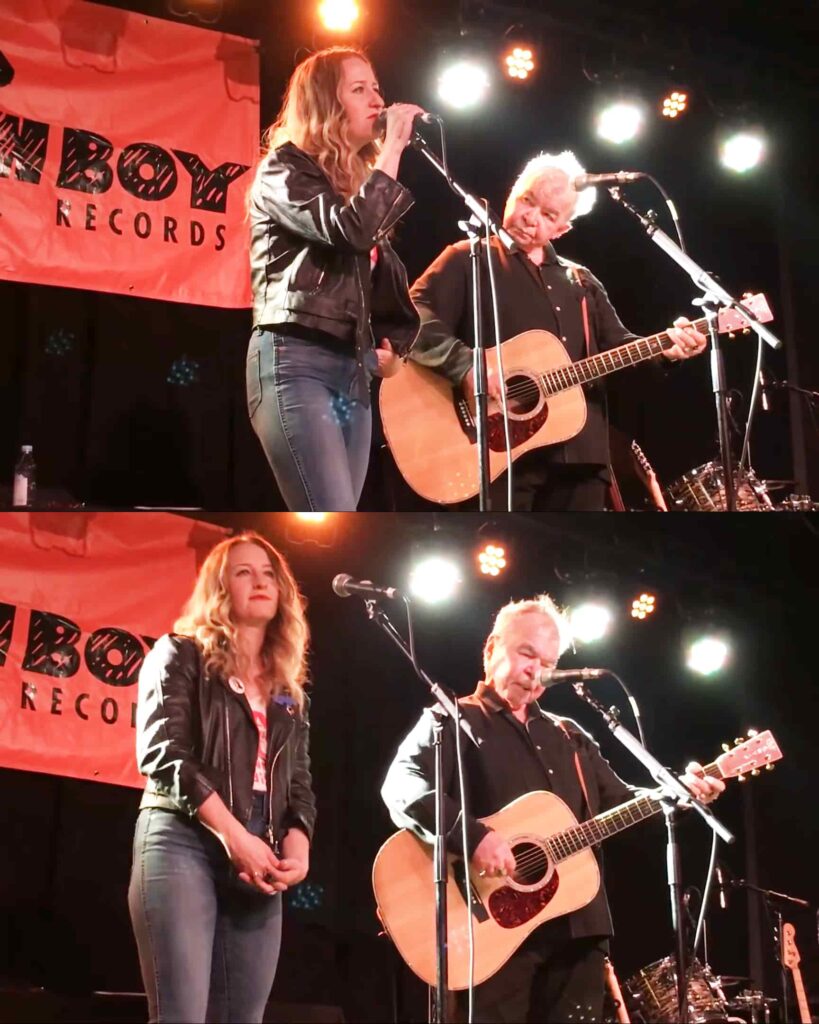
No One in the Room Knew They Were Watching One of John Prine’s Final Great Nashville Performances
When John Prine stepped onto the stage of The Basement East in Nashville to perform “Unwed Fathers” alongside Margo Price, it felt like a special collaboration between two respected songwriters.
Looking back today, it feels like much more.
It feels like a passing of the torch.
It feels like a meeting between two generations of American storytellers.
And perhaps most poignantly, it feels like one of the last opportunities to watch John Prine doing what he did better than almost anyone else: telling uncomfortable truths through song.
Originally released on Aimless Love in 1984, “Unwed Fathers” was among Prine’s most courageous compositions. Rather than focusing on romance, heartbreak, or familiar country themes, the song examined the lives of young women facing unplanned pregnancies while exposing a painful social reality often overlooked in public conversations.
The song’s title itself points toward the central irony.
Society frequently scrutinizes young mothers.
The fathers often disappear from the story.
When Prine wrote the song in the early 1980s, the subject was controversial. More than three decades later, when he and Margo Price performed it at The Basement East, America was once again engaged in intense debates surrounding reproductive rights, personal responsibility, and women’s autonomy.
What made the song remarkable was that Prine never transformed it into a political slogan.
He never lectured.
He never instructed listeners what to think.
Instead, he did what great songwriters do.
He told a story.
That storytelling approach allowed the song to survive changing political climates and speak to multiple generations of listeners.
The performance gained additional significance because of the artists sharing the stage.
Born nearly four decades apart, John Prine and Margo Price represented different chapters of the Americana tradition.
Prine had spent decades establishing himself as one of the most respected songwriters in American music. His influence stretched across folk, country, roots music, and beyond. By contrast, Price emerged as a leading voice of a younger generation, writing songs about working-class struggles, economic hardship, family, and social realities.
Watching them sing together, it was impossible not to notice the continuity between their artistic visions.
Prine’s songs often gave a voice to people overlooked by society.
Price built her career doing much the same.
In many ways, the performance looked like a master storyteller sharing the stage with one of his most worthy successors.
The setting added another layer of intimacy.
The Basement East was not a massive arena filled with giant screens and elaborate production. It was a room where songs mattered more than spectacle.
That environment suited “Unwed Fathers” perfectly.
This was never a song designed for dramatic singalongs or thunderous applause.
It was a song that asked listeners to sit quietly with difficult realities.
A song that worked best when heard as a conversation rather than a performance.
Perhaps the most emotional dimension of the video only became visible with time.
At the moment of this appearance, Prine was enjoying a remarkable late-career resurgence. He had recently released The Tree of Forgiveness, his first album of new material in more than thirteen years. Critics celebrated it as one of the strongest records of his career.
Few people could have known that it would become his final studio album.
Fewer still could have imagined that just a couple of years later, the world would lose him.
Because of that, the footage now carries a weight that audiences could not have felt on the night itself.
What once seemed like another excellent John Prine performance has become a treasured document of a beloved artist still operating at the height of his creative powers.
There is also a fascinating historical footnote. In 2019, Prine and Price would revisit “Unwed Fathers” as part of efforts supporting civil liberties advocacy during renewed national debates over reproductive rights. Seen in hindsight, this Basement East performance feels like the beginning of a deeper artistic partnership centered on a song whose relevance refused to fade.
That may be the most extraordinary thing about “Unwed Fathers.”
A song written in 1984 still felt urgent decades later.
Not because the world failed to change.
But because some human stories never stop demanding to be heard.
And on this Nashville stage, John Prine and Margo Price made sure those stories were heard once again.