
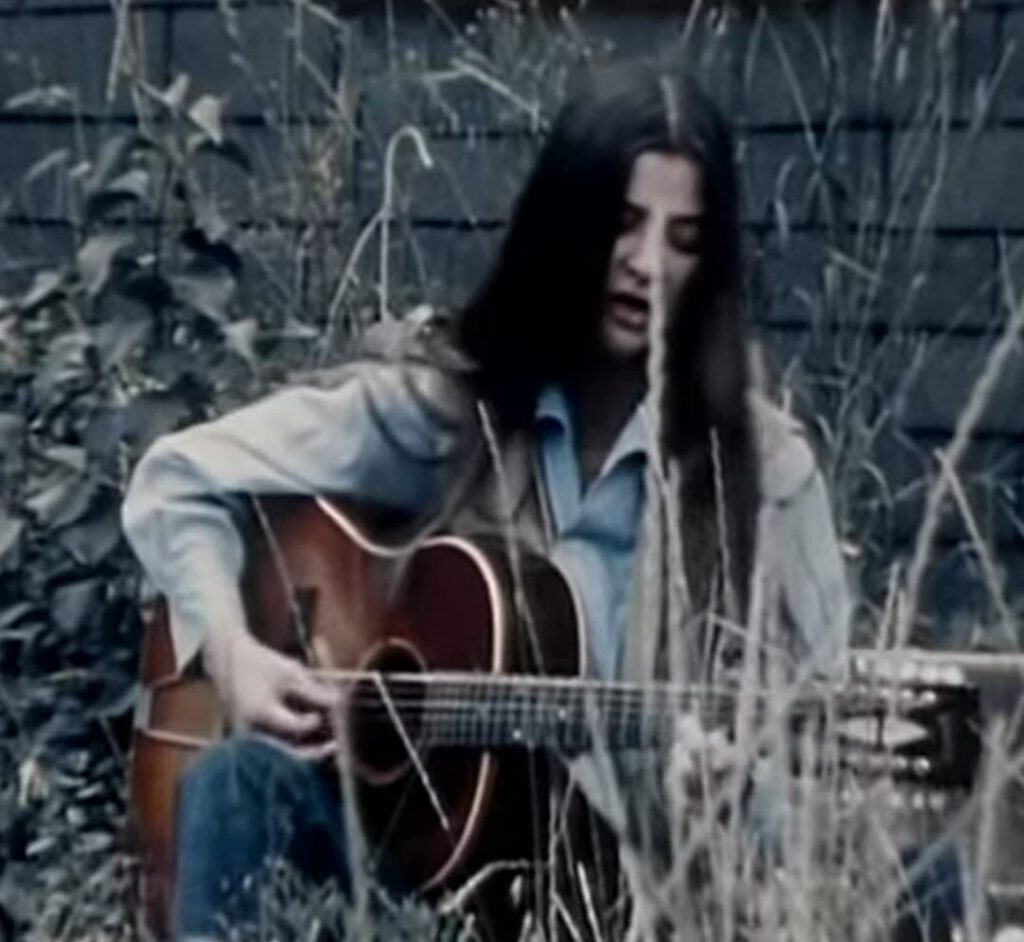
A farewell wrapped in tenderness, “Little Bit of Rain” feels less like a song and more like a fragile memory whispered through the dusk — a quiet reminder that love, even when fading away, can still leave warmth behind.
There are songs that arrive with great fanfare, climbing charts, filling radio stations, becoming impossible to escape for a season. And then there are songs like “Little Bit of Rain” by Karen Dalton — songs that seem to drift through time unnoticed at first, only to grow more powerful with each passing decade. It never became a hit single in the commercial sense. In fact, neither the song nor Dalton herself ever entered the major Billboard charts during her lifetime. Yet today, the recording is often spoken of with the same reverence reserved for the greatest lost treasures of American folk music.
Released in 1969 on her debut album It’s So Hard to Tell Who’s Going to Love You the Best, the song opened the record with a kind of emotional honesty that immediately set Dalton apart from nearly everyone else in the Greenwich Village folk scene. The song itself had originally been written by Fred Neil, one of the most respected and mysterious songwriters of the era, a man admired deeply by fellow musicians but never fully embraced by the mainstream. Dalton’s interpretation, however, transformed it into something hauntingly intimate.
By the late 1960s, folk music had already begun changing shape. The polished singer-songwriter movement was emerging, and audiences were slowly moving toward more commercially accessible sounds. But Karen Dalton seemed entirely uninterested in chasing success. According to stories from those recording sessions, producer Nick Venet struggled to convince her to record at all. Dalton disliked the pressure of studios and distrusted the music industry deeply. In one famous account, Fred Neil himself had to help calm her during the sessions, and parts of the album were reportedly captured almost by accident because she relaxed only when she thought the tape was not rolling.
That tension — between vulnerability and resistance — is exactly what gives “Little Bit of Rain” its extraordinary emotional weight.
The lyrics are deceptively simple:
“Try to remember all the good times
Long days filled with sunshine
And just a little bit of rain.”
There is no dramatic heartbreak here. No bitterness. No theatrical sorrow. Instead, the song speaks with the weary grace of someone who has already accepted that love and pain cannot be separated. Life gives sunshine and rain together. Memory does the same.
And perhaps that is why the recording continues to resonate so deeply with listeners decades later. Dalton does not sing the words as if she is performing them for an audience. She sings as though she is speaking quietly to one person sitting beside her in the dark. Her voice — rough, trembling, weathered beyond her years — carried an ache that critics and musicians have struggled to describe ever since. Even Bob Dylan once famously said she had “a voice like Billie Holiday and played guitar like Jimmy Reed.”
Listening to “Little Bit of Rain” today feels strangely different from listening to many celebrated recordings of its era. There is no sense of nostalgia manufactured for effect. The sadness is real. The loneliness is real. Even the silence between the lines feels real.
Part of that comes from Dalton’s own life. She spent much of her career drifting between Colorado, New York, and Woodstock, often living modestly and avoiding publicity altogether. She performed alongside major folk figures of the 1960s, yet remained almost invisible to the wider public. She never seemed comfortable with fame, and perhaps that reluctance preserved the purity of her music. There was no performance mask hiding the emotion.
Commercially, the song achieved no notable chart positions upon release, and the album itself remained largely overlooked in 1969. But time has been unusually kind to Karen Dalton. Over the years, younger generations of musicians and listeners slowly rediscovered her work. Artists ranging from alternative folk singers to indie musicians began citing her as an influence, and albums once ignored became regarded as masterpieces of emotional authenticity.
Today, “Little Bit of Rain” stands as one of the defining recordings of Dalton’s legacy — not because it dominated radio or sold millions of copies, but because it captured something timeless and painfully human. It reminds listeners that some songs are not meant to entertain us for a summer. Some songs stay quietly beside us for life.
And perhaps that is the greatest beauty of Karen Dalton herself. She never sang to become immortal. Yet somehow, through a trembling voice carrying “just a little bit of rain,” she became exactly that.