
A Soldier’s Silent Despair in a Song That Refuses to Look Away
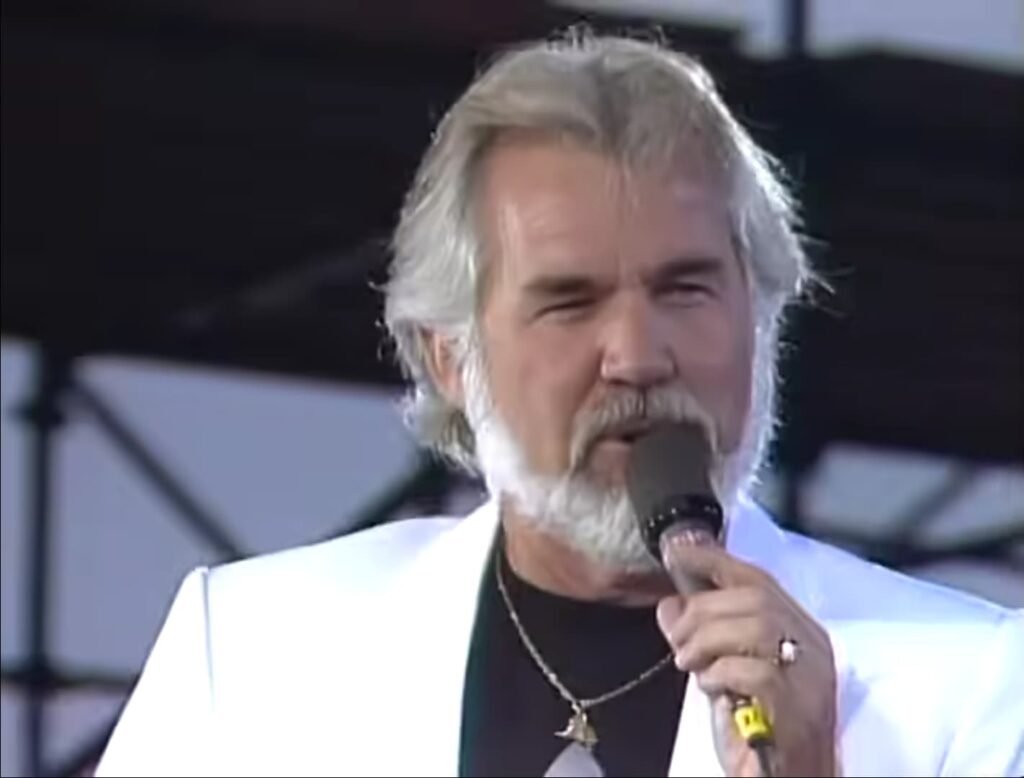
When Kenny Rogers stepped onto the stage at the Farm Aid 1985 on September 22, 1985, his performance of “Ruby, Don’t Take Your Love to Town” carried a weight far beyond its melody. Originally written by Mel Tillis and famously recorded by Rogers in 1969, the song had already become one of the most haunting narratives in country music. Yet on that night, before a crowd gathered for a cause rooted in hardship and resilience, it felt even more raw, more human.
From the very first lines, the story unfolds with painful clarity. A wounded veteran, paralyzed and confined, watches his wife prepare to leave for another night. The setting is simple, almost still, but the emotional tension is unbearable. Rogers does not rush the delivery. He lets each word linger, allowing the listener to sit inside the quiet desperation of a man who feels both love and helplessness at the same time.
What makes this performance so unforgettable is the restraint. Rogers, known for his smooth and steady voice, avoids dramatics. Instead, he leans into the storytelling. His phrasing is deliberate, almost conversational, as if he is not singing to a crowd but confiding in each individual listener. For those who lived through the years when this song first emerged, particularly the shadow cast by the Vietnam War, the narrative resonates on a deeply personal level.
The lyrics confront difficult truths. War does not end when the soldier returns home. It lingers in broken bodies, strained relationships, and unspoken pain. The line between love and resentment blurs, and Rogers captures that fragile balance with remarkable sensitivity. There is no villain here, only circumstance. A man who cannot be what he once was, and a woman still bound to her own needs and loneliness.
As the song reaches its climax, the tension tightens, yet Rogers never allows it to spill into excess. He holds it back, letting the silence between phrases speak just as loudly as the words themselves. It is in that restraint that the true heartbreak lies.
By the time the final note fades, the applause feels almost secondary. What remains is the story. For older listeners especially, “Ruby, Don’t Take Your Love to Town” is not just a song. It is a memory of a time when music dared to confront pain without softening it, and when a single voice on a quiet stage could carry the weight of an entire generation’s unspoken grief.