
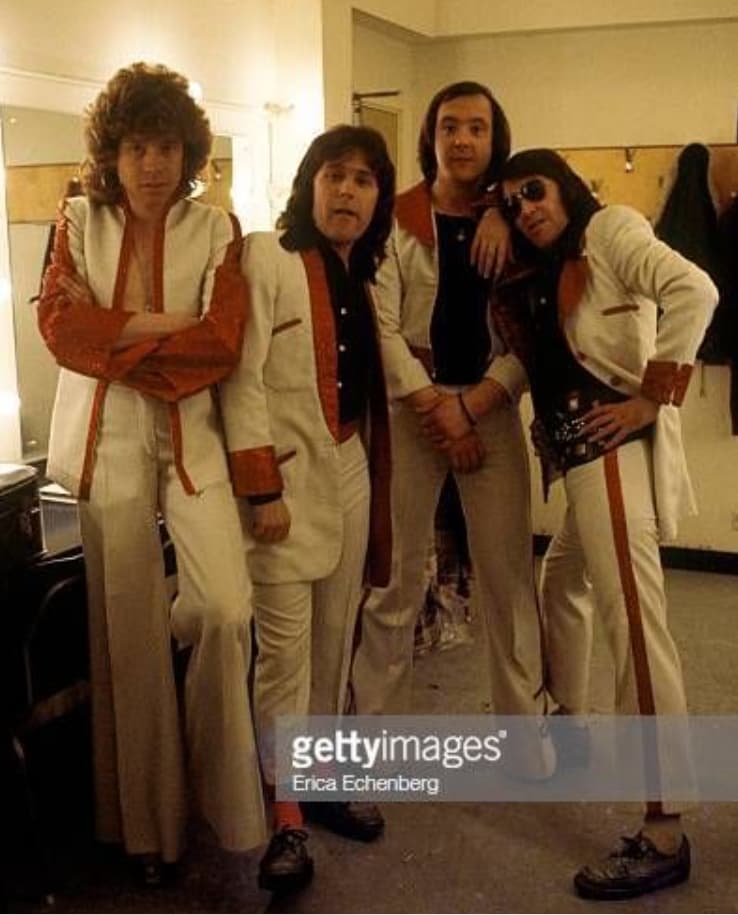
“Crazy” by Mud – a sparkling snapshot of early ’70s glam rock and a tender ode to youthful infatuation
When Mud’s “Crazy” first entered the airwaves in early 1973, it didn’t just chart — it gently captivated a generation standing at the threshold of love and liberation. Peaking at No. 12 on the UK Singles Chart, the song signified the band’s first major breakthrough after years of struggle, a signpost that their sound and spirit were about to blossom into something unforgettable.
In the pantheon of early glam‑rock jewels, “Crazy” sits like a bittersweet memory — equal parts effervescent pop and earnest rock‑flavored confession. Its creators, the duo Mike Chapman and Nicky Chinn, were already carving out a legacy behind some of the era’s most irresistible melodies. But with Mud, they tapped directly into something deeply human: that dizzying, slightly discomfiting moment when the neat edges of youthful certainty blur into the swirling colours of infatuation.
Imagine, for a moment, that early spring of 1973: transistor radios chirping across living rooms and diners, record players spinning under warm lamps, and voices everywhere caught up in the chorus of a song that felt both playful and probing. “Crazy” isn’t a bombastic anthem — it’s a confession. Its lyrics, smart yet simple, capture the tender vulnerability of someone both exhilarated and bewildered by love’s chaotic pull: “Crazy, crazy, you amaze me / Crazy lady, rearrange me…”
There’s a kind of gentle honesty in those words that resonates especially with those of us who’ve lived long enough to laugh at — and remember — the sweet, unselfconscious infatuations of youth. It’s not quite love, not quite obsession, yet so vividly that first rush where everything feels brighter, stranger, and just a little bit crazy. For listeners now looking back through decades of music history, the song feels less like a relic and more like an old photograph — warm around the edges, rich with emotion, and instantly transporting.
But the significance of “Crazy” goes beyond its lyrical charm. For Mud, a band rooted in the working‑class suburbs of Surrey, England, this single represented a turning point. Prior to working with Chapman and Chinn, they had spent years on the cusp of recognition, releasing records that barely stirred the charts. With “Crazy,” they finally found a voice that resonated broadly, launching them into a remarkable streak of hits that would define their golden years.
In the context of Mud’s career, “Crazy” is like the first morning light of spring — the moment before everything blooms. It arrived before the band’s more flamboyant rockers like “Dyna‑mite” and before the cultural phenomenon that was “Tiger Feet,” which would later top charts and become synonymous with 1970s British pop culture. Yet for many who lived through that era, “Crazy” never lost its quiet magic: a song that felt close, familiar, and achingly sincere.
Today, hearing it is to be reminded of a time when music felt like a companion for every feeling worth remembering — the nervous thrill of a first dance, the shy exchange of glances at the record store, the echo of a melody long after the needle lifted from the groove. It’s a song that carries not just the sound of an era, but its heart: hopeful, wildly emotional, and unabashedly alive.
For older listeners especially, “Crazy” isn’t merely a chart statistic — it’s a marker of youth, of days bathed in warm sunlight, dancing in living rooms and on front porches, hands tapping the furniture, hearts pulsing in rhythm with a chorus that shouted, even then, “I am here! I feel this!” And that — that joyful, trembling declaration — is what makes the song endure as something more than a hit; it remains a memory‑keeper, a melodious companion for all those moments when love made us feel wonderfully, irrepressibly, crazy.