
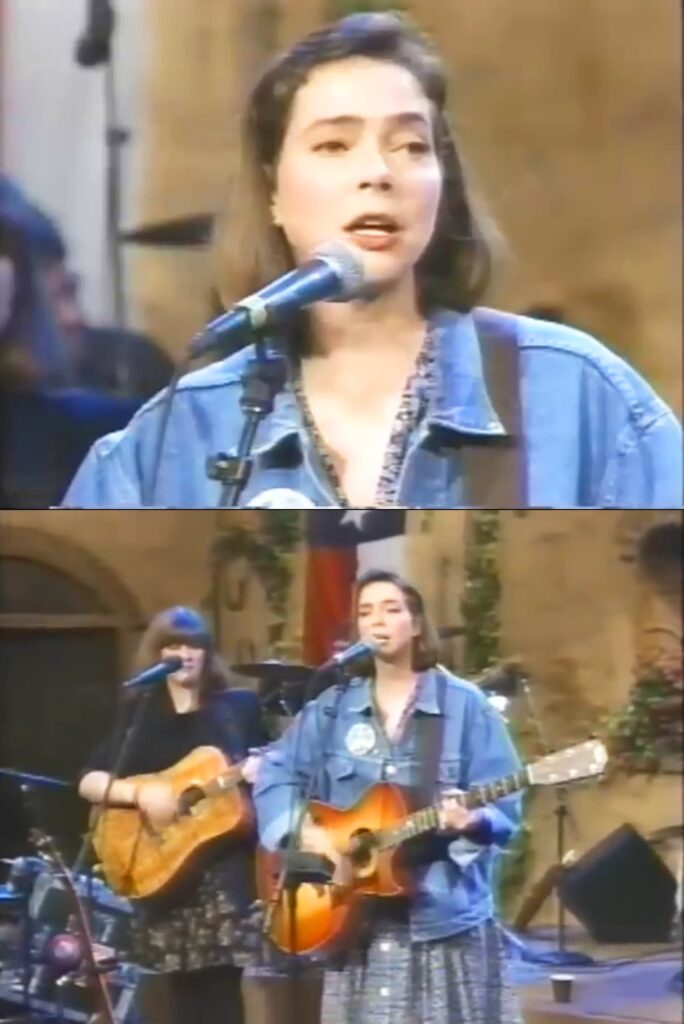
Nanci Griffith Never Raised Her Voice to Change the World. She Simply Asked People to Care About One Another.
Among the many unforgettable songs in Nanci Griffith’s remarkable catalog, few reveal her heart more completely than “It’s a Hard Life Wherever You Go.”
Unlike many country and folk songs that focus on romance, heartbreak, or personal memories, this composition dared to look beyond the boundaries of everyday life. It turned its attention toward a larger world marked by conflict, poverty, displacement, and human suffering.
Yet what made Nanci Griffith extraordinary was that she approached these subjects not with anger or ideology, but with compassion.
That spirit shines throughout this memorable performance from The Texas Connection, preserved today through a grainy VCR recording from the 1990s.
The footage itself feels like a time capsule.
The soft image quality, the occasional tape imperfections, and the unmistakable atmosphere of vintage television transport viewers back to a different era. Watching it today is like opening an old photo album and discovering a moment that somehow became more meaningful with time.
By this stage of her career, Griffith had already established herself as one of America’s most respected singer-songwriters. Her unique blend of folk, country, Celtic influences, and literary storytelling had earned her a devoted audience. Yet she continued to push beyond the expected boundaries of the genre.
“It’s a Hard Life Wherever You Go” emerged from Griffith’s observations of political violence, social unrest, and human hardship she witnessed while traveling and learning about conflicts in places such as Central America and Northern Ireland. Rather than writing a protest song in the traditional sense, she chose something far more personal.
She wrote about people.
Not governments.
Not slogans.
Not political arguments.
People.
That distinction is crucial to understanding why the song remains so powerful decades later.
The performance captures one of the most fascinating contradictions in Griffith’s artistry. Her voice was never the loudest in the room. She often described it humorously as a “little old voice.” Critics sometimes called it delicate, fragile, even childlike.
And yet few artists could deliver difficult truths with greater conviction.
Listening to her sing these lyrics, one hears both vulnerability and strength existing side by side. The voice may sound gentle, but the message refuses to look away from suffering.
Supporting her is the magnificent Blue Moon Orchestra, whose musicians create an atmosphere that is both intimate and expansive. The blend of acoustic textures, subtle percussion, rich harmonies, and folk-inspired arrangements softens the edges of the song’s serious subject matter without diminishing its impact.
The result feels almost cinematic.
Beautiful music carrying difficult truths.
Hope walking hand in hand with sorrow.
Perhaps that balance explains why the song has aged so gracefully.
Many socially conscious songs become trapped within the political debates of their own era. Griffith’s composition avoids that fate because its central message is fundamentally human rather than partisan.
Everyone is carrying something.
Everyone is struggling with battles others cannot see.
Everyone deserves compassion.
Those ideas remain as relevant today as they were when Griffith first wrote them.
Watching this performance now also carries an additional emotional weight. Since Nanci Griffith’s passing in 2021, many of her songs have taken on new dimensions. Her recordings no longer feel like current observations. They feel like letters left behind by a trusted friend.
That sense is especially strong here.
The title itself, “It’s a Hard Life Wherever You Go,” could easily sound cynical in lesser hands. Griffith transforms it into something remarkably hopeful.
She acknowledges hardship without surrendering to despair.
She recognizes pain without losing faith in kindness.
And she reminds listeners that understanding one another may be the most important thing we can do.
Perhaps that is why this faded VCR recording continues to resonate.
It preserves more than a performance.
It preserves a worldview.
A belief that even in a difficult world, empathy still matters.
And few artists expressed that belief more beautifully than Nanci Griffith.