
A Young Ricky Nelson’s Promise of Forever Captured in a Moment That Time Could Never Keep
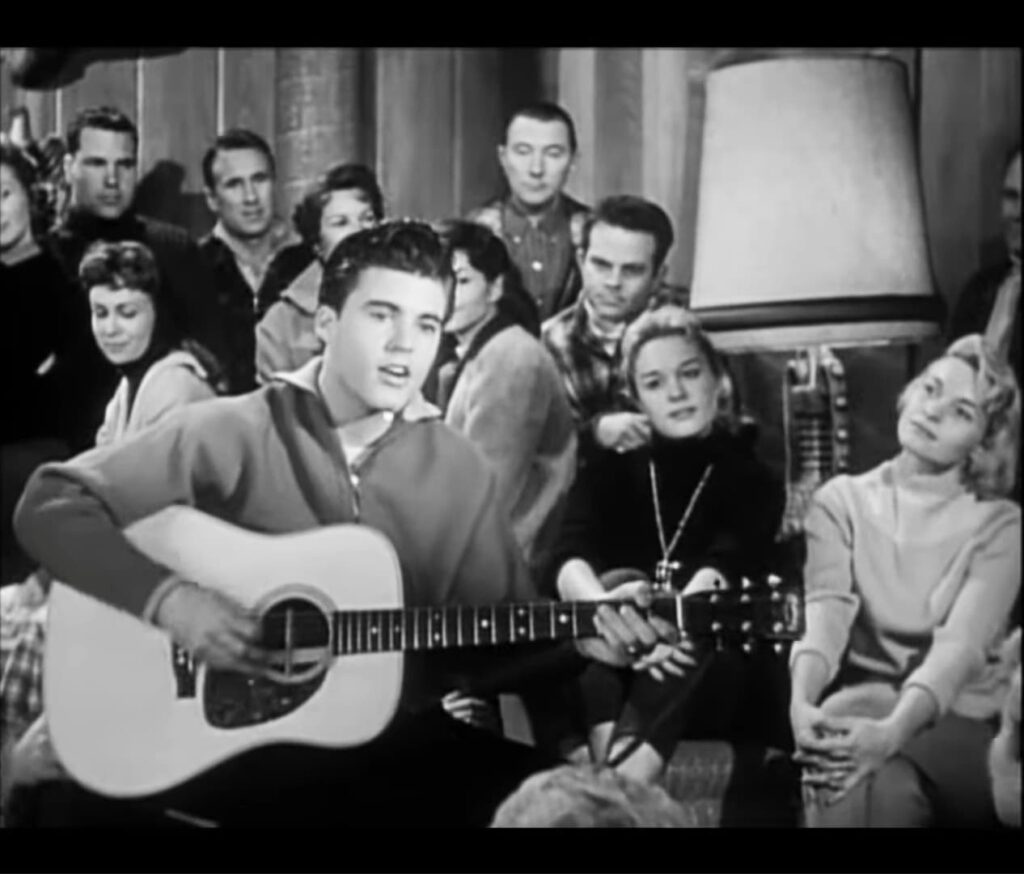
In 1959, Ricky Nelson stood before the cameras with a guitar in his hands and the easy smile of an eighteen-year-old who seemed to have the world waiting for him. Performing “Never Be Anyone Else But You” on the enormously popular television series The Adventures of Ozzie and Harriet, he looked like the very image of American youth at the dawn of a new decade. Millions of viewers watching from their living rooms saw more than a singer. They saw possibility, innocence, and a future that appeared limitless. What makes this brief performance so moving today is that modern audiences know something Ricky himself could not yet know: the future that seemed so bright and endless would not last forever.
Released in early 1959, “Never Be Anyone Else But You” became one of Nelson’s most successful recordings, climbing the charts during a period when rock and roll was rapidly reshaping popular culture. Unlike the rebellious image associated with some of his contemporaries, Ricky offered something gentler. His appeal came from sincerity rather than swagger. The song itself is remarkably simple, built around a heartfelt declaration of devotion. There are no dramatic twists or grand promises. Instead, its power comes from the quiet certainty of a young man convinced that the person he loves is the only one who matters. That simplicity helped the record connect with listeners across America and made it one of the defining love songs of Nelson’s early career.
Watching the 1959 television performance today feels almost like opening a time capsule. The black-and-white images preserve an era when families gathered around a single television set and popular music still carried an air of youthful optimism. Ricky’s voice is smooth and relaxed, free from any hint of self-consciousness. As he sings lines about never loving anyone else, he appears completely at ease, as though the words are merely an extension of who he is. There is no elaborate stage production, no special effects, and no attempt to overwhelm the audience. The charm comes entirely from the young performer himself. In less than two minutes, he captures the kind of innocence that popular culture rarely manages to preserve.
That is why the performance resonates so deeply now. Ricky Nelson would go on to enjoy tremendous success, face changing musical trends, reinvent himself as an artist, and ultimately leave the world far too soon in 1985. Yet none of those later chapters exist in this brief television appearance. Here, he remains forever frozen in the spring of 1959. The applause has not yet faded. The future has not yet arrived. He is simply a young man with a guitar, singing about faithful love with complete conviction. Time would move on, generations would pass, and the world would change beyond recognition. But within these ninety seconds, Ricky Nelson remains exactly as millions first remembered him: young, hopeful, and smiling as he sings that there could never be anyone else but the one he loves.
 Oldies Songs