
A Song Passed Down Like a Wound: Steve Earle Reclaims “Dublin Blues” in a Quiet Studio
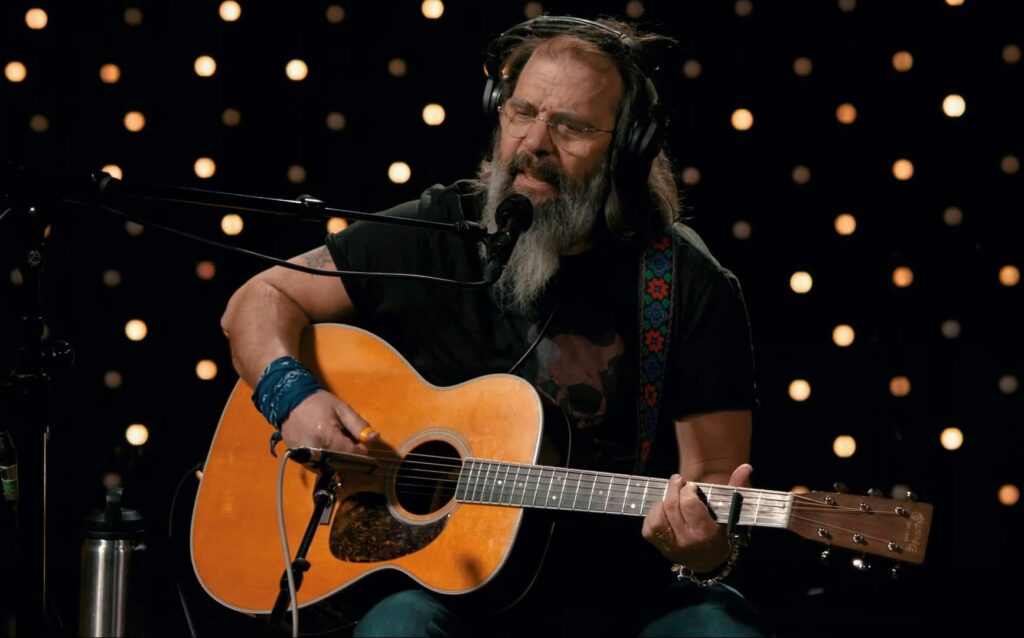
When Steve Earle stepped into the KEXP studio on April 1, 2019, there was no attempt to compete with the legacy of Guy Clark’s “Dublin Blues.” Instead, what unfolded was something more intimate. A continuation. A conversation between two songwriters, one present in the room, the other carried in memory.
Earle has never hidden the influence Clark had on his life and craft. In many ways, performing “Dublin Blues” is less an act of interpretation and more an act of respect. And in this stripped-down setting, his delivery leans into that understanding. The arrangement is sparse, almost fragile, allowing the lyrics to take precedence over everything else.
From the opening lines, the familiar imagery returns. Austin, late nights, cigarettes, the quiet unraveling of a man caught between places and memories. But in Earle’s voice, the song feels slightly different. Where Clark carried a weary acceptance, Earle brings a sharper edge, as if the wounds are still closer to the surface.
That distinction is subtle, but important. It transforms the song from reflection into something that feels more immediate. The lines about pride, distance, and the inability to walk away from love land with a quiet urgency. There is less distance between the singer and the story, as though he is still moving through it rather than looking back.
What remains unchanged is the core truth of the song. Love that endures beyond reason. Regret that cannot be undone. Memory that refuses to fade. Earle does not reinterpret these themes. He honors them, letting them stand exactly as they were written.
The KEXP setting amplifies this effect. There is no crowd to respond, no stage to fill. Just a room, a microphone, and a voice carrying the weight of another man’s words. In that stillness, every phrase becomes more exposed, more human.
Looking back, this performance is not about reinvention. It is about preservation. Steve Earle does not try to make “Dublin Blues” his own. He understands that some songs belong to the road they have already traveled.