
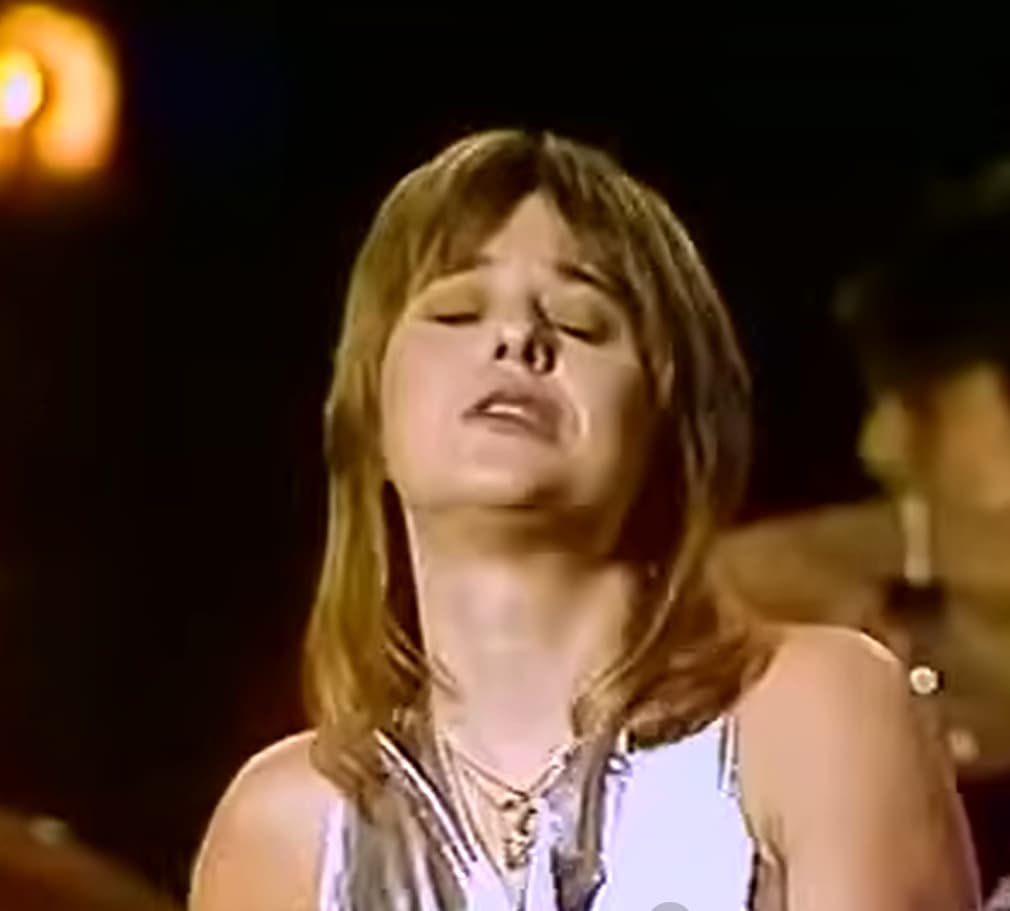
“If You Can’t Give Me Love” — the sound of a rebellious rock queen briefly lowering her guard, revealing loneliness behind the leather and glitter.
When Suzi Quatro stepped onto the stage to perform “If You Can’t Give Me Love” in 1978 — especially in memorable television appearances such as Ein Kessel Buntes — there was something quietly magnetic about her presence. She was never the polished pop princess of the era, nor the fragile ballad singer audiences were used to seeing. She carried herself like a streetwise rocker: leather jumpsuits, short blonde hair, fierce eyes, and that unmistakable bass-guitar attitude that had already made her one of the most groundbreaking women in rock history. Yet this song revealed another side of her — softer, wistful, vulnerable without ever sounding weak.
Released in early 1978 from the album “If You Knew Suzi…”, the song became one of Quatro’s biggest international hits. It reached No. 4 on the UK Singles Chart, while also charting strongly across Europe and Australia. In Germany, where Suzi remained enormously beloved throughout the late 1970s, television performances like the famous Ein Kessel Buntes appearance helped cement her image as more than just a rock singer — she became a symbol of confidence, independence, and emotional honesty.
What made the song resonate so deeply was its balance between tenderness and pride. Written by the legendary songwriting duo Nicky Chinn and Mike Chapman, the track carried their trademark melodic sophistication, but unlike many glam-rock songs of the era, this one felt intimate. The lyrics are deceptively simple: a woman asks not for riches or fairy-tale promises, but for sincerity. If true love is impossible, then honesty will do. There is resignation in the words, but also dignity.
That emotional maturity gave the song unusual depth for mainstream late-70s pop-rock. It spoke to people who had already lived through heartbreak, compromise, and disappointment. The narrator understands love cannot always be perfect. Yet she still longs for warmth, closeness, and something real in a world increasingly becoming artificial and fast-moving.
And then there was Suzi Quatro’s voice.
Many listeners still remember how astonishingly powerful she sounded live. Even decades later, comments beneath restored performances repeat the same sentiment: “What a strong voice, doesn’t even need a mic.” That was not exaggeration. Quatro possessed one of the most naturally commanding female rock voices of her generation — rough around the edges in the best possible way, emotionally direct, never over-stylized. She sang as though every line came from lived experience rather than rehearsed performance.
Watching those old television clips today is almost like opening a faded photo album from another emotional universe. The camera work was simple. The lighting warm and human. No digital effects, no elaborate choreography, no layers of studio correction. Even Suzi’s appearance reflected that era’s authenticity — little makeup, natural beauty, effortless charisma. Many viewers still remark on her iconic haircut from that period, a style that perfectly matched her rebellious yet approachable image. She looked modern without trying too hard, glamorous without losing her toughness.
More importantly, she represented something revolutionary. Before many female rock artists were accepted as instrumentalists and bandleaders, Suzi Quatro had already shattered expectations. She played bass aggressively, fronted her own band, and commanded stages traditionally dominated by men. By the late 1970s, she was not merely successful — she was historic. For countless young women watching television in Europe, Australia, and beyond, she proved that femininity and rock power could coexist naturally.
The phrase many fans still use — “The Queen of Rock” — was not simply admiration. It reflected how singular she felt during that era. There were louder bands, more technically polished singers, and more fashionable stars, but very few performers combined strength, vulnerability, musical skill, and authenticity quite like Quatro did.
Listening to “If You Can’t Give Me Love” today carries a very particular kind of nostalgia. It is not merely nostalgia for youth or for the late 1970s. It is nostalgia for sincerity itself — for a time when songs seemed emotionally direct, when performers relied more on presence than spectacle, and when voices carried human imperfections that made them unforgettable.
Perhaps that is why the song continues to survive across generations. Beneath its gentle melody and radio-friendly structure lies a universal truth: people can endure almost anything except emotional emptiness. And Suzi Quatro, with that fierce heart hidden beneath rock-and-roll armor, sang that truth beautifully.